P66 (Papyrus Bodmer II): John 7:6-8:16 (pages 45-52)
Introduction
P66 is a papyrus codex of the Gospel of John copied in Egypt around 200, the most complete early copy of John. Most of it is Papyrus Bodmer II in the Fondation Martin Bodmer, Cologny (Geneva); small pieces are in the Chester Beatty Library, Dublin, and the Institut für Altertumskunde, Cologne. The first five quires (John 1:1-14:26) survive as a bound book of numbered pages; later leaves, from John 14:29 to 21:9, are damaged and kept between glass. The scribe made many corrections, some of them his own; only the first hand is shown here.
Each section below is one page: the photograph, the NTVMR diplomatic transcription line by line, and the King James Version of every verse on the page. Pages of the bound book are shown on the photographic plates published by Victor Martin and J. W. B. Barns in 1962 (scanned by the Bodmer Lab), the glass-mounted leaves on colour photographs. Lost: John 6:12-34 (pages 35-38) and parts of chapters 14-21; the transcription ends at 21:9. Where P66 lacks a verse that the KJV has (John 5:4, the account of the adulteress at 7:53-8:11, 16:15), the section says so.
This entry covers pages 45-52 (John 7:6-8:16).
How was this verified? (Provenance)
Where on the image
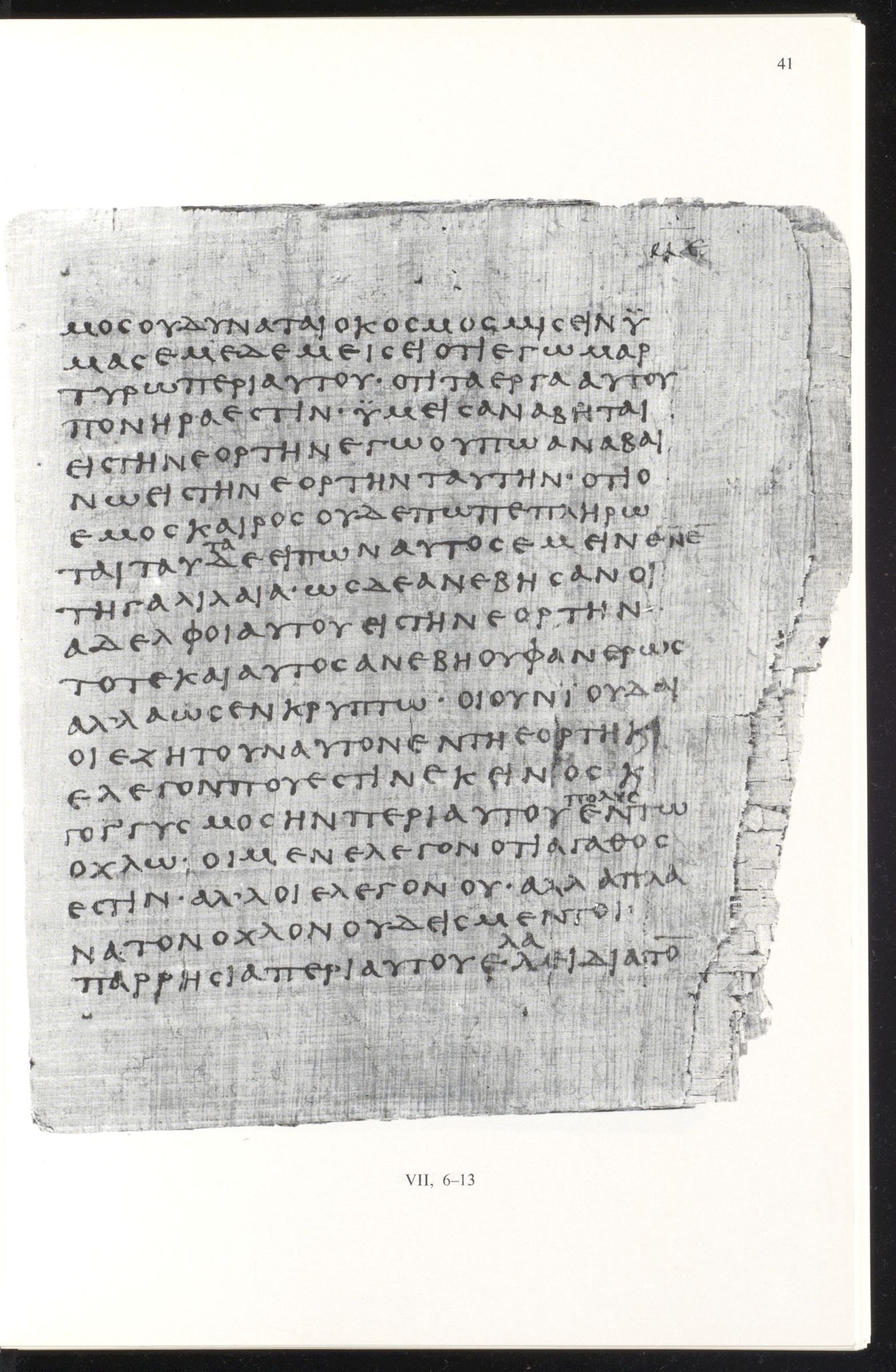
Fondation Martin Bodmer, Papyrus Bodmer II, Bodmer Lab image 1072205287_049 (https://bodmerlab.unige.ch/fr/constellations/papyri/mirador/1072205287), photographic plate of the 1962 Martin-Barns edition, shown whole. NTVMR page 410 (page 45) is linked to this image in NTVMR's page index. 7:6 begins on the previous page; 7:13 continues on the next page. Checked on the image: the printed caption reads ‹VII, 6-13›; the last line of writing, ‹παρρησια περι αυτου ελει δια τον› (line 19 of the transcription), is legible at the foot of the page.
7:6 μος 7 ου δυναται ο κοσμος μισειν υ
μας εμε δε μεισει οτι εγω μαρ
τυρω περι αυτου· οτι τα εργα αυτου
πονηρα εστιν· 8 υμεις αναβαται
εις την εορτην εγω ουπω αναβαι
νω εις την εορτην ταυτην· οτι ο
εμος καιρος ουδεπω πεπληρω
ται 9 ταυ δε ειπων αυτος εμεινεν
τη γαλιλαια· 10 ως δε ανεβησαν οι
αδελφοι αυτου εις την εορτην
τοτε και αυτος ανεβη ου φανερως
αλλα ως εν κρυπτω· 11 οι ουν ιουδαι
οι εζητουν αυτον εν τη εορτη και
ελεγον που εστιν εκεινος 12 και
γογγυσμος ην περι αυτου εν τω
οχλω· οι μεν ελεγον οτι αγαθος
εστιν· αλλοι ελεγον ου· αλλα πλα
να τον οχλον 13 ουδεις μεντοι
παρρησια περι αυτου ελει δια τον
7:6Then Jesus said unto them, My time is not yet come: but your time is alway ready. 7The world cannot hate you; but me it hateth, because I testify of it, that the works thereof are evil. 8Go ye up unto this feast: I go not up yet unto this feast; for my time is not yet full come. 9When he had said these words unto them, he abode still in Galilee. 10¶ But when his brethren were gone up, then went he also up unto the feast, not openly, but as it were in secret. 11Then the Jews sought him at the feast, and said, Where is he? 12And there was much murmuring among the people concerning him: for some said, He is a good man: others said, Nay; but he deceiveth the people. 13Howbeit no man spake openly of him for fear of the Jews.
Where on the image
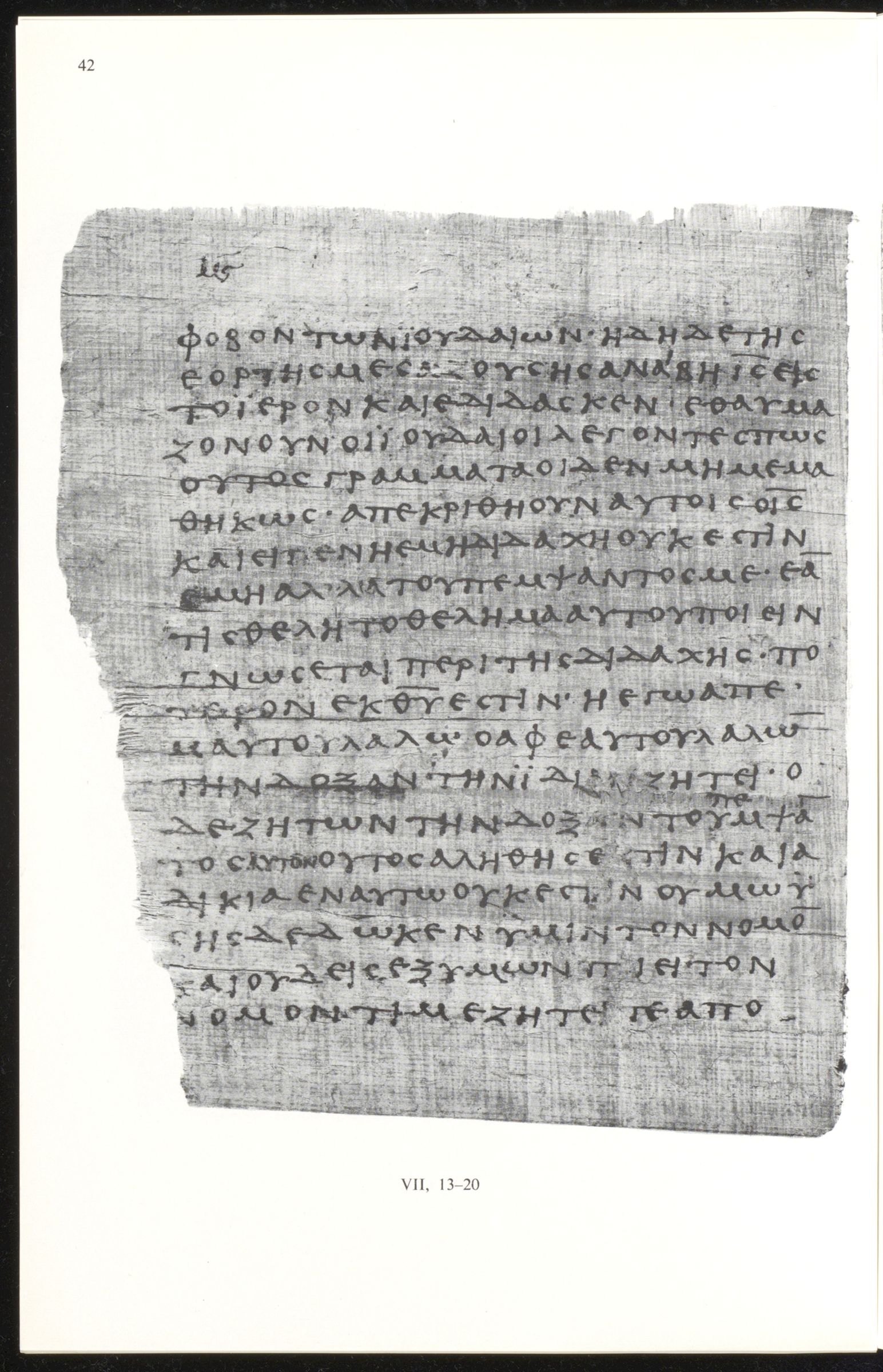
Fondation Martin Bodmer, Papyrus Bodmer II, Bodmer Lab image 1072205287_050 (https://bodmerlab.unige.ch/fr/constellations/papyri/mirador/1072205287), photographic plate of the 1962 Martin-Barns edition, shown whole. NTVMR page 420 (page 46) is linked to this image in NTVMR's page index. 7:13 begins on the previous page; 7:19 continues on the next page. Checked on the image: the printed caption reads ‹VII, 13-20›; the last line of writing, ‹νομον τι με ζητειτε απο› (line 19 of the transcription), is legible at the foot of the page.
7:13 φοβον των ιουδαιων· 14 ηδη δε της
εορτης μεσαζουσης αναβη ι̅ς̅ εις
το ιερον και εδιδασκεν· 15 εθαυμα
ζον ουν οι ιουδαιοι λεγοντες πως
ουτος γραμματα οιδεν μη μεμα
θηκως· 16 απεκριθη ουν αυτοις ο ι̅ς̅
και ειπεν η εμη διδαχη ουκ εστιν
εμη αλλα του πεμψαντος με· 17 εαν
τις θελη το θελημα αυτου ποιειν
γνωσεται περι της διδαχης· πο
τερον εκ θ̅υ̅ εστιν· η εγω απ ε
μαυτου λαλω 18 ο αφ εαυτου λαλων
την δοξαν την ιδιαν ζητει· ο
δε ζητων την δοξαν του μψαν
τος μ̣ε̣ ουτος αληθης εστιν και α
δικια εν αυτω ουκ εστιν 19 ου μωυ
σης δεδωκεν υμιν τον νομον
και ουδεις εξ υμων πιει τον
νομον τι με ζητειτε απο
7:13Howbeit no man spake openly of him for fear of the Jews. 14¶ Now about the midst of the feast Jesus went up into the temple, and taught. 15And the Jews marvelled, saying, How knoweth this man letters, having never learned? 16Jesus answered them, and said, My doctrine is not mine, but his that sent me. 17If any man will do his will, he shall know of the doctrine, whether it be of God, or whether I speak of myself. 18He that speaketh of himself seeketh his own glory: but he that seeketh his glory that sent him, the same is true, and no unrighteousness is in him. 19Did not Moses give you the law, and yet none of you keepeth the law? Why go ye about to kill me?
Where on the image
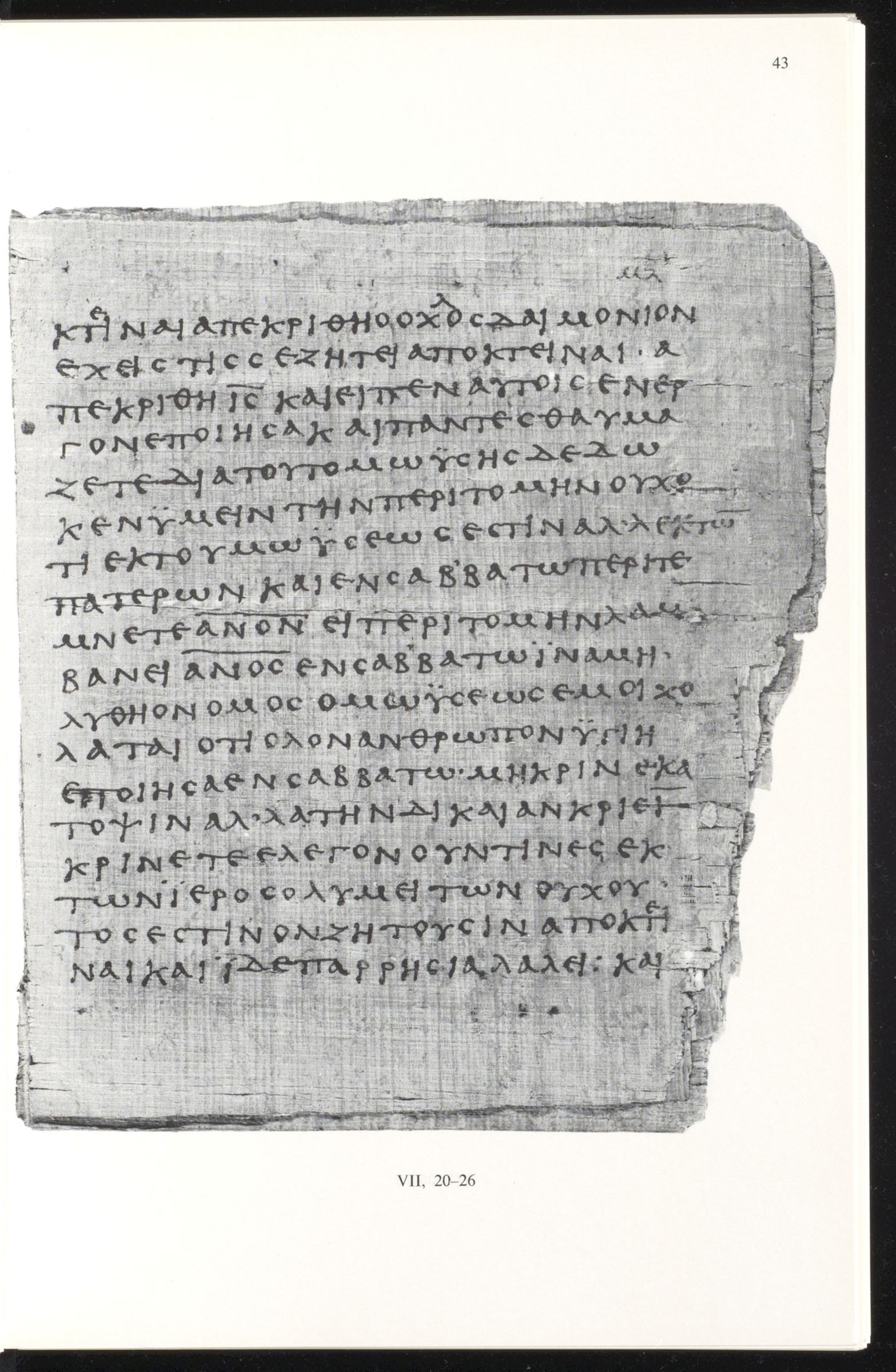
Fondation Martin Bodmer, Papyrus Bodmer II, Bodmer Lab image 1072205287_051 (https://bodmerlab.unige.ch/fr/constellations/papyri/mirador/1072205287), photographic plate of the 1962 Martin-Barns edition, shown whole. NTVMR page 430 (page 47) is linked to this image in NTVMR's page index. 7:19 begins on the previous page; 7:26 continues on the next page. Checked on the image: the printed caption reads ‹VII, 20-26›.
7:19 κτιναι 20 απεκριθη ο οχος δαιμονιον
εχεις τις σε ζητει αποκτειναι· 21 α
πεκριθη ι̅ς̅ και ειπεν αυτοις εν ερ
γον εποιησα και παντες θαυμα
ζετε 22 δια τουτο μωυσης δεδω
κεν υμειν την περιτομην ουχ ο
τι εκ του μωυσεως εστιν αλλ εκ
πατερων και εν σαββατω περιτε
μνετε α̅ν̅ο̅ν̅ 23 ει περιτομην λαμ
βανει α̅ν̅ο̅ς̅ εν σαββατω ινα μη
λυθη ο νομος ο μωυσεως εμοι χο
λαται οτι ολον ανθρωπον υγιη
εποιησα εν σαββατω· 24 μη κρινε κα
τ οψιν αλλα την δικαιαν κρισιν
κρινετε 25 ελεγον ουν τινες εκ
των ιεροσολυμειτων ουχ ου
τος εστιν ον ζητουσιν αποκτι
ναι 26 και ιδε παρρησια λαλει· και
7:19Did not Moses give you the law, and yet none of you keepeth the law? Why go ye about to kill me? 20The people answered and said, Thou hast a devil: who goeth about to kill thee? 21Jesus answered and said unto them, I have done one work, and ye all marvel. 22Moses therefore gave unto you circumcision; (not because it is of Moses, but of the fathers;) and ye on the sabbath day circumcise a man. 23If a man on the sabbath day receive circumcision, that the law of Moses should not be broken; are ye angry at me, because I have made a man every whit whole on the sabbath day? 24Judge not according to the appearance, but judge righteous judgment. 25Then said some of them of Jerusalem, Is not this he, whom they seek to kill? 26But, lo, he speaketh boldly, and they say nothing unto him. Do the rulers know indeed that this is the very Christ?
Where on the image
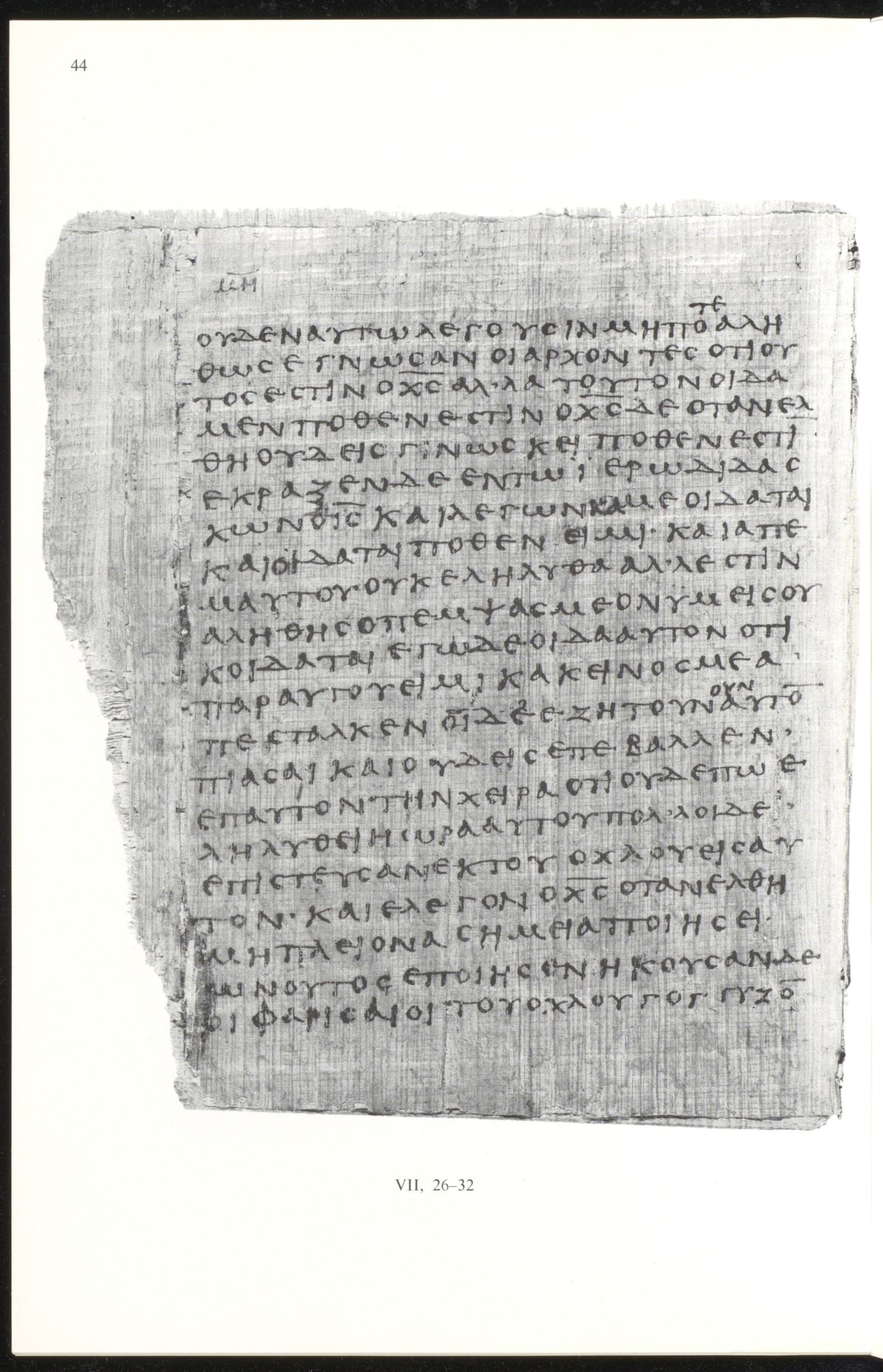
Fondation Martin Bodmer, Papyrus Bodmer II, Bodmer Lab image 1072205287_052 (https://bodmerlab.unige.ch/fr/constellations/papyri/mirador/1072205287), photographic plate of the 1962 Martin-Barns edition, shown whole. NTVMR page 440 (page 48) is linked to this image in NTVMR's page index. 7:26 begins on the previous page; 7:32 continues on the next page. Checked on the image: the printed caption reads ‹VII, 26-32›; the last line of writing, ‹οι φαρισαιοι του οχλου γογγυζον› (line 21 of the transcription), is legible at the foot of the page.
7:26 ουδεν αυτω λεγουσιν μηπο αλη
θως εγνωσαν οι αρχοντες οτι ου
τος εστιν ο χ̅ς̅ 27 αλλα τουτον οιδα
μεν ποθεν εστιν ο χ̅ς̅ δε οταν ελ
θη ουδεις γινωσκει ποθεν εστιν
28 εκραξεν δε εν τω ιερω διδασ
κων ο ι̅ς̅ και λεγων εμε οιδαται
και οιδαται ποθεν ειμι. και απ ε
μαυτου ουκ εληλυθα αλλ εστιν
αληθης ο πεμψας με ον υμεις ου
κ οιδαται 29 εγω δε οιδα αυτον οτι
παρ αυτου ειμι κακεινος με α
πεσταλκεν 30 οι δε εζητουν αυτον
πιασαι και ουδεις επεβαλλεν
επ αυτον την χειρα οτι ουδεπω ε
ληλυθει η ωρα αυτου 31 πολλοι δε
επιστευσαν εκ του οχλου εις αυ
τον· και ελεγον ο χ̅ς̅ οταν ελθη
μη πλειονα σημεια ποιησει·
ων ουτος εποιησεν 32 ηκουσαν δε
οι φαρισαιοι του οχλου γογγυζον
7:26But, lo, he speaketh boldly, and they say nothing unto him. Do the rulers know indeed that this is the very Christ? 27Howbeit we know this man whence he is: but when Christ cometh, no man knoweth whence he is. 28Then cried Jesus in the temple as he taught, saying, Ye both know me, and ye know whence I am: and I am not come of myself, but he that sent me is true, whom ye know not. 29But I know him: for I am from him, and he hath sent me. 30Then they sought to take him: but no man laid hands on him, because his hour was not yet come. 31And many of the people believed on him, and said, When Christ cometh, will he do more miracles than these which this man hath done? 32¶ The Pharisees heard that the people murmured such things concerning him; and the Pharisees and the chief priests sent officers to take him.
Where on the image
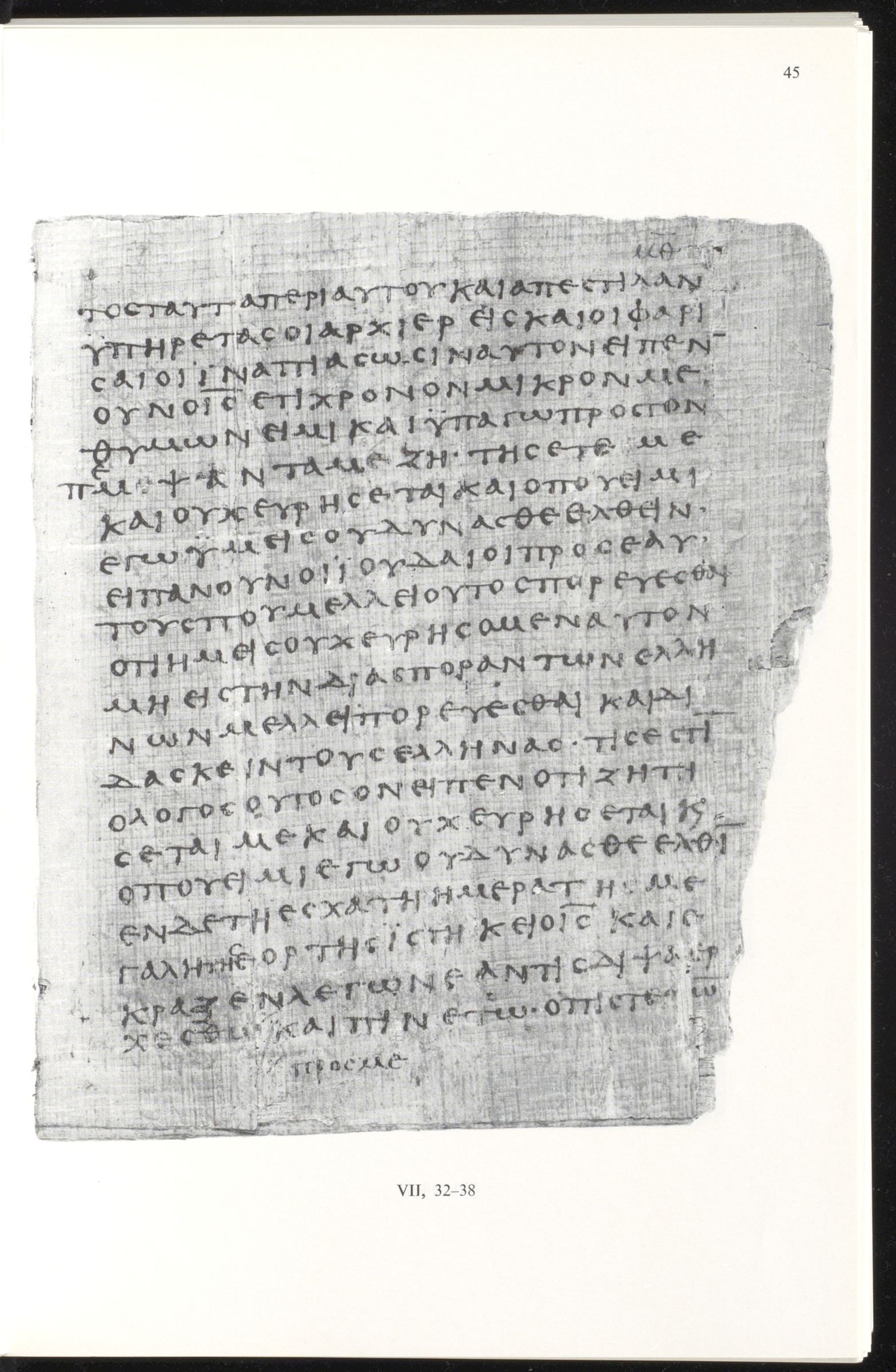
Fondation Martin Bodmer, Papyrus Bodmer II, Bodmer Lab image 1072205287_053 (https://bodmerlab.unige.ch/fr/constellations/papyri/mirador/1072205287), photographic plate of the 1962 Martin-Barns edition, shown whole. NTVMR page 450 (page 49) is linked to this image in NTVMR's page index. 7:32 begins on the previous page; 7:38 continues on the next page. Checked on the image: the printed caption reads ‹VII, 32-38›; the last line of writing, ‹χεσθω και πινετω· ο πιστευ̣ων› (line 21 of the transcription), is legible at the foot of the page.
7:32 τος ταυτα περι αυτου και απεστιλαν
υπηρετας οι αρχιερεις και οι φαρι
σαιοι ινα πιασωσιν αυτον 33 ειπεν
ουν ο ι̅ς̅ ετι χρονον μικρον με
θ υμων ειμι και υπαγω προς τον
με̣ψψ̣ντα με 34 ζητησετα̣ι̣ με
και ουχ ευρησεται και οπου ειμι
εγω υμεις ου δυνασθε ελθειν
35 ειπαν ουν οι ιουδαιοι προς εαυ
τους που μελλει ουτος πορευεσθαι
οτι ημεις ουχ ευρησομεν αυτον
μη εις την διασποραν των ελλη
νων μελλει πορευεσθαι και δι
δασκειν τους ελληνας· 36 τις εστιν
ο λογος ουτος ον ειπεν οτι ζητη
σεται με και ουχ ευρησεται και
οπου ειμι εγω ου δυνασθε ελθιν
37 εν δε τη εσχατη ημερα της με
γαλης̣ εορτης ιστηκει ο ι̅ς̅ και ε
κραζ̣εν λεγων εαν τις διψα ερ
χεσθω και πινετω· 38 ο πιστευ̣ων
7:32¶ The Pharisees heard that the people murmured such things concerning him; and the Pharisees and the chief priests sent officers to take him. 33Then said Jesus unto them, Yet a little while am I with you, and then I go unto him that sent me. 34Ye shall seek me, and shall not find me: and where I am, thither ye cannot come. 35Then said the Jews among themselves, Whither will he go, that we shall not find him? will he go unto the dispersed among the Gentiles, and teach the Gentiles? 36What manner of saying is this that he said, Ye shall seek me, and shall not find me: and where I am, thither ye cannot come? 37In the last day, that great day of the feast, Jesus stood and cried, saying, If any man thirst, let him come unto me, and drink. 38He that believeth on me, as the scripture hath said, out of his belly shall flow rivers of living water.
Where on the image
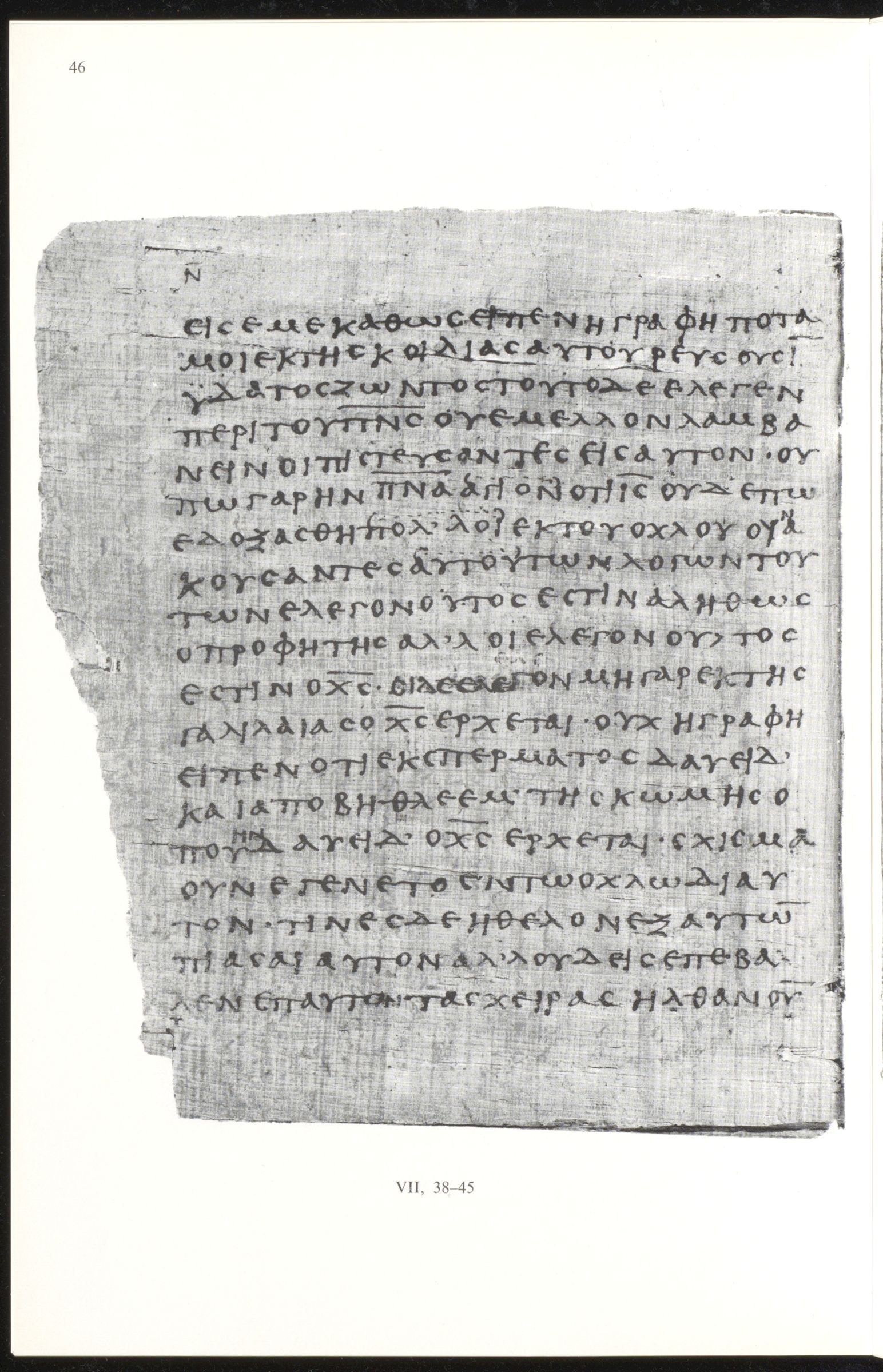
Fondation Martin Bodmer, Papyrus Bodmer II, Bodmer Lab image 1072205287_054 (https://bodmerlab.unige.ch/fr/constellations/papyri/mirador/1072205287), photographic plate of the 1962 Martin-Barns edition, shown whole. NTVMR page 460 (page 50) is linked to this image in NTVMR's page index. 7:38 begins on the previous page; 7:45 continues on the next page. Checked on the image: the printed caption reads ‹VII, 38-45›; the last line of writing, ‹λεν επ αυτω̣ τας χειρας ηλθαν ουν› (line 19 of the transcription), is legible at the foot of the page.
7:38 εις εμε καθως ειπεν η γραφη ποτα
μοι εκ της κοιλιας αυτου ρευσουσιν
υδατος ζωντος 39 τουτο δε ελεγεν
περι του π̅ν̅ς̅ ου εμελλον λαμβα
νειν οι πιστευσαντες εις αυτον· ου
πω γαρ ην π̅ν̅α̅ αγιον οτι ι̅ς̅ ουδεπω
εδοξασθη 40 πολλοι εκ του οχλου οι α
κουσαντες αυτου των λογων του
των ελεγον ουτος εστιν αληθως
ο προφητης 41 αλλοι ελεγον ουτος
εστιν ο χ̅ς̅· α̣λ̣λοι̣ γον μη γαρ εκ της
γαλιλαιας ο χ̅ς̅ ερχεται· 42 ουχ η γραφη
ειπεν οτι εκ σπερματος δαυειδ
και απο βηθλεεμ της κωμης ο
που δαυειδ ο χ̅ς̅ ερχεται· 43 σχισμα
ουν εγενετο εν τω οχλω δι αυ
τον· 44 τινες δε ηθελον εξ αυτων
πιασαι αυτον αλλ ουδεις επεβαλ
λεν επ αυτω̣ τας χειρας 45 ηλθαν ουν
7:38He that believeth on me, as the scripture hath said, out of his belly shall flow rivers of living water. 39(But this spake he of the Spirit, which they that believe on him should receive: for the Holy Ghost was not yet given; because that Jesus was not yet glorified.) 40¶ Many of the people therefore, when they heard this saying, said, Of a truth this is the Prophet. 41Others said, This is the Christ. But some said, Shall Christ come out of Galilee? 42Hath not the scripture said, That Christ cometh of the seed of David, and out of the town of Bethlehem, where David was? 43So there was a division among the people because of him. 44And some of them would have taken him; but no man laid hands on him. 45¶ Then came the officers to the chief priests and Pharisees; and they said unto them, Why have ye not brought him?
Where on the image
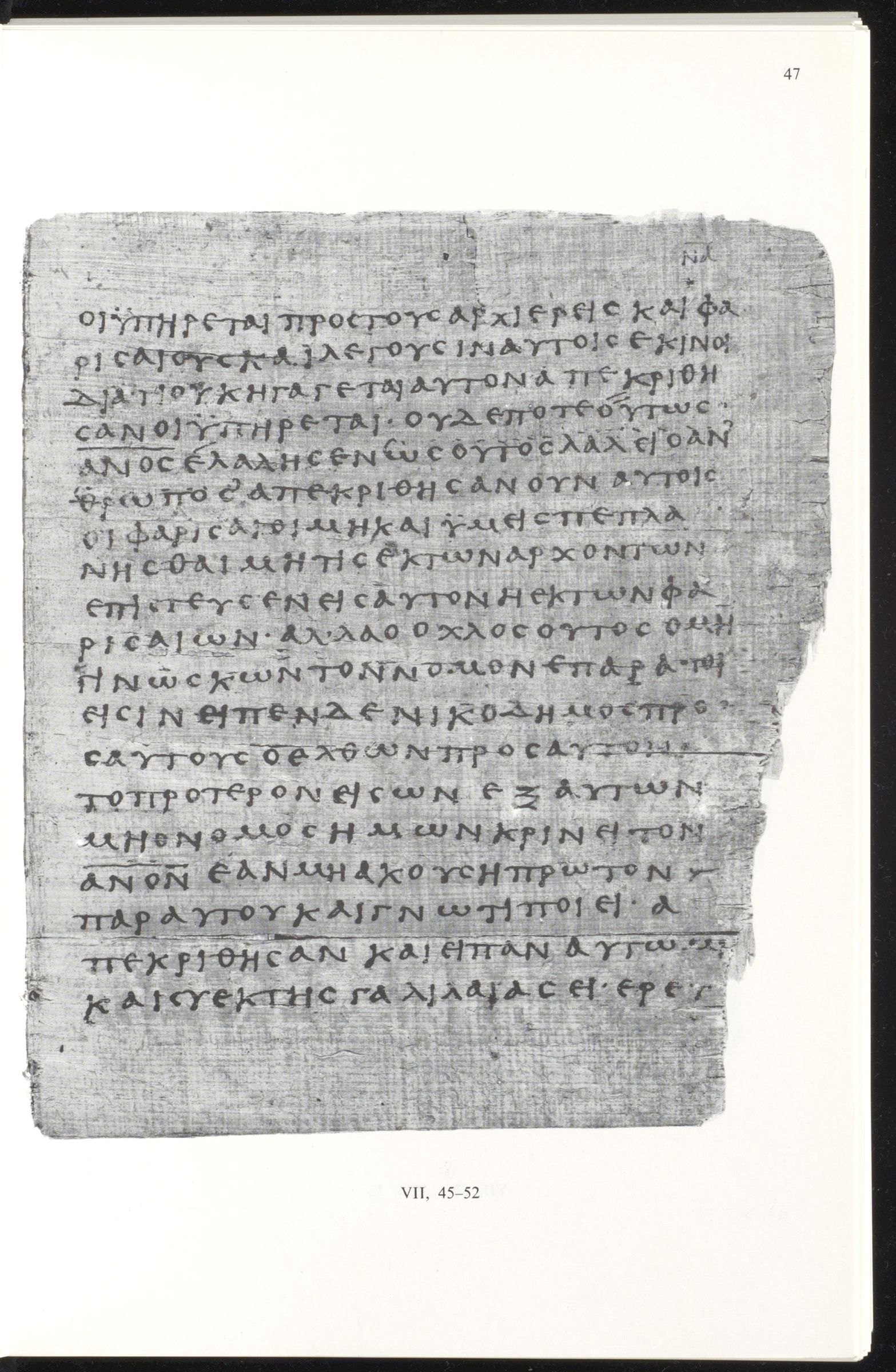
Fondation Martin Bodmer, Papyrus Bodmer II, Bodmer Lab image 1072205287_055 (https://bodmerlab.unige.ch/fr/constellations/papyri/mirador/1072205287), photographic plate of the 1962 Martin-Barns edition, shown whole. NTVMR page 470 (page 51) is linked to this image in NTVMR's page index. 7:45 begins on the previous page; 7:52 continues on the next page. Checked on the image: the printed caption reads ‹VII, 45-52›; the last line of writing, ‹και συ εκ της γαλιλαιας ει· ερευ› (line 19 of the transcription), is legible at the foot of the page.
7:45 οι υπηρεται προς τους αρχιερεις και φα
ρισαιους και λεγουσιν αυτοις εκινοι
δια τι ουκ ηγαγεται αυτον 46 απεκριθη
σαν οι υπηρεται· ουδεποτε ουτως
α̅ν̅ο̅ς̅ ελαλησεν ως ουτος λαλει ο αν
θρωπος 47 απεκριθησαν ουν αυτοις
οι φαρισαιοι μη και υμεις πεπλα
νησθαι 48 μη τις εκ των αρχοντων
επιστευσεν εις αυτον η εκ των φα
ρισαιων· 49 αλλα ο οχλος ουτος ο μη
γινωσκων τον νομον επαρατοι
εισιν 50 ειπεν δε νικοδημος προ
ς αυτους ο ελθων προς αυτον
το προτερον εις ων εξ αυτων
51 μη ο νομος ημων κρινει τον
α̅ν̅ο̅ν̅ εαν μη ακουση πρωτον
παρ αυτου και γνω τι ποιει· 52 α
πεκριθησαν και ειπαν αυτω μη
και συ εκ της γαλιλαιας ει· ερευ
7:45¶ Then came the officers to the chief priests and Pharisees; and they said unto them, Why have ye not brought him? 46The officers answered, Never man spake like this man. 47Then answered them the Pharisees, Are ye also deceived? 48Have any of the rulers or of the Pharisees believed on him? 49But this people who knoweth not the law are cursed. 50Nicodemus saith unto them, (he that came to Jesus by night, being one of them,) 51Doth our law judge any man, before it hear him, and know what he doeth? 52They answered and said unto him, Art thou also of Galilee? Search, and look: for out of Galilee ariseth no prophet.
Where on the image
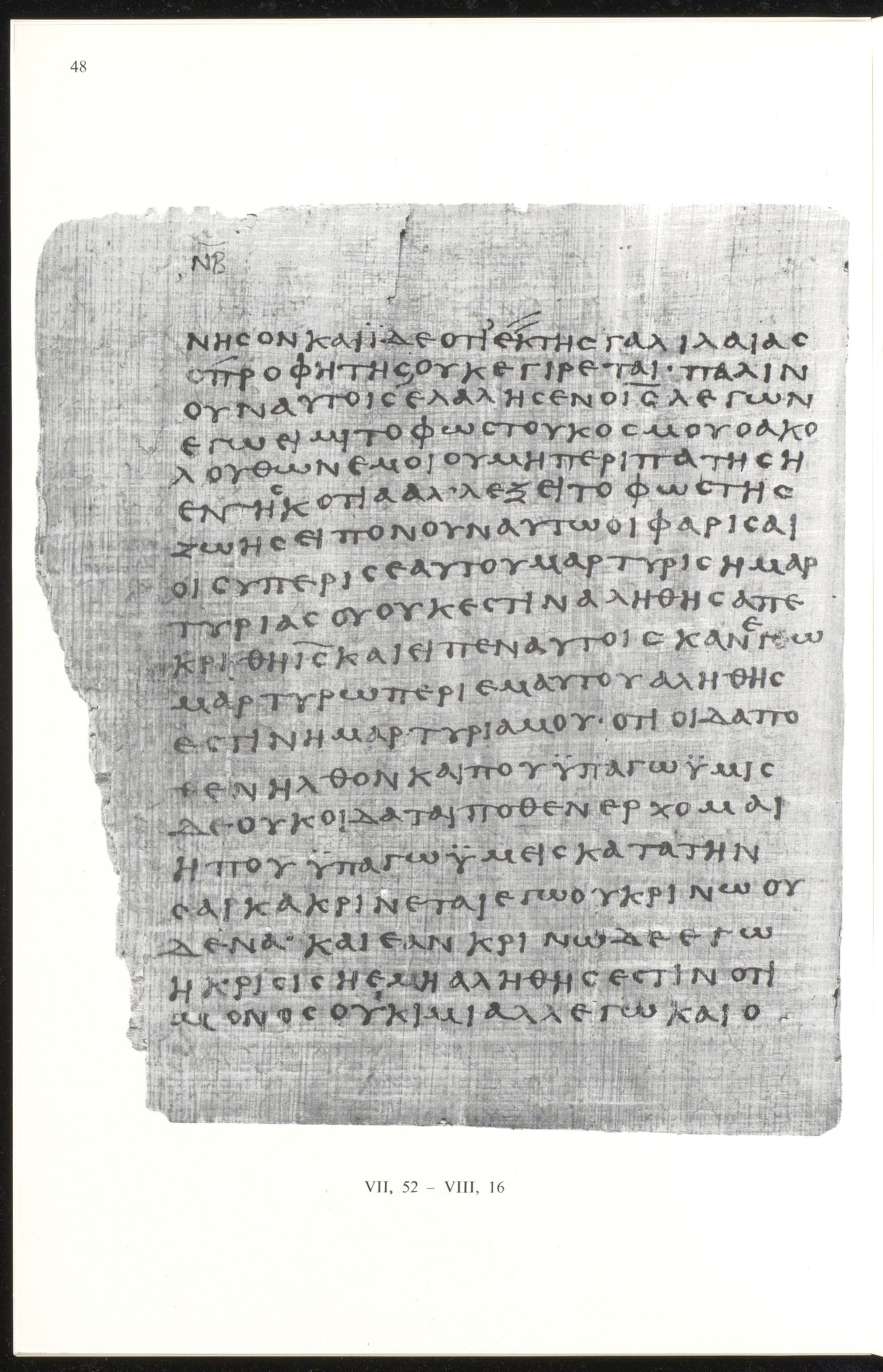
Fondation Martin Bodmer, Papyrus Bodmer II, Bodmer Lab image 1072205287_056 (https://bodmerlab.unige.ch/fr/constellations/papyri/mirador/1072205287), photographic plate of the 1962 Martin-Barns edition, shown whole. NTVMR page 480 (page 52) is linked to this image in NTVMR's page index. 7:52 begins on the previous page; 8:16 continues on the next page. Not written in this papyrus: John 7:53-8:11. The NTVMR transcription marks these verses as empty at this point of the text, so the English leaves them out. Checked on the image: the printed caption reads ‹VII, 52 - VIII, 16›; the last line of writing, ‹μονος ουκ ιμι αλλ εγω και ο› (line 19 of the transcription), is legible at the foot of the page.
7:52 νησον και ιδε οτι εκ της γαλιλαιας
ο προφητης ουκ εγιρεται· 8:12 παλιν
ουν αυτοις ελαλησεν ο ι̅ς̅ λεγων
εγω ειμι το φως του κοσμου ο ακο
λουθων εμοι ου μη περιπατηση
εν τη κοτια αλλ εξει το φως της
ζωης 13 ειπον ουν αυτω οι φαρισαι
οι συ περι σεαυτου μαρτυρις η μαρ
τυρια σου ουκ εστιν αληθης 14 απε
κριθη ι̅ς̅ και ειπεν αυτοις καν γεω
μαρτυρω περι εμαυτου αληθης
εστιν η μαρτυρια μου· οτι οιδα πο
θεν ηλθον και που υπαγω υμις
δε ουκ οιδαται ποθεν ερχομαι
η που υπαγω 15 υμεις κατα την
σαρκα κρινεται εγω ου κρινω ου
δενα· 16 και εαν κρινω δε εγω
η κρισις η εμη αληθης εστιν οτι
μονος ουκ ιμι αλλ εγω και ο
7:52They answered and said unto him, Art thou also of Galilee? Search, and look: for out of Galilee ariseth no prophet. 8:12¶ Then spake Jesus again unto them, saying, I am the light of the world: he that followeth me shall not walk in darkness, but shall have the light of life. 13The Pharisees therefore said unto him, Thou bearest record of thyself; thy record is not true. 14Jesus answered and said unto them, Though I bear record of myself, yet my record is true: for I know whence I came, and whither I go; but ye cannot tell whence I come, and whither I go. 15Ye judge after the flesh; I judge no man. 16And yet if I judge, my judgment is true: for I am not alone, but I and the Father that sent me.
Notes
- Greek: the NTVMR diplomatic transcription, line by line as on the papyrus. Square brackets enclose letters that are lost or illegible and were supplied by the transcribers; a dot under a letter marks it as uncertain; [...] marks a gap. Nomina sacra and numerals keep the scribe's overline. Spelling is the scribe's (no accents or breathings). Words broken at a line end stay broken as on the papyrus. Corrections are not shown: the text is the first hand.
- English: the King James Version (1611), whole verses, for every verse that has text on the page. A verse that begins on one page and ends on the next is given in full on both. The KJV translates a later form of the Greek text, so its wording does not always match the papyrus; material differences (such as verses the papyrus does not have) are noted in the section.
Cite
Sources
- Source: Papyrus Bodmer II (P66), Fondation Martin Bodmer: images from the Bodmer Lab, University of Geneva; Greek from the INTF NTVMR transcription of P66; English from the King James Version (holding institution)
- Critical edition: INTF NTVMR diplomatic transcription (CC BY 4.0)
← previous · → next · v cycle view · l back to library