P66 (Papyrus Bodmer II): John 8:16-9:6 (pages 53-60)
Introduction
P66 is a papyrus codex of the Gospel of John copied in Egypt around 200, the most complete early copy of John. Most of it is Papyrus Bodmer II in the Fondation Martin Bodmer, Cologny (Geneva); small pieces are in the Chester Beatty Library, Dublin, and the Institut für Altertumskunde, Cologne. The first five quires (John 1:1-14:26) survive as a bound book of numbered pages; later leaves, from John 14:29 to 21:9, are damaged and kept between glass. The scribe made many corrections, some of them his own; only the first hand is shown here.
Each section below is one page: the photograph, the NTVMR diplomatic transcription line by line, and the King James Version of every verse on the page. Pages of the bound book are shown on the photographic plates published by Victor Martin and J. W. B. Barns in 1962 (scanned by the Bodmer Lab), the glass-mounted leaves on colour photographs. Lost: John 6:12-34 (pages 35-38) and parts of chapters 14-21; the transcription ends at 21:9. Where P66 lacks a verse that the KJV has (John 5:4, the account of the adulteress at 7:53-8:11, 16:15), the section says so.
This entry covers pages 53-60 (John 8:16-9:6).
How was this verified? (Provenance)
Where on the image
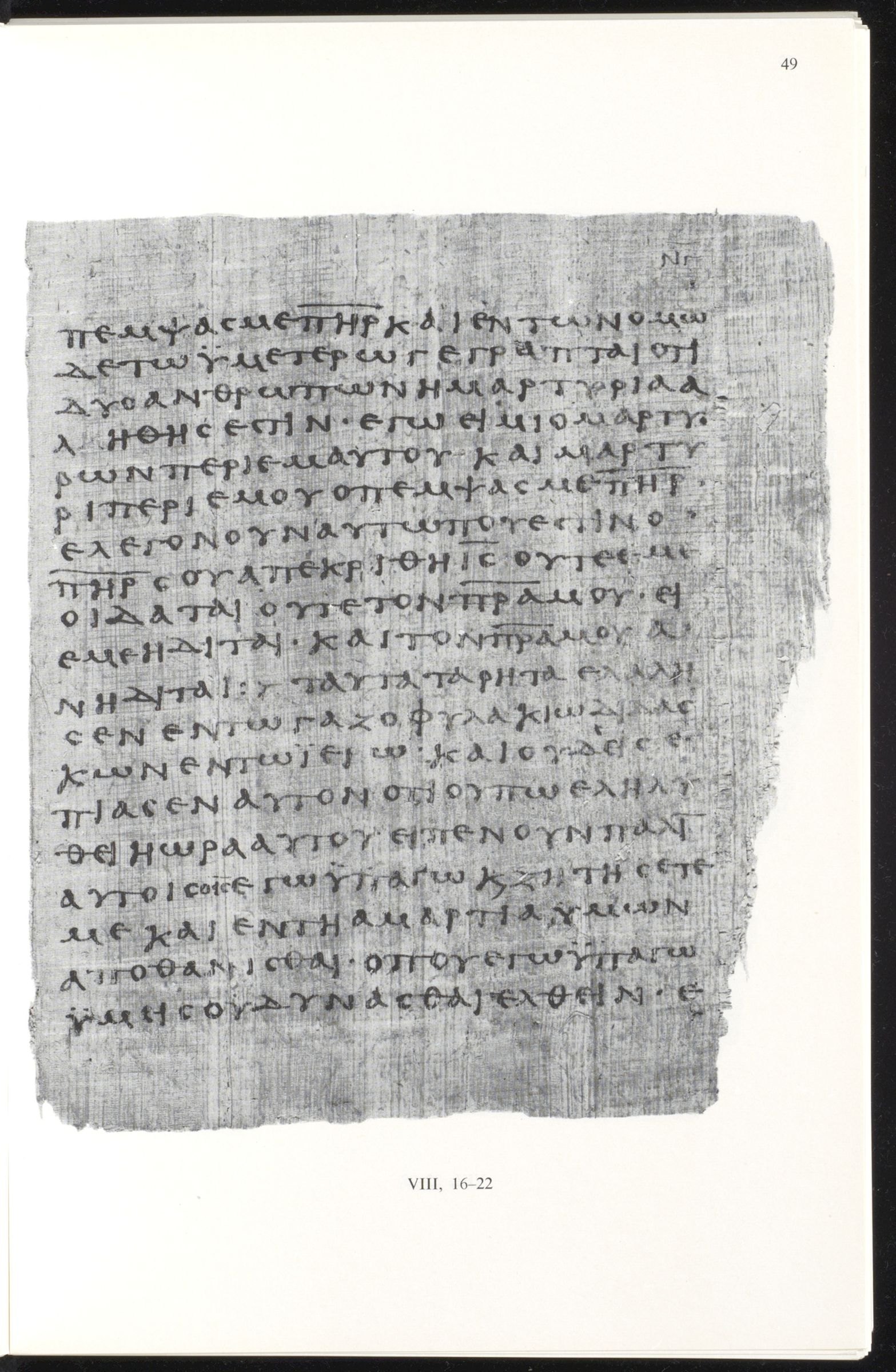
Fondation Martin Bodmer, Papyrus Bodmer II, Bodmer Lab image 1072205287_057 (https://bodmerlab.unige.ch/fr/constellations/papyri/mirador/1072205287), photographic plate of the 1962 Martin-Barns edition, shown whole. NTVMR page 490 (page 53) is linked to this image in NTVMR's page index. 8:16 begins on the previous page; 8:22 continues on the next page. Checked on the image: the printed caption reads ‹VIII, 16-22›; the last line of writing, ‹υμεις ου δυνασθαι ελθειν· ε› (line 19 of the transcription), is legible at the foot of the page.
8:16 πεμψας με π̅η̅ρ̅ 17 και εν τω νομω
δε τω υμετερω γεγραπται οτι
δυο ανθρωπων η μαρτυρια α
λληθης εστιν· 18 εγω ειμι ο μαρτυ
ρων περι εμαυτου και μαρτυ
ρι περι εμου ο πεμψας με π̅η̅ρ̅
19 ελεγον ουν αυτω που εστιν ο
π̅η̅ρ̅ σου απεκριθη ι̅ς̅ ουτε εμε
οιδαται ουτε τον π̅ρ̅α̅ μου· ει
εμε ηδιται· και τον π̅ρ̅α̅ μου α
ν ηδιται· 20 ταυτα τα ρητα ελαλη
σεν εν τω γαζοφυλακιω διδασ
κων εν τω ιερω· και ουδεις ε
πιασεν αυτον οτι ουπω εληλυ
θει η ωρα αυτου· 21 ειπεν ουν παλιν
αυτοις εγω υπαγω και ζητησετε
με και εν τη αμαρτια υμων
αποθανισθαι· οπου εγω υπαγω
υμεις ου δυνασθαι ελθειν· 22 ε
8:16And yet if I judge, my judgment is true: for I am not alone, but I and the Father that sent me. 17It is also written in your law, that the testimony of two men is true. 18I am one that bear witness of myself, and the Father that sent me beareth witness of me. 19Then said they unto him, Where is thy Father? Jesus answered, Ye neither know me, nor my Father: if ye had known me, ye should have known my Father also. 20These words spake Jesus in the treasury, as he taught in the temple: and no man laid hands on him; for his hour was not yet come. 21Then said Jesus again unto them, I go my way, and ye shall seek me, and shall die in your sins: whither I go, ye cannot come. 22Then said the Jews, Will he kill himself? because he saith, Whither I go, ye cannot come.
Where on the image
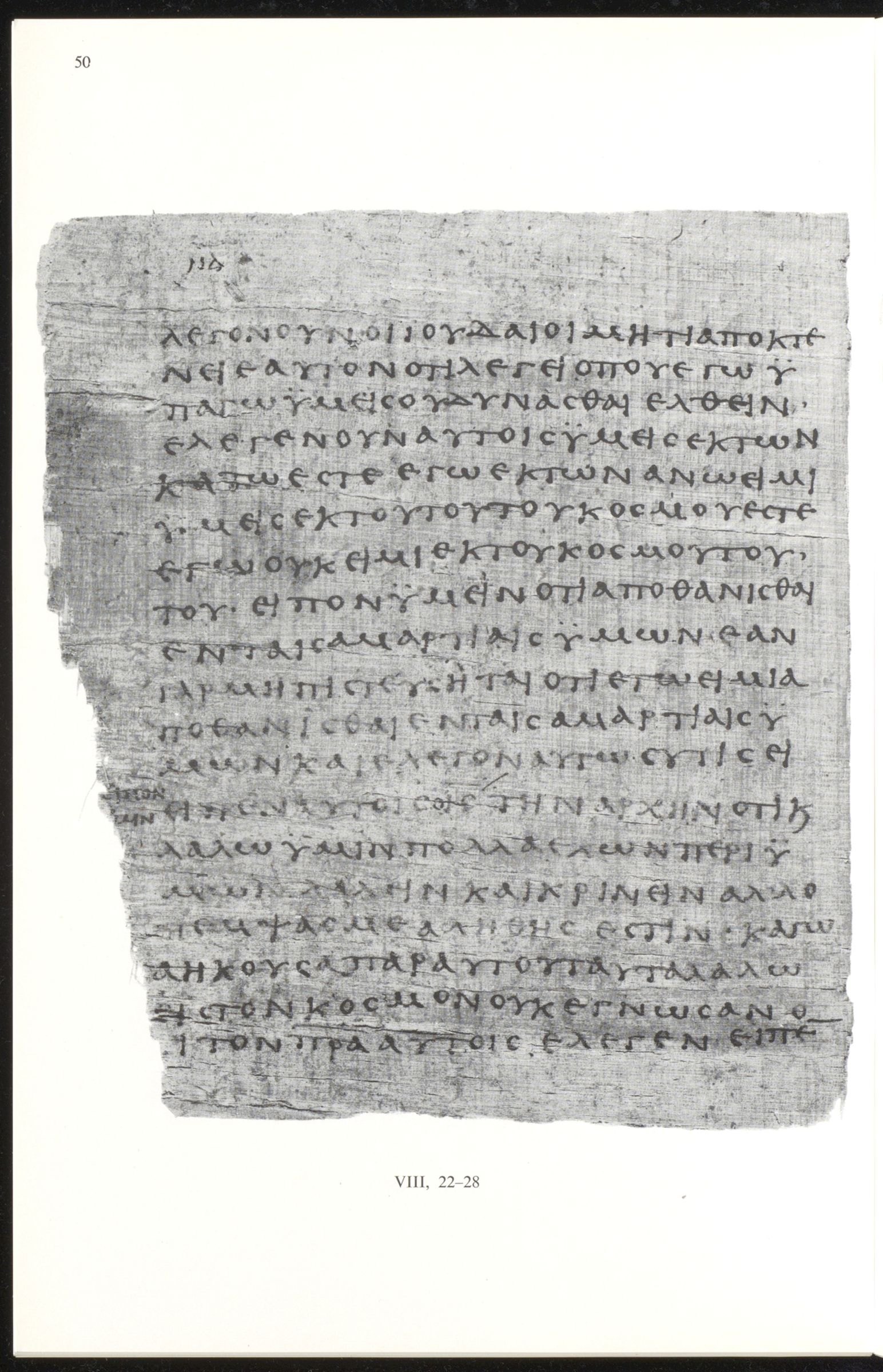
Fondation Martin Bodmer, Papyrus Bodmer II, Bodmer Lab image 1072205287_058 (https://bodmerlab.unige.ch/fr/constellations/papyri/mirador/1072205287), photographic plate of the 1962 Martin-Barns edition, shown whole. NTVMR page 500 (page 54) is linked to this image in NTVMR's page index. 8:22 begins on the previous page; 8:28 continues on the next page. Checked on the image: the printed caption reads ‹VIII, 22-28›; the last line of writing, ‹τ̣ι τον π̅ρ̅α̅ αυτοις ελεγεν ειπεν› (line 19 of the transcription), is legible at the foot of the page.
8:22 λεγον ουν οι ιουδαιοι μητι αποκτε
νει εαυτον οτι λεγει οπου εγω υ
παγω υμεις ου δυνασθαι ελθειν
23 ελεγεν ουν αυτοις υμεις εκ των
κατω εστε εγω εκ των ανω ειμι
υμεις εκ τουτου του κοσμου εστε
εγω ουκ ειμι εκ του κοσμου του
του· 24 ειπον υμειν οτι αποθανισθαι
εν ταις αμαρτιαις υμων εαν
γαρ μη πιστευσηται οτι εγω ειμι α
ποθανισθαι εν ταις αμαρτιαις υ
μων 25 και ελεγον αυτω συ τις ει
ειπεν αυτοις ι̅ς̅ την αρχην ο τι και
λαλω υμιν 26 πολλα εχων περι υ
μων λαλειν και κρινειν αλλ ο
πεμψας με αληθης εστιν· καγω
α ηκουσα παρ αυτου ταυτα λαλω
εις τον κοσμον 27 ουκ εγνωσαν ο
τ̣ι τον π̅ρ̅α̅ αυτοις ελεγεν 28 ειπεν
8:22Then said the Jews, Will he kill himself? because he saith, Whither I go, ye cannot come. 23And he said unto them, Ye are from beneath; I am from above: ye are of this world; I am not of this world. 24I said therefore unto you, that ye shall die in your sins: for if ye believe not that I am he, ye shall die in your sins. 25Then said they unto him, Who art thou? And Jesus saith unto them, Even the same that I said unto you from the beginning. 26I have many things to say and to judge of you: but he that sent me is true; and I speak to the world those things which I have heard of him. 27They understood not that he spake to them of the Father. 28Then said Jesus unto them, When ye have lifted up the Son of man, then shall ye know that I am he, and that I do nothing of myself; but as my Father hath taught me, I speak these things.
Where on the image
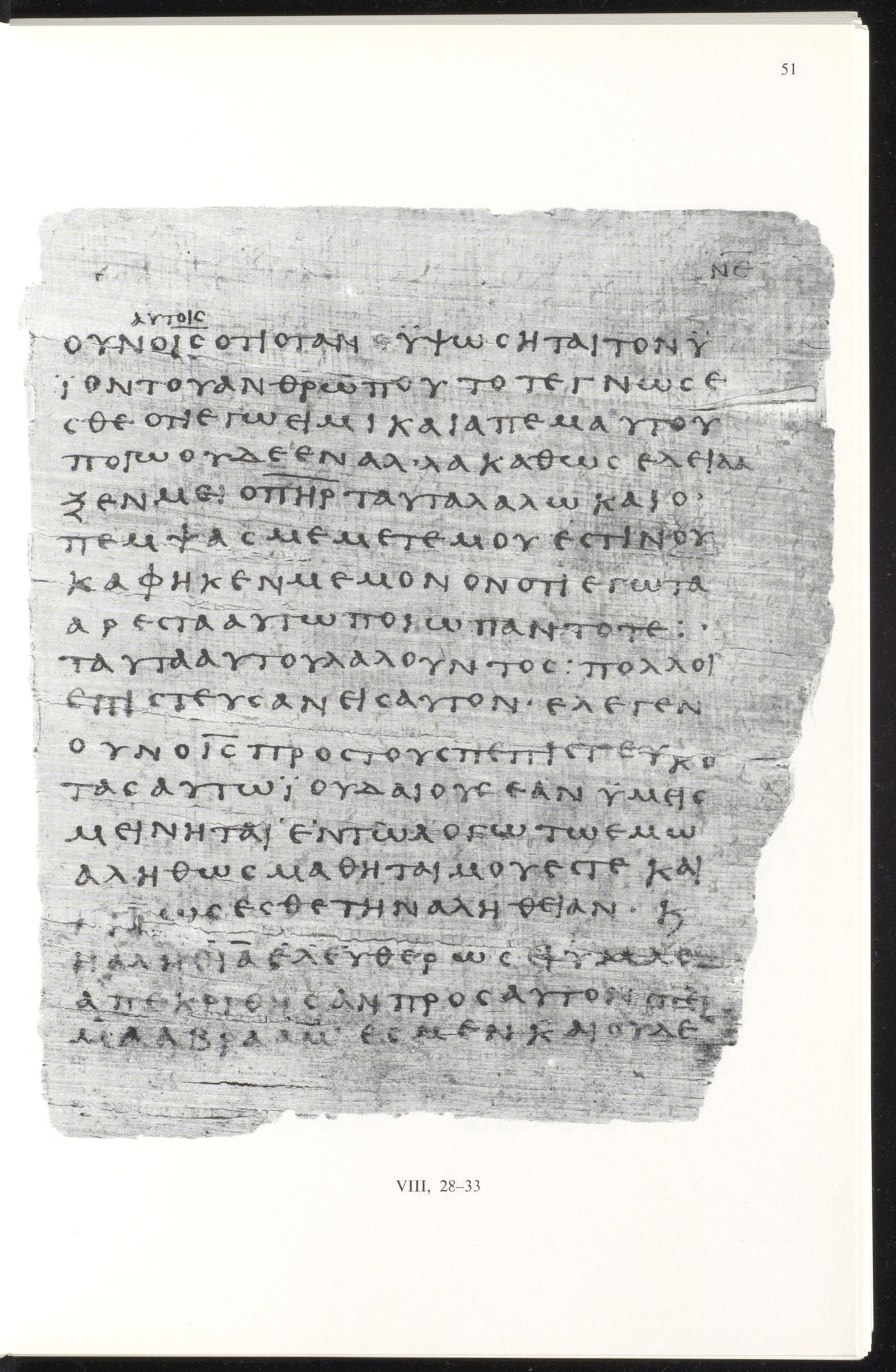
Fondation Martin Bodmer, Papyrus Bodmer II, Bodmer Lab image 1072205287_059 (https://bodmerlab.unige.ch/fr/constellations/papyri/mirador/1072205287), photographic plate of the 1962 Martin-Barns edition, shown whole. NTVMR page 510 (page 55) is linked to this image in NTVMR's page index. 8:28 begins on the previous page; 8:33 continues on the next page. Checked on the image: the printed caption reads ‹VIII, 28-33›; the last line of writing, ‹μα αβρααμ εσμεν και ουδε› (line 18 of the transcription), is legible at the foot of the page.
8:28 ουν ο ι̅ς̅ οτι οταν ο̣ υψωσηται τον υ
ιον του ανθρωπου τοτε γνωσε
σθε οτι εγω ειμι και απ εμαυτου
ποιω ουδε εν αλλα καθως εδει
ξεν μο̣ι ο π̅η̅ρ̅ ταυτα λαλω 29 και ο
πεμψας με μετ εμου εστιν ου
κ αφηκεν με μονον οτι εγω τα
αρεστα αυτω ποιω παντοτε·
30 ταυτα αυτου λαλουντος· πολλοι
επιστευσαν εις αυτον· 31 ελεγεν
ουν ο ι̅ς̅ προς τους πεπιστευκο
τας αυτω ιουδαιους εαν υμεις
μεινηται εν τω λογω τω εμω
αληθως μαθηται μου εστε 32 και
γ̣ν̣ωσεσθε την αληθειαν· και
η αληθια ελευθερωσει υμας
33 απεκριθησαν προς αυτον σπερ
μα αβρααμ εσμεν και ουδε
8:28Then said Jesus unto them, When ye have lifted up the Son of man, then shall ye know that I am he, and that I do nothing of myself; but as my Father hath taught me, I speak these things. 29And he that sent me is with me: the Father hath not left me alone; for I do always those things that please him. 30As he spake these words, many believed on him. 31Then said Jesus to those Jews which believed on him, If ye continue in my word, then are ye my disciples indeed; 32And ye shall know the truth, and the truth shall make you free. 33¶ They answered him, We be Abraham’s seed, and were never in bondage to any man: how sayest thou, Ye shall be made free?
Where on the image
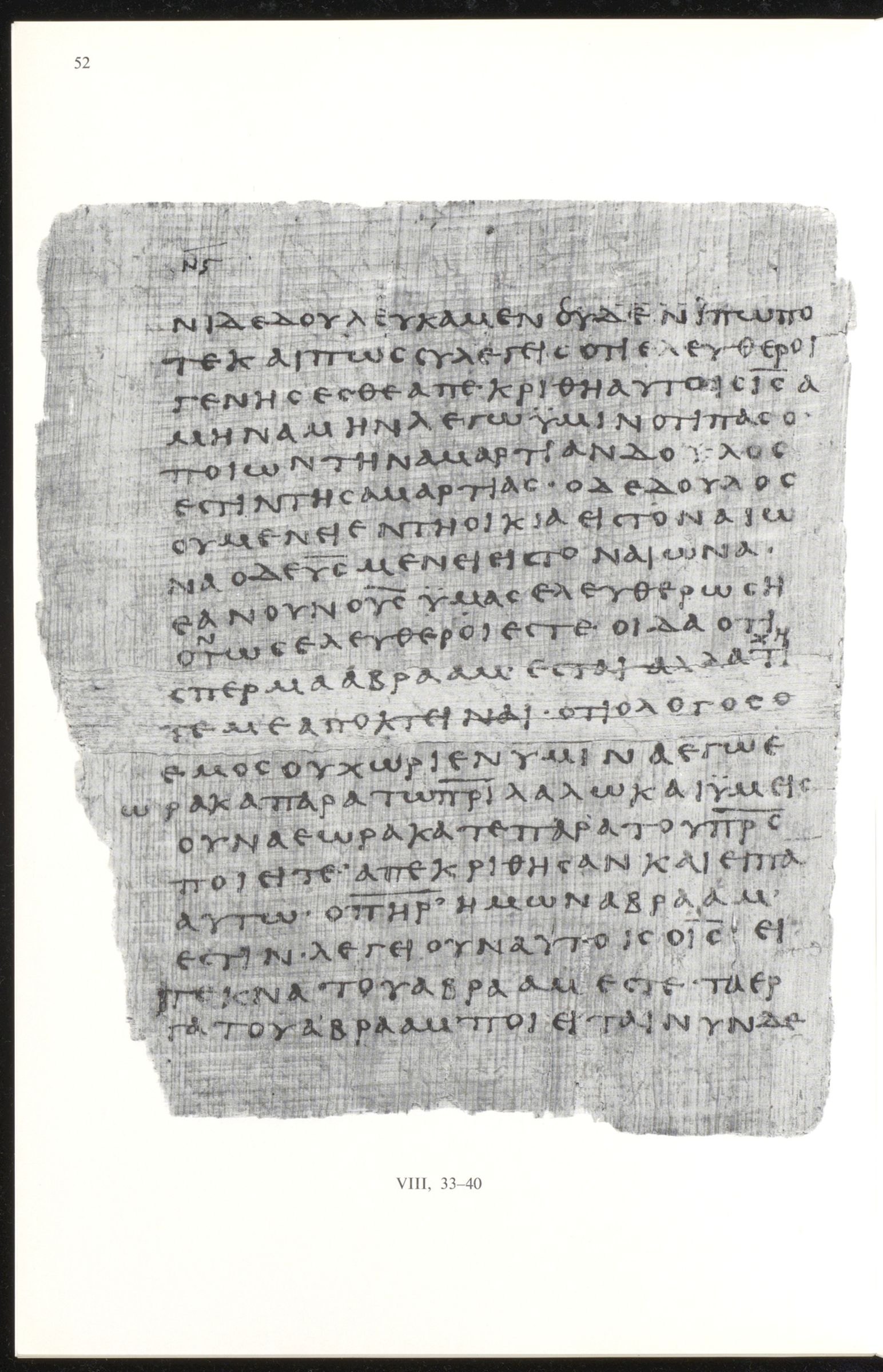
Fondation Martin Bodmer, Papyrus Bodmer II, Bodmer Lab image 1072205287_060 (https://bodmerlab.unige.ch/fr/constellations/papyri/mirador/1072205287), photographic plate of the 1962 Martin-Barns edition, shown whole. NTVMR page 520 (page 56) is linked to this image in NTVMR's page index. 8:33 begins on the previous page; 8:40 continues on the next page. Checked on the image: the printed caption reads ‹VIII, 33-40›; the last line of writing, ‹γα του αβρααμ ποιειται νυν δε› (line 20 of the transcription), is legible at the foot of the page.
8:33 νι δεδουλευκαμεν ουδενι πωπο
τε και πως συ λεγεις οτι ελευθεροι
γενησεσθε 34 απεκριθη αυτω ι̅ς̅ α
μην αμην λεγω υμιν οτι πας ο
ποιων την αμαρτιαν δουλος
εστιν της αμαρτιας· 35 ο δε δουλος
ου μενει εν τη οικια εις τον αιω
να ο δε υ̅ς̅ μενει εις τον αιωνα.
36 εαν ουν ο υ̅ς̅ υμας ελευθερωση
οτως ελευθεροι εστε 37 οιδα οτι
σπερμα αβρααμ εσται αλλα τι
τε με αποκτειναι· οτι ο λογος ο
εμος ου χωρι εν υμιν 38 α εγω ε
ρακα παρα τω π̅ρ̅ι̅ λαλω και υμεις
ουν α εωρακατε παρα του π̅ρ̅ς̅
ποιειτε· 39 απεκριθησαν και ειπαν
αυτω· ο π̅η̅ρ̅ ημων αβρααμ
εστιν· λεγει ουν αυτοις ο ι̅ς̅ ει
τεκνα του αβρααμ εστε τα ερ
γα του αβρααμ ποιειται 40 νυν δε
8:33¶ They answered him, We be Abraham’s seed, and were never in bondage to any man: how sayest thou, Ye shall be made free? 34Jesus answered them, Verily, verily, I say unto you, Whosoever committeth sin is the servant of sin. 35And the servant abideth not in the house for ever: but the Son abideth ever. 36If the Son therefore shall make you free, ye shall be free indeed. 37I know that ye are Abraham’s seed; but ye seek to kill me, because my word hath no place in you. 38I speak that which I have seen with my Father: and ye do that which ye have seen with your father. 39They answered and said unto him, Abraham is our father. Jesus saith unto them, If ye were Abraham’s children, ye would do the works of Abraham. 40But now ye seek to kill me, a man that hath told you the truth, which I have heard of God: this did not Abraham.
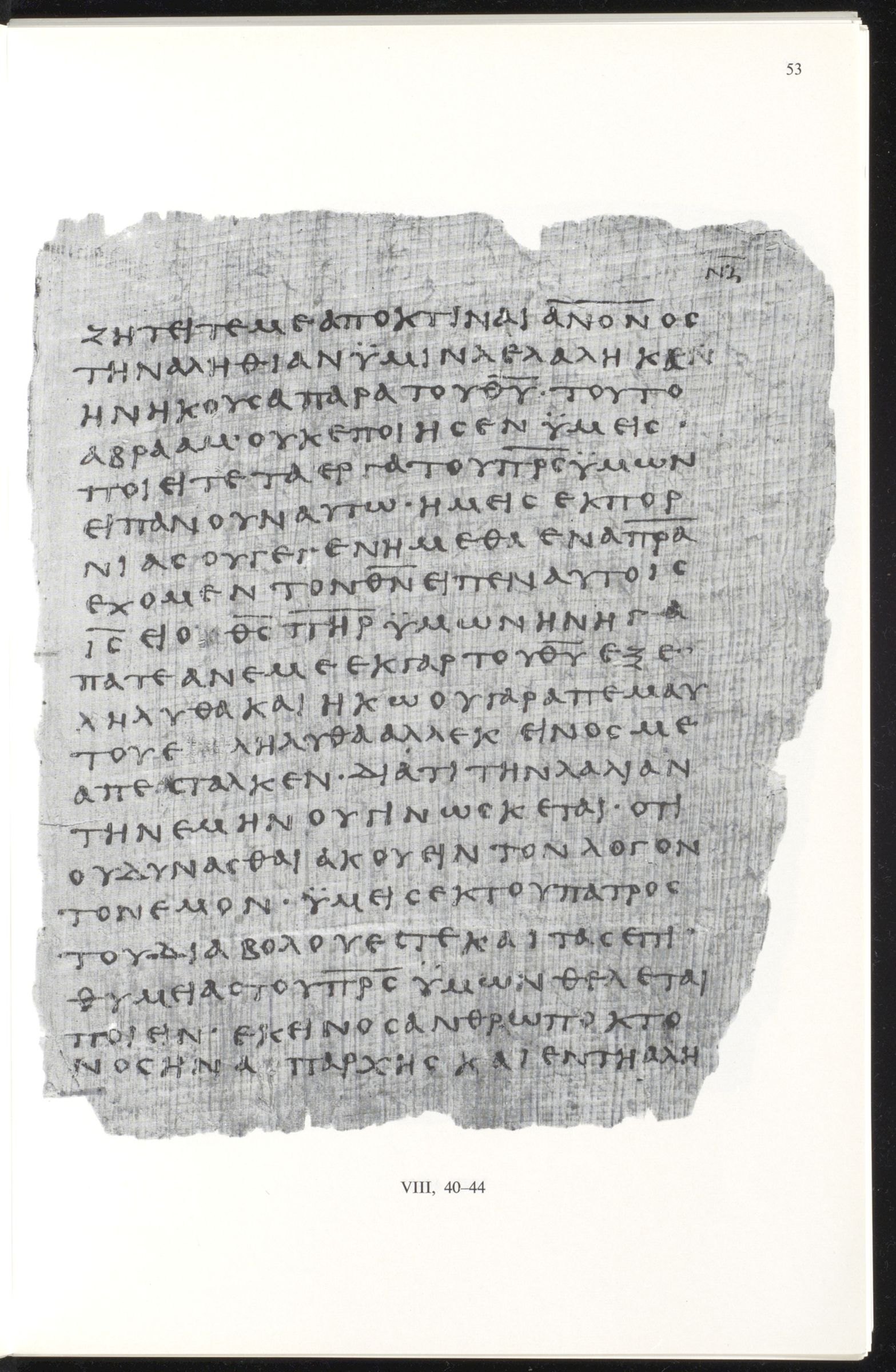
Where on the image
Fondation Martin Bodmer, Papyrus Bodmer II, Bodmer Lab image 1072205287_061 (https://bodmerlab.unige.ch/fr/constellations/papyri/mirador/1072205287), photographic plate of the 1962 Martin-Barns edition, shown whole. NTVMR page 530 (page 57) is linked to this image in NTVMR's page index. 8:40 begins on the previous page; 8:44 continues on the next page. Checked on the image: the printed caption reads ‹VIII, 40-44›; the last line of writing, ‹νος ην απ αρχης και εν τη αλη› (line 20 of the transcription), is legible at the foot of the page.
8:40 ζητειτε με αποκτιναι α̅ν̅ο̅ν̅ ος
την αληθιαν υμιν λελαληκεν
ην ηκουσα παρα του θ̅υ̅· τουτο
αβρααμ ουκ εποιησεν 41 υμεις
ποιειτε τα εργα του π̅ρ̅ς̅ υμων
ειπαν ουν αυτω· ημεις εκ πορ
νιας ου γεγενημεθα ενα π̅ρ̅α̅
εχομεν τον θ̅ν̅ 42 ειπεν αυτοις
ι̅ς̅ ει ο χ θ̅ς̅ π̅η̅ρ̅ υμων ην ηγα
πατε αν εμε εκ γαρ του θ̅υ̅ εξε
ληλυθα και ηκω ου γαρ απ εμαυ
του εξ̣ε̣ληλυθα αλλ εκεινος με
απεσταλκεν· 43 δια τι την λαλιαν
την εμην ου γινωσκεται· οτι
ου δυνασθαι ακουειν τον λογον
τον εμον· 44 υμεις εκ του πατρος
του διαβολου εστε και τας επι
θυμειας του π̅ρ̅ς̅ υμων θελεται
ποιειν· εκεινος ανθρωποκτο
νος ην απ αρχης και εν τη αλη
8:40But now ye seek to kill me, a man that hath told you the truth, which I have heard of God: this did not Abraham. 41Ye do the deeds of your father. Then said they to him, We be not born of fornication; we have one Father, even God. 42Jesus said unto them, If God were your Father, ye would love me: for I proceeded forth and came from God; neither came I of myself, but he sent me. 43Why do ye not understand my speech? even because ye cannot hear my word. 44Ye are of your father the devil, and the lusts of your father ye will do. He was a murderer from the beginning, and abode not in the truth, because there is no truth in him. When he speaketh a lie, he speaketh of his own: for he is a liar, and the father of it.
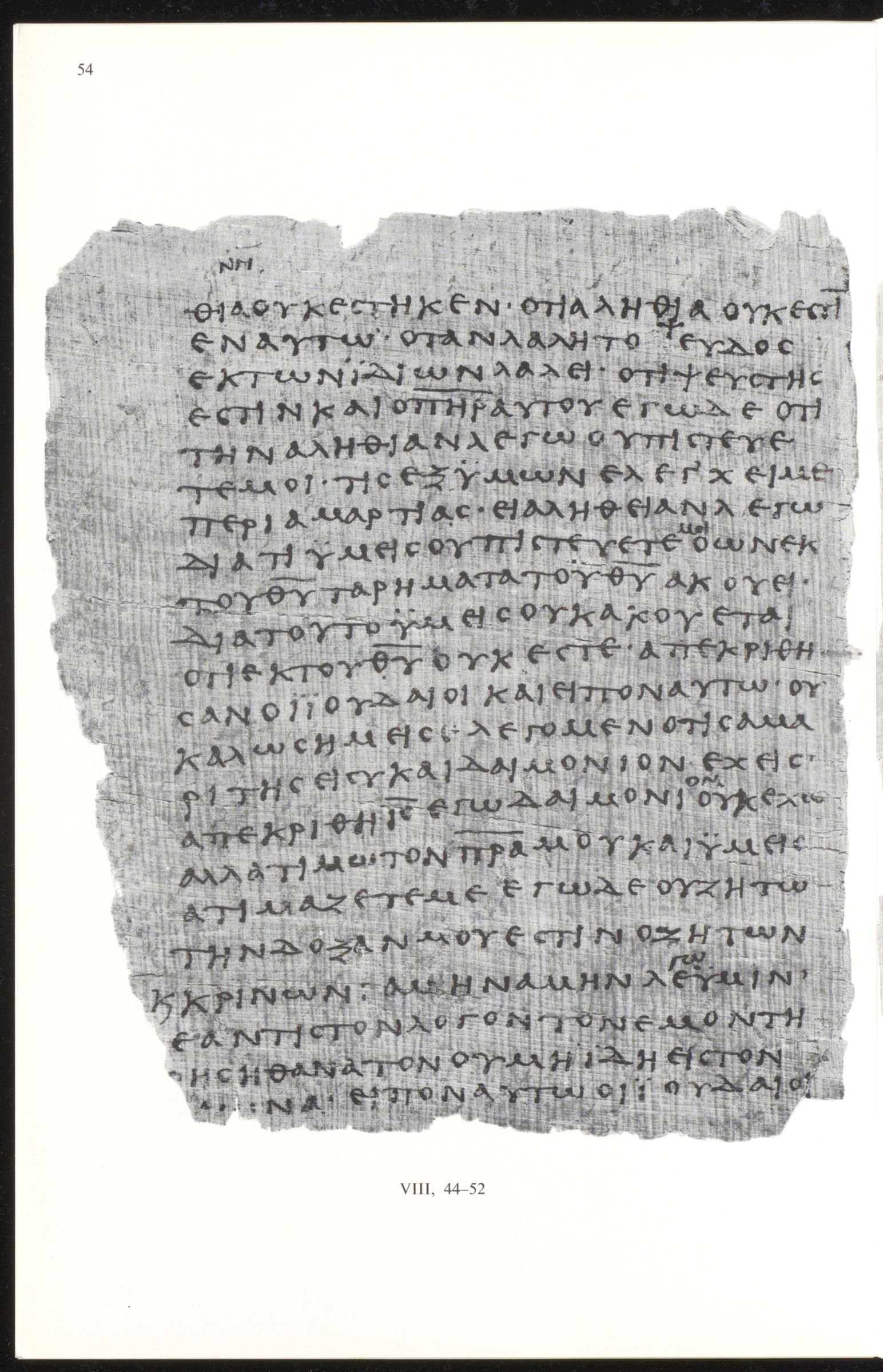
Where on the image
Fondation Martin Bodmer, Papyrus Bodmer II, Bodmer Lab image 1072205287_062 (https://bodmerlab.unige.ch/fr/constellations/papyri/mirador/1072205287), photographic plate of the 1962 Martin-Barns edition, shown whole. NTVMR page 540 (page 58) is linked to this image in NTVMR's page index. 8:44 begins on the previous page; 8:52 continues on the next page. Checked on the image: the printed caption reads ‹VIII, 44-52›; the last line of writing, ‹α̣ι̣ω̣να· ειπον αυτω οι ιουδαιοι› (line 22 of the transcription), is legible at the foot of the page.
8:44 θια ουκ εστηκεν· οτι αληθια ουκ εστιν
εν αυτω· οταν λαλη το δ̣ευδος
εκ των ιδιων λαλει· οτι ψευστης
εστιν και ο π̅η̅ρ̅ αυτου 45 εγω δε οτι
την αληθιαν λεγω ου πιστευε
τε μοι· 46 τις εξ υμων ελεγχει με
περι αμαρτιας· ει αληθειαν λεγω
δια τι υμεις ου πιστευετε 47 ο ων εκ
του θ̅υ̅ τα ρηματα του θ̅υ̅ ακουει·
δια τουτο υμεις ουκ ακουεται
οτι εκ του θ̅υ̅ ουκ εστε· 48 απεκριθη
σαν οι ιουδαιοι και ειπον αυτω· ου
καλως ημεις ελεγομεν οτι σαμα
ριτης ει συ και δαιμονιον εχεις
49 απεκριθη ι̅ς̅ εγω δαιμονι ουχ εχω
αλλα τιμω τον π̅ρ̅α̅ μου και υμεις
ατιμαζετε με 50 εγω δε ου ζητω
την δοξαν μου εστιν ο ζητων
κρινων· 51 αμην αμην λε υμιν
εαν τις τον λογον τον εμον τη
ρ̣ηση θανατον ου μη ιδη εις τον
α̣ι̣ω̣να· 52 ειπον αυτω οι ιουδαιοι
8:44Ye are of your father the devil, and the lusts of your father ye will do. He was a murderer from the beginning, and abode not in the truth, because there is no truth in him. When he speaketh a lie, he speaketh of his own: for he is a liar, and the father of it. 45And because I tell you the truth, ye believe me not. 46Which of you convinceth me of sin? And if I say the truth, why do ye not believe me? 47He that is of God heareth God’s words: ye therefore hear them not, because ye are not of God. 48Then answered the Jews, and said unto him, Say we not well that thou art a Samaritan, and hast a devil? 49Jesus answered, I have not a devil; but I honour my Father, and ye do dishonour me. 50And I seek not mine own glory: there is one that seeketh and judgeth. 51Verily, verily, I say unto you, If a man keep my saying, he shall never see death. 52Then said the Jews unto him, Now we know that thou hast a devil. Abraham is dead, and the prophets; and thou sayest, If a man keep my saying, he shall never taste of death.
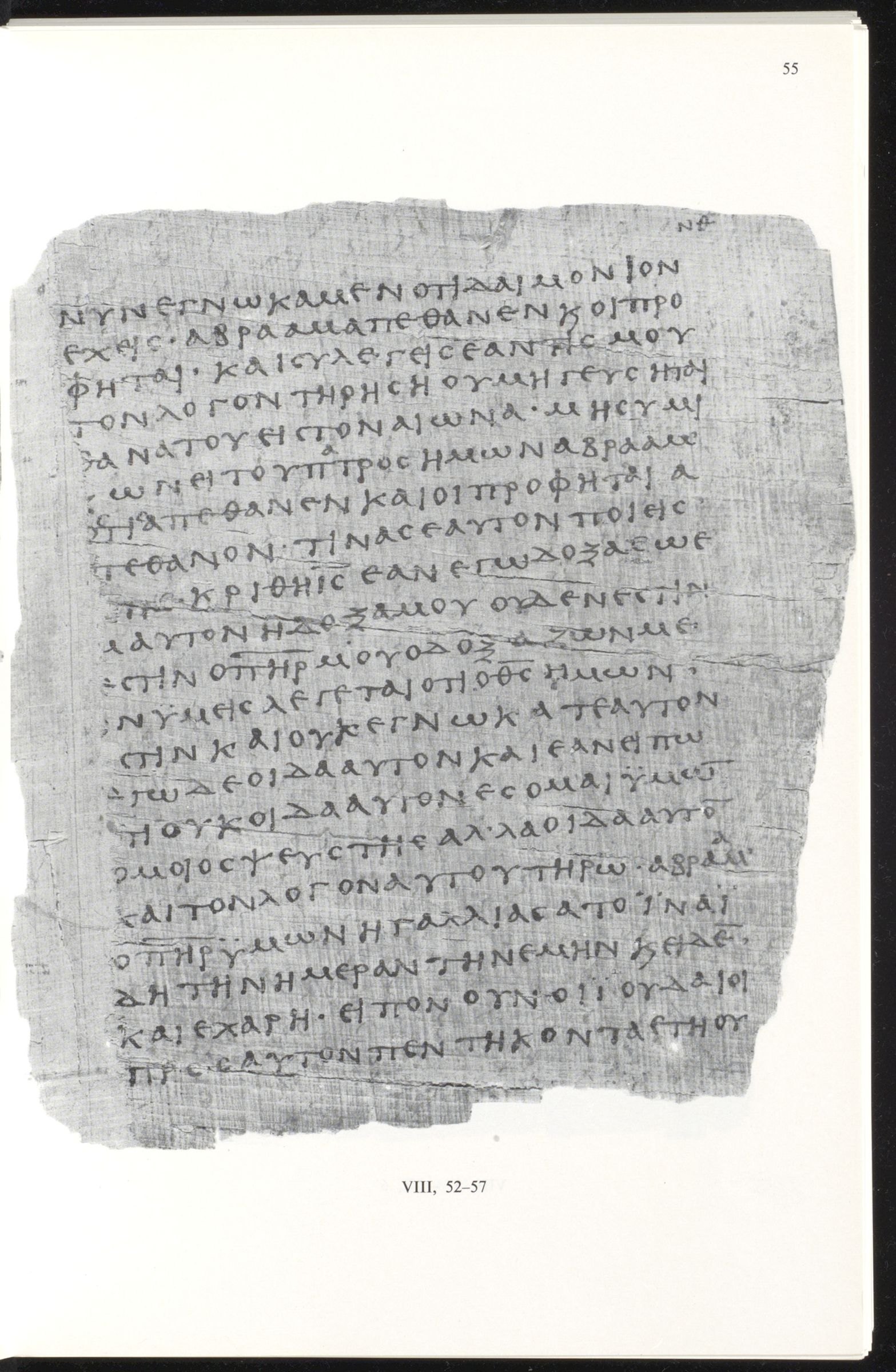
Where on the image
Fondation Martin Bodmer, Papyrus Bodmer II, Bodmer Lab image 1072205287_063 (https://bodmerlab.unige.ch/fr/constellations/papyri/mirador/1072205287), photographic plate of the 1962 Martin-Barns edition, shown whole. NTVMR page 550 (page 59) is linked to this image in NTVMR's page index. 8:52 begins on the previous page; 8:57 continues on the next page. Checked on the image: the printed caption reads ‹VIII, 52-57›; the last line of writing, ‹προς αυτον πεντηκοντα ετη ου› (line 21 of the transcription), is legible at the foot of the page.
8:52 νυν εγνωκαμεν οτι δαιμονιον
εχεις· αβρααμ απεθανεν και οι προ
φηται· και συ λεγεις εαν τις μου
τον λογον τηρηση ου μη γευσηται
θανατου εις τον αιωνα· 53 μη συ μι
ζ̣ων ει του πτρος ημων αβρααμ
οτι απεθανεν και οι προφηται α
πεθανον· τινα σεαυτον ποιεις
54 [α]πεκριθη ι̅ς̅ εαν εγω δοξαζ̣ω ε
μ̣αυτον η δοξα μου ουδεν εστιν
εστιν ο π̅η̅ρ̅ μου ο δοξαζων με
ο̣ν υμεις λεγεται οτι ο θ̅ς̅ υμων
[ε]στιν 55 και ου γ̣εγνωκατε αυτον
ε̣γω δε οιδα αυτον και εαν ειπω
[ο]τι ουκ οιδα αυτον εσομαι υμων
ομοιος ψευστης αλλα οιδα αυτον
και τον λογον αυτου τηρω· 56 αβραμ
ο π̅η̅ρ̅ υμων ηγαλλιασατο ινα ι
δη την ημεραν την εμην και ειδεν
και εχαρη· 57 ειπον ουν οι ιουδαιοι
προς αυτον πεντηκοντα ετη ου
8:52Then said the Jews unto him, Now we know that thou hast a devil. Abraham is dead, and the prophets; and thou sayest, If a man keep my saying, he shall never taste of death. 53Art thou greater than our father Abraham, which is dead? and the prophets are dead: whom makest thou thyself? 54Jesus answered, If I honour myself, my honour is nothing: it is my Father that honoureth me; of whom ye say, that he is your God: 55Yet ye have not known him; but I know him: and if I should say, I know him not, I shall be a liar like unto you: but I know him, and keep his saying. 56Your father Abraham rejoiced to see my day: and he saw it, and was glad. 57Then said the Jews unto him, Thou art not yet fifty years old, and hast thou seen Abraham?
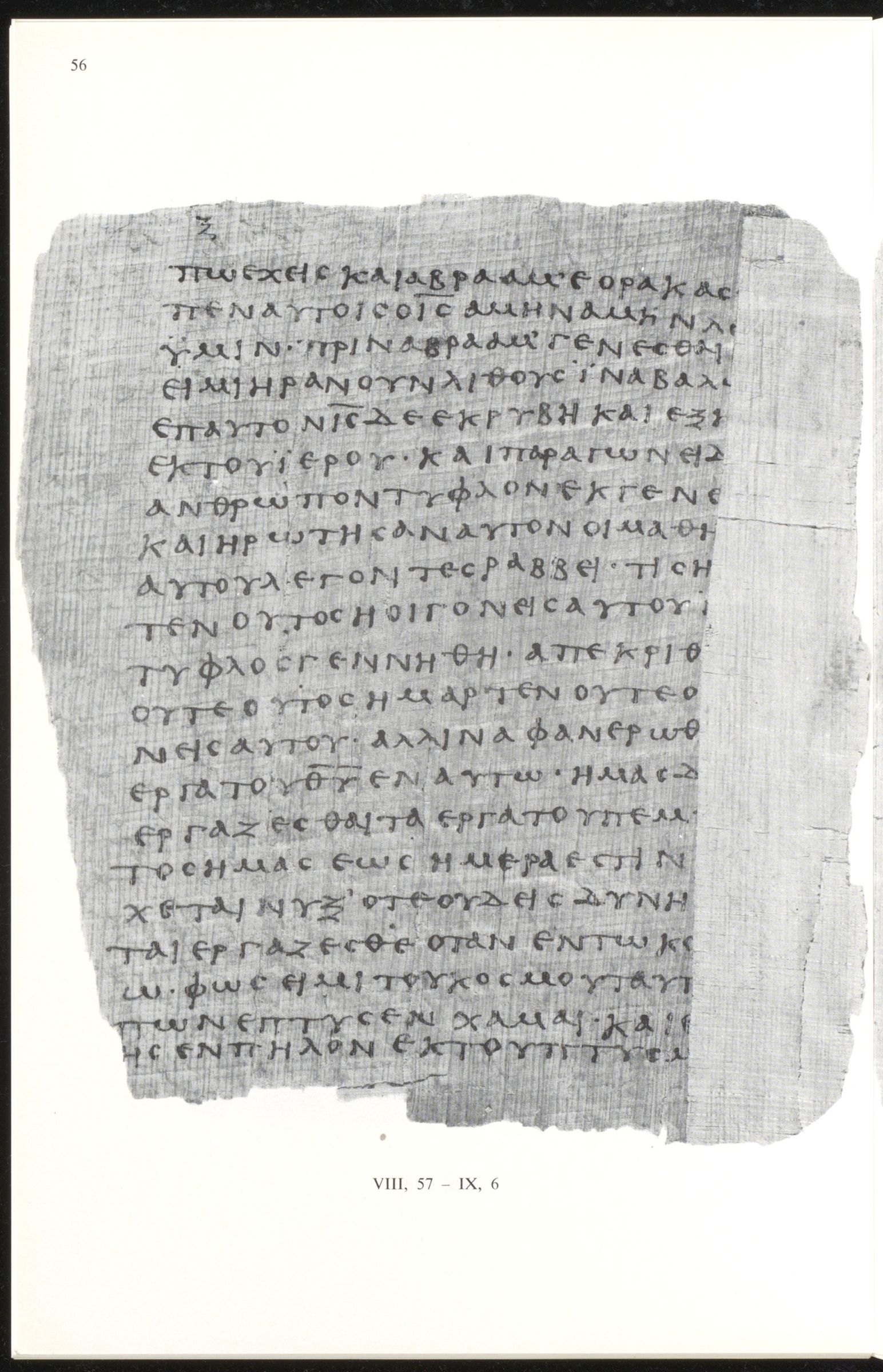
Where on the image
Fondation Martin Bodmer, Papyrus Bodmer II, Bodmer Lab image 1072205287_064 (https://bodmerlab.unige.ch/fr/constellations/papyri/mirador/1072205287), photographic plate of the 1962 Martin-Barns edition, shown whole. NTVMR page 560 (page 60) is linked to this image in NTVMR's page index. 8:57 begins on the previous page; 9:6 continues on the next page. Checked on the image: the printed caption reads ‹VIII, 57 - IX, 6›; the last line of writing, ‹ησεν πηλον εκ του πτυσμ̣› (line 21 of the transcription), is legible at the foot of the page.
8:57 πω εχεις και αβρααμ εορακας 58 [ει]
πεν αυτοις ο ι̅ς̅ αμην αμην λε̣[γω]
υμιν· πριν αβρααμ γενεσθαι [εγω]
ειμι 59 ηραν ουν λιθους ινα βαλω̣[σιν]
επ αυτον ι̅ς̅ δε εκρυβη και εξη̣[λθεν]
εκ του ιερου· 9:1 και παραγων ειδ[εν]
ανθρωπον τυφλον εκ γενε[της]
2 και ηρωτησαν αυτον οι μαθη[ται]
αυτου λεγοντες ραββει· τις η[μαρ]
τεν ουτος η οι γονεις αυτου ι[να]
τυφλος γεννηθη· 3 απεκριθ[η ι̅ς̅]
ουτε ουτος ημαρτεν ουτε ο[ι γο]
νεις αυτου· αλλ ινα φανερωθ[η τα]
εργα του θ̅υ̅ εν αυτω· 4 ημας δ[ει]
εργαζεσθαι τα εργα του πεμψ̣[αν]
τος ημας εως ημερα εστιν [ερ]
χεται νυξ οτε ουδεις δυνη[σε]
ται εργαζεσθε 5 οταν εν τω κο[σμω]
ω φως ειμι του κοσμου 6 ταυτ[α ει]
πων επτυσεν χαμαι· και ε̣[ποι]
ησεν πηλον εκ του πτυσμ̣[ατος]
8:57Then said the Jews unto him, Thou art not yet fifty years old, and hast thou seen Abraham? 58Jesus said unto them, Verily, verily, I say unto you, Before Abraham was, I am. 59Then took they up stones to cast at him: but Jesus hid himself, and went out of the temple, going through the midst of them, and so passed by. 9:1And as Jesus passed by, he saw a man which was blind from his birth. 2And his disciples asked him, saying, Master, who did sin, this man, or his parents, that he was born blind? 3Jesus answered, Neither hath this man sinned, nor his parents: but that the works of God should be made manifest in him. 4I must work the works of him that sent me, while it is day: the night cometh, when no man can work. 5As long as I am in the world, I am the light of the world. 6When he had thus spoken, he spat on the ground, and made clay of the spittle, and he anointed the eyes of the blind man with the clay,
Notes
- Greek: the NTVMR diplomatic transcription, line by line as on the papyrus. Square brackets enclose letters that are lost or illegible and were supplied by the transcribers; a dot under a letter marks it as uncertain; [...] marks a gap. Nomina sacra and numerals keep the scribe's overline. Spelling is the scribe's (no accents or breathings). Words broken at a line end stay broken as on the papyrus. Corrections are not shown: the text is the first hand.
- English: the King James Version (1611), whole verses, for every verse that has text on the page. A verse that begins on one page and ends on the next is given in full on both. The KJV translates a later form of the Greek text, so its wording does not always match the papyrus; material differences (such as verses the papyrus does not have) are noted in the section.
Cite
Sources
- Source: Papyrus Bodmer II (P66), Fondation Martin Bodmer: images from the Bodmer Lab, University of Geneva; Greek from the INTF NTVMR transcription of P66; English from the King James Version (holding institution)
- Critical edition: INTF NTVMR diplomatic transcription (CC BY 4.0)
← previous · → next · v cycle view · l back to library