P75 (Papyrus Hanna 1): John 11:2-57 (fols. 59r-60v)
Introduction
P75 is a papyrus codex of Luke and John copied in Egypt around 175-225, the oldest known copy of Luke and one of the oldest of John. It was bought by Martin Bodmer in the 1950s and published as Papyrus Bodmer XIV-XV; in 2006 it was given to the Vatican Library, where it is kept as Papyrus Hanna 1 (Mater Verbi). Its text is very close to that of Codex Vaticanus, written some 150 years later. Where Luke ends and John begins (folio 44r) both titles stand on the same page.
About 51 leaves survive, many damaged at the top and edges, especially in Luke 3-7. Lost: Luke 1:1-3:17, most of 3:23-4:33, 5:11-36, 6:5-10, 7:33-34 and 7:44-45 (and parts of 7:36-49), 17:16-19, 18:19-22:3; John 11:46-47, 12:1-2, 13:11-14:7 and everything after 15:10 except small fragments. Each section below is one page: the photograph, the NTVMR diplomatic transcription line by line, and the King James Version of every verse on the page. Where P75 lacks a verse or words that the KJV has (for example John 5:4 or the account of the adulteress, John 7:53-8:11), the section says so. Six damaged pages (folios 7v, 11r, 39v, 58r, 58v and 64v) are left out because their text could not be matched to the photographs with certainty.
This entry covers fols. 59r-60v (John 11:2-57), shown on the Vatican Library's photographs (frames 2B.11r to 2B.12v).
How was this verified? (Provenance)
Where on the image
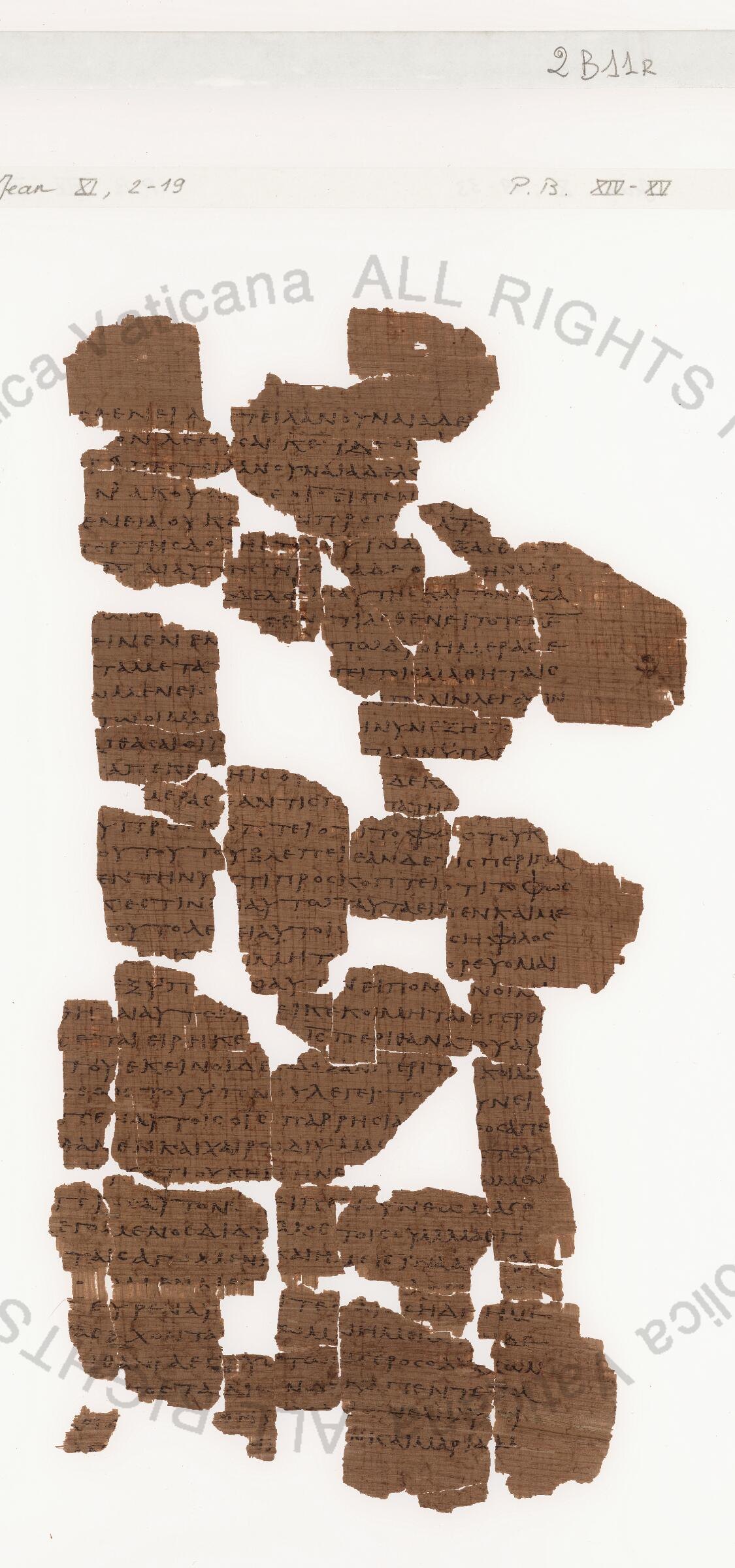
Vatican Library, Pap. Hanna 1 (Mater Verbi), DigiVatLib image 93, frame 2B.11r (https://digi.vatlib.it/view/MSS_Pap.Hanna.1(Mater.Verbi)/0093), cropped to the frame. NTVMR page 930 (folio 59r). 11:2 begins on the previous page; 11:19 continues on the next page. Checked on the image: near the top απεστειλαν ουν αι αδελ[φαι] (11:3), matching the transcription of this page.
11:2 [η]σθενει· 3 α[πε]στειλαν ουν αι αδελ̣[φαι προς]
[αυτ]ον λεγου̣σαι· κ̅ε̅· ιδε ον̣ φ̣[ιλεις ασθε]
[νε]ι· απεστειλαν ουν αι αδελφ̣[αι προς αυ]
[το]ν 4 ακουσα[ς] δ̣ε ο ι̅ς̅ ειπεν [αυτη η ασ]
[θ]ενεια ουκ ε[στι]ν προς θ̣[αν]ατο̣[ν αλλ]
[υ]π̣ερ της δοξ̣ης του θ̣̣̅υ̅ ινα δ̣[ο]ξασθη̣ ο̣ υ̅ς̅
[του] θ̣̣̅υ̅ δι αυτης· 5 ηγαπ̣α δε ο [ι̅ς̅] τ̣ην μαρ
[θαν και της] α̣δελφης αυτης και τον λα̣ζα
[ρο]ν̣ 6 ω̣ς̣ ο̣[υν ηκο]υ̣σεν ο̣τι ασθενει τοτε μεν
[εμ]εινεν εν [ω ην το]πω δυο ημερας 7 ε
[πει]τα μετα τ̣[ουτο λε]γει τοις μαθηταις
[αγ]ω̣μεν εις τ̣[ην ιουδαι]α̣ν̣ παλιν 8 λεγου[σ]ιν
[αυ]τω οι μαθ[ηται ραββ]ε̣ι νυν εζητο[υν]
[σε] λ̣ιθασαι οι ι[ουδαιοι και] παλιν υπαγ̣[εις]
[εκε]ι̣· 9 απεκριθ̣η ι̅ς̅ ου̣[χι δω]δεκα̣ [ωραι εισιν]
[της η]μ̣ερας εαν τις πε̣[ρι]π̣ατη ε[ν τη ημε]
[ρα ο]υ προσκοπτει οτ̣ι το φω̣ς του κ[ο]
[σμ]ου τουτου βλεπει 10 εαν δε τις περιπα
[τη] εν τη νυκ̣τι προσκοπτει οτι το φως
[ου]κ εστιν ε̣ν̣ αυτω 11 ταυτα ειπεν και με
[τα] τ̣ουτο λε[γ]ει αυτοις [λαζαρο]ς η φιλος
[ημ]ω̣ν̣ κ[εκο]ιμητα̣[ι αλλα π]ορευομαι
[ινα] εξυπ[νισ]ω̣ αυτ[ο]ν̣ 12 ειπον ο̣υ̣ν οι μα̣
θητ̣αι αυτω κ̣̣̅[ε̅] ει κεκοιμηται εγερθη̣
σεται 13 ειρηκε[ι δε ο] ι̅ς̅ περι θανατου αυ
του εκεινοι δε ε̣δοξαν περι τη̣ς̣ κοιμη̣
σεως του υπνου λεγει· 14 τοτ̣[ε ο]υν ει
πεν̣ αυτοις ο ι̅ς̅ παρρησια [λαζα]ρ̣ος απε
θανεν 15 και χαιρω δι υμας [ινα πι]στευ
[σ]η̣τ̣ε̣ οτι ουκ ημην ε[κει αλλα αγ]ωμεν
πρ̣ος αυτον· 16 ειπεν ουν θωμας ο
λ̣εγομενος διδυμος τοις συμμαθη
ταις αγωμεν και ημεις ινα απ̣ο̣θα
[ν]ω̣μ̣εν με̣τ̣ α̣υ̣[του] 17 ε̣λθ̣ω[ν ο]υ̣ν̣ ο̣
[ι̅]ς̣̣̅ ευρεν αυ[το]ν̣ τεσ̣σ̣αρ̣α̣ς ηδη̣ ημε
ρ̣ας εχοντα [εν] τ̣ω μνημειω̣ 18 η̣ν̣ δε
[β]η̣θανια εγγυς των ιεροσολυ̣μ̣ων
[ως α]π̣ο σταδιων δε̣καπεντε 19 πολ
λ̣οι δ̣[ε εκ τ]ω̣ν ι̣[ο]υ̣δ̣[α]ι̣ω̣ν εληλυ[θ]ει
[σ]α̣ν̣ [προς τη]ν̣ μ̣[αρθα]ν και μαριαμ
11:2(It was that Mary which anointed the Lord with ointment, and wiped his feet with her hair, whose brother Lazarus was sick.) 3Therefore his sisters sent unto him, saying, Lord, behold, he whom thou lovest is sick. 4When Jesus heard that, he said, This sickness is not unto death, but for the glory of God, that the Son of God might be glorified thereby. 5Now Jesus loved Martha, and her sister, and Lazarus. 6When he had heard therefore that he was sick, he abode two days still in the same place where he was. 7Then after that saith he to his disciples, Let us go into Judæa again. 8His disciples say unto him, Master, the Jews of late sought to stone thee; and goest thou thither again? 9Jesus answered, Are there not twelve hours in the day? If any man walk in the day, he stumbleth not, because he seeth the light of this world. 10But if a man walk in the night, he stumbleth, because there is no light in him. 11These things said he: and after that he saith unto them, Our friend Lazarus sleepeth; but I go, that I may awake him out of sleep. 12Then said his disciples, Lord, if he sleep, he shall do well. 13Howbeit Jesus spake of his death: but they thought that he had spoken of taking of rest in sleep. 14Then said Jesus unto them plainly, Lazarus is dead. 15And I am glad for your sakes that I was not there, to the intent ye may believe; nevertheless let us go unto him. 16Then said Thomas, which is called Didymus, unto his fellowdisciples, Let us also go, that we may die with him. 17Then when Jesus came, he found that he had lain in the grave four days already. 18Now Bethany was nigh unto Jerusalem, about fifteen furlongs off: 19And many of the Jews came to Martha and Mary, to comfort them concerning their brother.
Where on the image
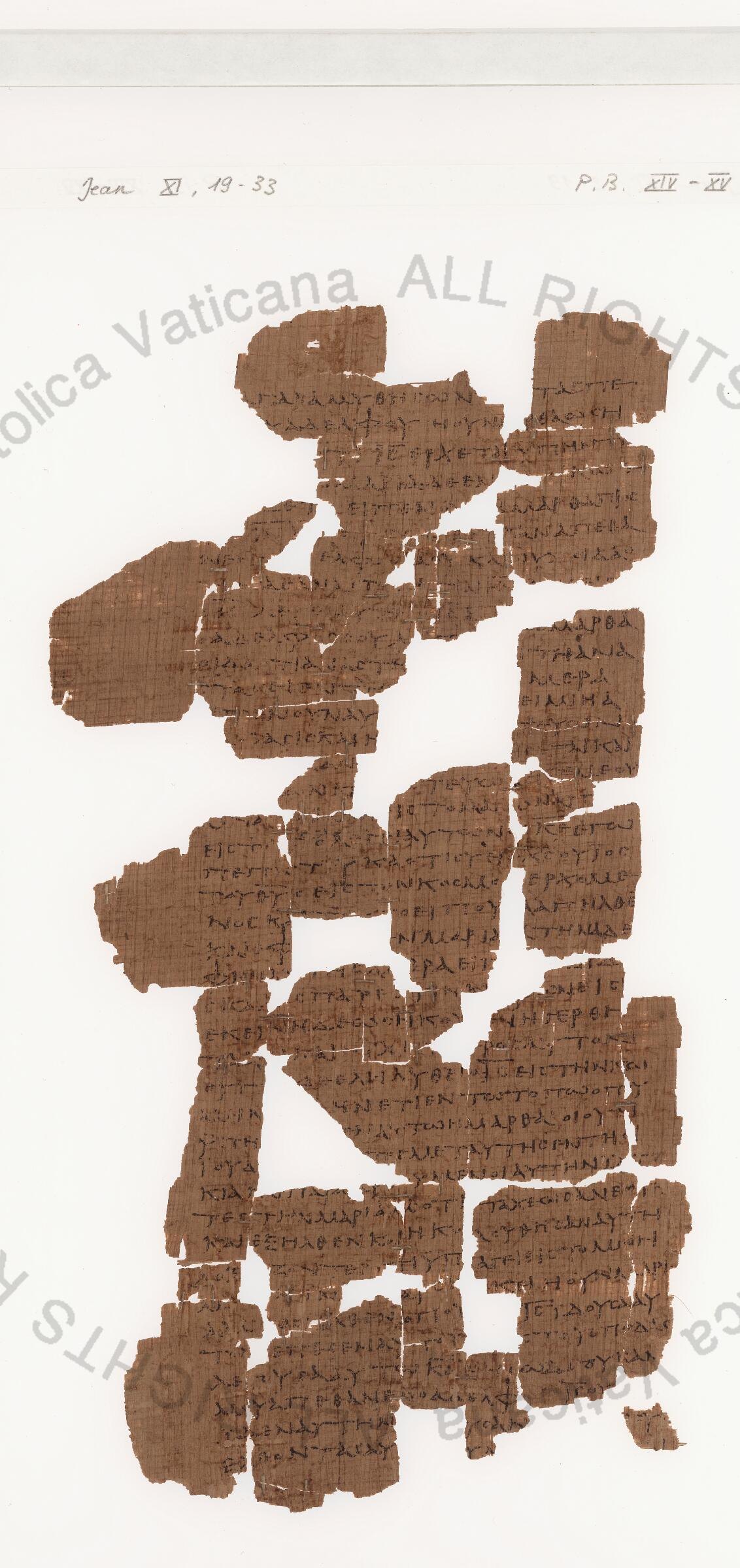
Vatican Library, Pap. Hanna 1 (Mater Verbi), DigiVatLib image 94, frame 2B.11v (https://digi.vatlib.it/view/MSS_Pap.Hanna.1(Mater.Verbi)/0094), cropped to the frame. NTVMR page 940 (folio 59v). 11:19 begins on the previous page; 11:33 continues on the next page. Checked on the image: in the upper part ερχεται (11:20) and ο αδελφος (11:21-23), matching the transcription of this page.
11:19 [ιν]α̣ παραμυθησων[ται αυ]τας πε
[ρι το]υ̣ αδελφου· 20 η ουν μ̣[α]ρ̣θα ως η
[κουσεν] ο̣τι ι̅ς̅ ερχεται υπηντη̣
[σεν αυτ]ω̣ μαρια δε εν [τω] ο̣ικω ε
[καθε]ζ̣ε̣τ̣[ο] 21 ειπεν ου̣[ν] η̣ μαρθα προς
[τον] ι̣̣̅ν̣̣̅ κ̣̣̅[ε̅] ε̣ι̣ η̣ς̣ ω̣δ̣ε ο̣υ̣κ̣ αν απεθα
νεν̣ ο̣ [αδ]ελφο̣ς̣ μ̣ο̣υ 22 και ν̣υν̣ οιδα ο
τ̣ι ο̣σα εαν α̣ιτη̣[σ]η̣ το̣ν θ̣̣̅ν̣̣̅ δ̣[ω]σ̣ε̣ι̣ σ̣[οι]
ο̣ θ̣̣̅ς̣̣̅ 23 λεγει̣ α̣υτη ο ι̅ς̅ αν̣[αστησεται]
ο αδελφο̣ς σου 24 λ[ε]γ̣ε̣[ι αυτ]ω̣ μαρθα
οιδα [ο]τι αναστη[σεται ε]ν̣ τη ανα
στασ̣ει εν τη̣ [εσχατη η]μερα·
25 [ε]ι̣πεν ουν αυ[τη ο ι̅ς̅ εγω] ειμι η α
[ν]α̣σ̣τασις και η [ζωη ο πισ]τευων
[εις εμε] κ̣αν [αποθανη ζ]η̣σεται 26 και
[πας ο ζ]ων κα̣[ι πι]στευων̣ ε̣ι̣ς εμε ου
μ̣η̣ α[π]ο̣θ̣α̣ν̣η̣ ε̣ις τον αιω̣να π[ιστευ]
εις του̣το 27 λεγει αυτω να̣ι̣ κ̅ε̅ εγω
πεπιστε̣υκα οτι συ ει ο χ̅ς̅ ο υιος
του θ̅υ̅ ο εις τον κοσμο[ν] ερχομε
νος 28 και̣ τ̣ο̣υ̣τ̣ο ειπου[σ]α̣ απηλθεν
και εφ[ωνησ]ε̣ν· μαριαμ̣ την αδε[λ]
φην α̣υ̣τ̣η̣ς λα̣θ̣ρα ειπ̣[ουσα ο] δ̣ιδ[α]
σκαλ̣[ο]ς παρεσ̣τιν κ̣α̣[ι] φ̣ω̣νει σε̣
29 εκεινη δε ως ηκου̣[σ]ε̣ν ηγερθη̣
ταχυ̣ και η̣ρχετ̣[ο] π̣ρος αυτον
30 ουπ[ω] δε εληλυθει ο ι̅ς̅ εις την κω
μην̣ [αλ]λ̣ ην ετι εν τω τοπω οπο̣υ
υπη[ντησ]εν αυτω η μαρθα· 31 οι ουν
ιουδ[αιοι οι ον]τες μετ αυτης εν τη ο̣ι
κια κ̣α̣ι̣ παρ̣αμ̣υ̣[θο]υμενοι αυτην ιδ̣ο̣ν
τες την μαριαμ· οτι ταχεως ανεσ̣τ̣η̣
και εξηλθεν και ηκολ̣ουθησαν αυτη
δοξ[α]ζοντες̣ ο̣τι υπαγει εις το μνη
με̣[ιο]ν ιν[α κλ]αυ̣ση̣ ε̣κει 32 η ουν μαρι
αμ· ω̣ς η̣λθεν οπου̣ [ην] ι̅ς̅ ιδουσα αυ
τον̣ επεσεν αυτου [προ]ς τους ποδας
λεγ̣ουσα αυτω κ̅ε̅ ει ης̣ ωδε̣ ουκ αν
μου απεθανεν̣ ο αδελφ[ο]ς̣ 33 ι̅ς̅ ου[ν ως]
ιδεν αυτην [κλαιο]υσαν [και του]ς̣ συ[ν]
ελ̣θοντας αυ[τη ιο]υδ̣[αιους κλ]α̣ι̣[ον]
11:19And many of the Jews came to Martha and Mary, to comfort them concerning their brother. 20Then Martha, as soon as she heard that Jesus was coming, went and met him: but Mary sat still in the house. 21Then said Martha unto Jesus, Lord, if thou hadst been here, my brother had not died. 22But I know, that even now, whatsoever thou wilt ask of God, God will give it thee. 23Jesus saith unto her, Thy brother shall rise again. 24Martha saith unto him, I know that he shall rise again in the resurrection at the last day. 25Jesus said unto her, I am the resurrection, and the life: he that believeth in me, though he were dead, yet shall he live: 26And whosoever liveth and believeth in me shall never die. Believest thou this? 27She saith unto him, Yea, Lord: I believe that thou art the Christ, the Son of God, which should come into the world. 28And when she had so said, she went her way, and called Mary her sister secretly, saying, The Master is come, and calleth for thee. 29As soon as she heard that, she arose quickly, and came unto him. 30Now Jesus was not yet come into the town, but was in that place where Martha met him. 31The Jews then which were with her in the house, and comforted her, when they saw Mary, that she rose up hastily and went out, followed her, saying, She goeth unto the grave to weep there. 32Then when Mary was come where Jesus was, and saw him, she fell down at his feet, saying unto him, Lord, if thou hadst been here, my brother had not died. 33When Jesus therefore saw her weeping, and the Jews also weeping which came with her, he groaned in the spirit, and was troubled,
Where on the image
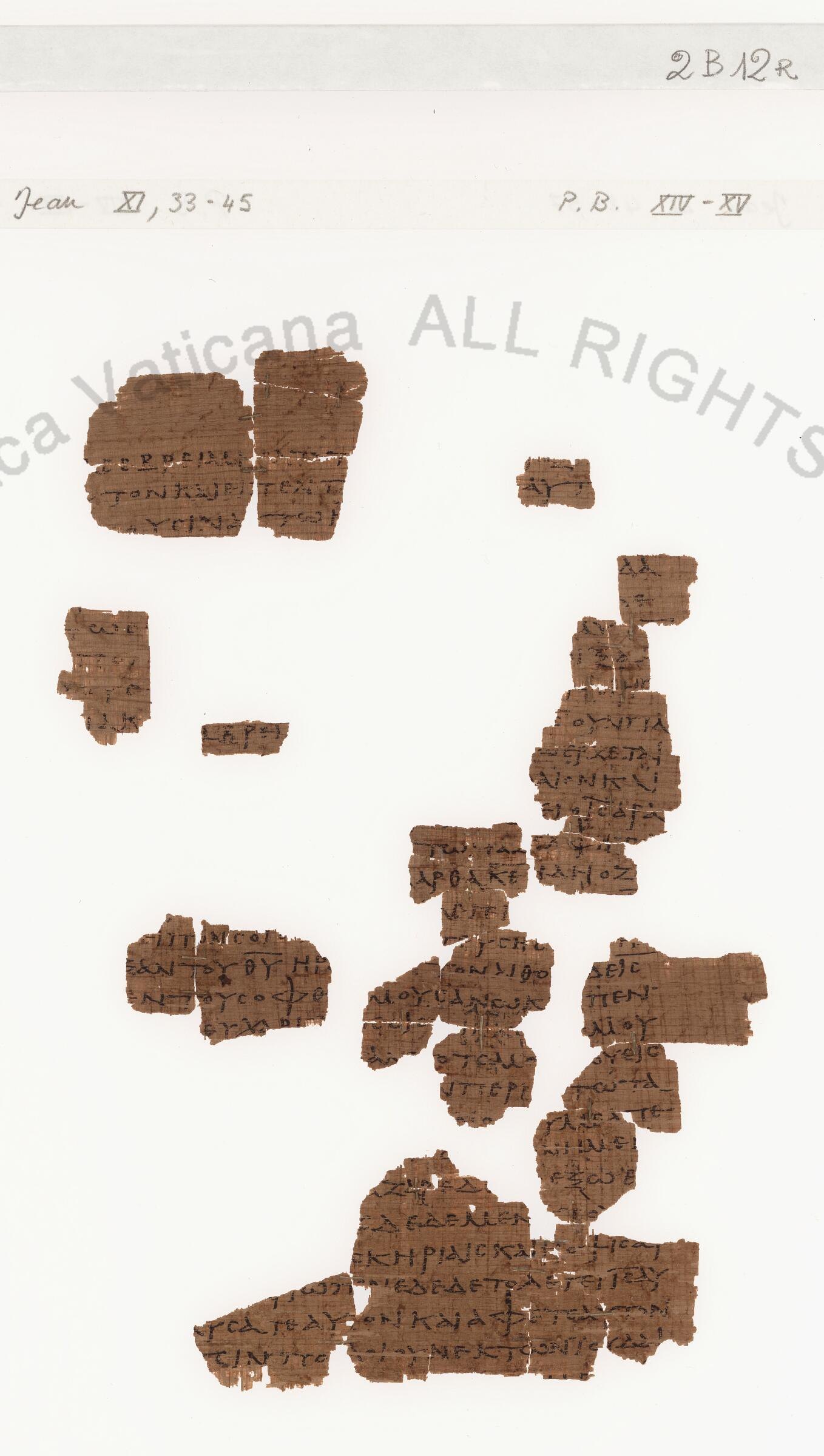
Vatican Library, Pap. Hanna 1 (Mater Verbi), DigiVatLib image 95, frame 2B.12r (https://digi.vatlib.it/view/MSS_Pap.Hanna.1(Mater.Verbi)/0095), cropped to the frame. NTVMR page 950 (folio 60r). 11:33 begins on the previous page; 11:45 continues on the next page. Checked on the image: near the top ηδη οζει (11:39), matching the transcription of this page.
11:33 [τ]α̣ς εβρειμη̣σατο̣ τ[ω π̅ν̅ι̅ και ετα]ρ̣α̣ξ̣[εν ε]
[α]υ̣τον 34 και ειπεν π̣[ου τεθεικατε] αυτ[ον]
[λεγ]ουσιν α[υ]τω κ̣̣̅[ε̅ ερχου και ιδε] 35 [ε]δα
[κ]ρ̣[υσεν ο ι̅ς̅] 36 [ελεγον ουν οι ιουδαιοι ι]δ̣ε
π̣ως ε̣[φιλει αυτον] 37 [τινες δε εξ] αυτ̣[ω]ν
[ει]πον̣ [ουκ εδυνατο ουτος ο αν]ο̣ιξας̣
τ̣ους ο̣[φθαλμους του τυφλου] π̣οιησ[αι]
[ι]ν̣α κ[αι ουτος μη αποθανη] 38 [ι̅]ς̣̣̅ ουν πα
[λιν ε]μ̣βρει[μωμενος εν εαυτ]ω ερχεται
[εις το μνημειον ην δε σπη]λ̣αιον και
[λιθος επεκειτο επ αυτω] 39 [λ]ε̣[γ]ει ο ι̅ς̅ αρα
[τε τον λιθον λεγει αυ]τω η αδ̣ελφη τ̣ο̣υ̣
[τετελευτηκοτος] μ̣αρθα κ̅ε̅ η̣δη οζ[ει]
[τετα]ρ̣[ταιος γαρ εστιν] 40 λ̣εγει [αυτη ο] ι̣̣̅ς̣̣̅
[ουκ] ε̣ιπον σοι ο̣[τι εαν πισ]τ̣ευσης̣ [οψη τ]η̣[ν]
[δο]ξαν του θ̅υ̅ 41 ηρα̣[ν ου]ν̣ τον λιθο[ν ο] δε ι̅ς̅
[ηρ]ε̣ν τους οφθ[αλ]μους ανω κ[αι ει]πεν·
[πατερ] ευχαρ̣ι̣σ̣τ̣ω̣ σοι ο[τ]ι ηκο̣υ̣[σα]ς̣ μου
42 [εγω δε ηδειν οτι π]αντ̣οτε μο̣υ ακουεις
[αλλα δια τον οχλον το]ν̣ περιεστωτα
[ειπον ινα πιστευσωσι]ν̣ ο̣[τι σ]υ με α̣π̣ε
[στειλας] 43 [και ταυτα ει]π̣ω̣[ν φω]νη μεγ̣α̣
[λη εκραυγασεν λ]α̣ζαρε δε̣[υρο] εξω· 44 ε[ξ]
[ηλθεν ο τεθνηκω]ς δεδεμεν[ο]ς̣ του̣[ς πο]
[δας και τας χειρα]ς κηριαις και η οψις αυ̣
[του σουδα]ρ̣ι̣ω πε̣ρ̣ι̣εδεδετο λεγει ι̅ς̅ αυ
[τοις] λ̣υσατε αυτ̣ον και αφετε αυτον
[υπα]γ̣ειν 45 πο[λ]λ̣οι ουν εκ των ιου̣δαι
[ων οι ελθοντες προς την] μ̣α̣ρ̣[ιαμ]
11:33When Jesus therefore saw her weeping, and the Jews also weeping which came with her, he groaned in the spirit, and was troubled, 34And said, Where have ye laid him? They said unto him, Lord, come and see. 35Jesus wept. 36Then said the Jews, Behold how he loved him! 37And some of them said, Could not this man, which opened the eyes of the blind, have caused that even this man should not have died? 38Jesus therefore again groaning in himself cometh to the grave. It was a cave, and a stone lay upon it. 39Jesus said, Take ye away the stone. Martha, the sister of him that was dead, saith unto him, Lord, by this time he stinketh: for he hath been dead four days. 40Jesus saith unto her, Said I not unto thee, that, if thou wouldest believe, thou shouldest see the glory of God? 41Then they took away the stone from the place where the dead was laid. And Jesus lifted up his eyes, and said, Father, I thank thee that thou hast heard me. 42And I knew that thou hearest me always: but because of the people which stand by I said it, that they may believe that thou hast sent me. 43And when he thus had spoken, he cried with a loud voice, Lazarus, come forth. 44And he that was dead came forth, bound hand and foot with graveclothes: and his face was bound about with a napkin. Jesus saith unto them, Loose him, and let him go. 45Then many of the Jews which came to Mary, and had seen the things which Jesus did, believed on him.
Where on the image
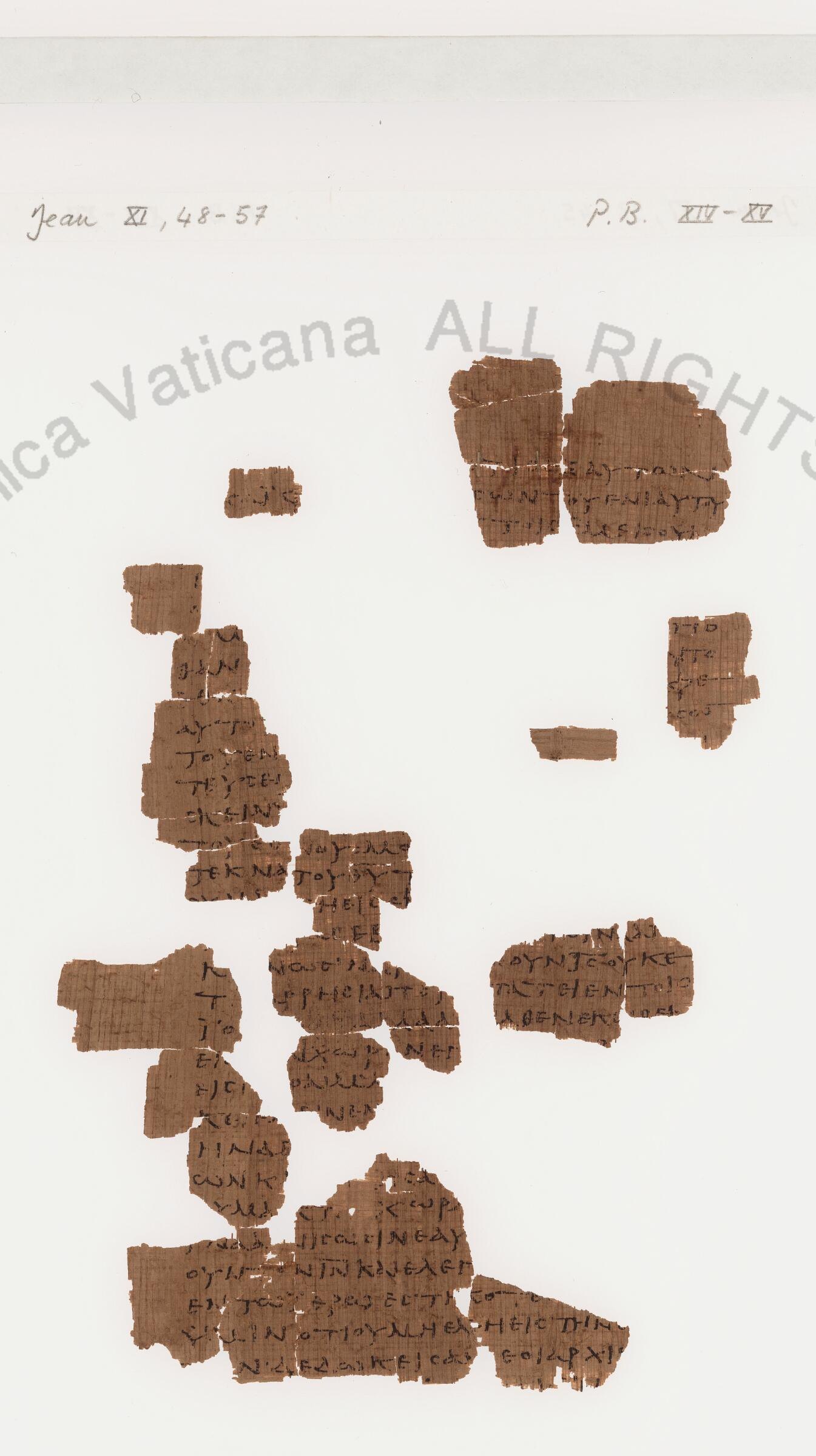
Vatican Library, Pap. Hanna 1 (Mater Verbi), DigiVatLib image 96, frame 2B.12v (https://digi.vatlib.it/view/MSS_Pap.Hanna.1(Mater.Verbi)/0096), cropped to the frame. NTVMR page 960 (folio 60v). 11:48 begins on the previous page; 11:57 continues on the next page. Checked on the image: near the top τα τεκνα του θ̅υ̅ (11:52), lower down ερημου (11:54), matching the transcription of this page.
11:48 [και το εθνος] 49 [εις δ]ε̣ τ̣υ̣ς̣ εξ αυτων
κ̣αιφ[ας αρχιερευ]ς ων του ενιαυτου
ε̣[κεινου ειπεν α]υ̣τοις υ̣μεις ουκ̣
ο[ιδατε ουδεν] 50 [ουδε λογιζεσθε οτι]
σ̣[υ]μ[φερει υμιν ινα εις α̅ν̅ο̅ς̅ α]πο
θαν[η υπερ του λαου και μη ολο]ν το
ε̣θν̣ο̣[ς αποληται] 51 [τουτο δε α]φ ε
αυτου̣ [ουκ ειπεν αλλα αρχιερε]υ̣ς ων
του εν[ιαυτου εκεινου επροφ]η̣
τευσεν̣ [οτι εμελλεν ι̅ς̅ αποθνη]
σκειν υ̣[περ του εθνους] 52 [και ουχ υπερ]
του εθ̣ν̣ους μο[νον αλλ ινα και τα]
τεκνα του θ̅υ̅ τ̣[α διεσκορπισμενα]
σ̣υ̣ν̣α̣[γα]γ̣η εις ε̣ν̣ 53 [απ εκεινης ουν]
[της ημε]ρ̣α̣ς εβ[ουλευσαν]τ̣ο̣ ι̣να̣ απ̣[ο]
κ̣[τει]νωσι̣ν α̣υ̣[τον] 54 ο̣ ουν ι̅ς̅ ουκε
τι̣ [π]α̣ρρησια πε̣ρ̣[ιε]π̣ατει εν τοις
ιο[υδαι]ο̣ι̣ς̣ αλ̣λα απ̣η̣λθεν εκε̣ι̣θ̣ε̣ν̣
εις̣ τη̣ν̣ χωρα̣ν εγ[γυς της ε]ρ̣[ημου]
εις ε̣φραιμ· λ̣[εγομενην πολιν κα]
κει εμ̣ε̣ι̣νεν̣ [μετα των μαθητων]
55 ην δε̣ [εγγυς το πασχα των ιουδαι]
ων κα̣[ι ανε]β̣ησα[ν πολλοι εις ιεροσο]
[λ]υ̣μα [ε]κ̣ τη̣[ς] χωρα̣[ς προ του πασχα]
ι̣να α[γ]ν̣ισωσιν εαυ[τους] 56 [εζητουν]
ουν τον ι̅ν̅ και ελεγ[ον μετ αλληλων]
εν τω ι̣ερω εστηκ̣οτε̣[ς τι δοκει]
υμιν οτι ου μη ελθ̣η εις την ε̣[ορ]
τ̣[η]ν· 57 δεδωκεισαν̣ [δ]ε οι αρχιε̣[ρεις]
[και οι φαρισαιοι εντο]λ̣α̣ς̣ ι̣ν̣[α εαν]
11:48If we let him thus alone, all men will believe on him: and the Romans shall come and take away both our place and nation. 49And one of them, named Caiaphas, being the high priest that same year, said unto them, Ye know nothing at all, 50Nor consider that it is expedient for us, that one man should die for the people, and that the whole nation perish not. 51And this spake he not of himself: but being high priest that year, he prophesied that Jesus should die for that nation; 52And not for that nation only, but that also he should gather together in one the children of God that were scattered abroad. 53Then from that day forth they took counsel together for to put him to death. 54Jesus therefore walked no more openly among the Jews; but went thence unto a country near to the wilderness, into a city called Ephraim, and there continued with his disciples. 55¶ And the Jews’ passover was nigh at hand: and many went out of the country up to Jerusalem before the passover, to purify themselves. 56Then sought they for Jesus, and spake among themselves, as they stood in the temple, What think ye, that he will not come to the feast? 57Now both the chief priests and the Pharisees had given a commandment, that, if any man knew where he were, he should shew it, that they might take him.
Notes
- Greek: the NTVMR diplomatic transcription, line by line as on the papyrus. Square brackets enclose letters that are lost or illegible and were supplied by the transcribers; a dot under a letter marks it as uncertain; [...] marks a gap. Nomina sacra and numerals keep the scribe's overline. Spelling is the scribe's (no accents or breathings). Words broken at a line end stay broken as on the papyrus. Corrections are not shown: the text is the first hand.
- English: the King James Version (1611), whole verses, for every verse that has text on the page. A verse that begins on one page and ends on the next is given in full on both. The KJV translates a later form of the Greek text, so its wording does not always match the papyrus; material differences (such as verses the papyrus does not have) are noted in the section.
Cite
Sources
- Source: Papyrus Hanna 1 (Mater Verbi), Vatican Library: photographs from DigiVatLib; Greek from the INTF NTVMR transcription of P75; English from the King James Version (holding institution)
- Critical edition: INTF NTVMR diplomatic transcription (CC BY 4.0)
← previous · → next · v cycle view · l back to library