P75 (Papyrus Hanna 1): John 9:8-10:14 (fols. 56v-57v)
Introduction
P75 is a papyrus codex of Luke and John copied in Egypt around 175-225, the oldest known copy of Luke and one of the oldest of John. It was bought by Martin Bodmer in the 1950s and published as Papyrus Bodmer XIV-XV; in 2006 it was given to the Vatican Library, where it is kept as Papyrus Hanna 1 (Mater Verbi). Its text is very close to that of Codex Vaticanus, written some 150 years later. Where Luke ends and John begins (folio 44r) both titles stand on the same page.
About 51 leaves survive, many damaged at the top and edges, especially in Luke 3-7. Lost: Luke 1:1-3:17, most of 3:23-4:33, 5:11-36, 6:5-10, 7:33-34 and 7:44-45 (and parts of 7:36-49), 17:16-19, 18:19-22:3; John 11:46-47, 12:1-2, 13:11-14:7 and everything after 15:10 except small fragments. Each section below is one page: the photograph, the NTVMR diplomatic transcription line by line, and the King James Version of every verse on the page. Where P75 lacks a verse or words that the KJV has (for example John 5:4 or the account of the adulteress, John 7:53-8:11), the section says so. Six damaged pages (folios 7v, 11r, 39v, 58r, 58v and 64v) are left out because their text could not be matched to the photographs with certainty.
This entry covers fols. 56v-57v (John 9:8-10:14), shown on the Vatican Library's photographs (frames 2B.8v to 2B.9v).
How was this verified? (Provenance)
Where on the image
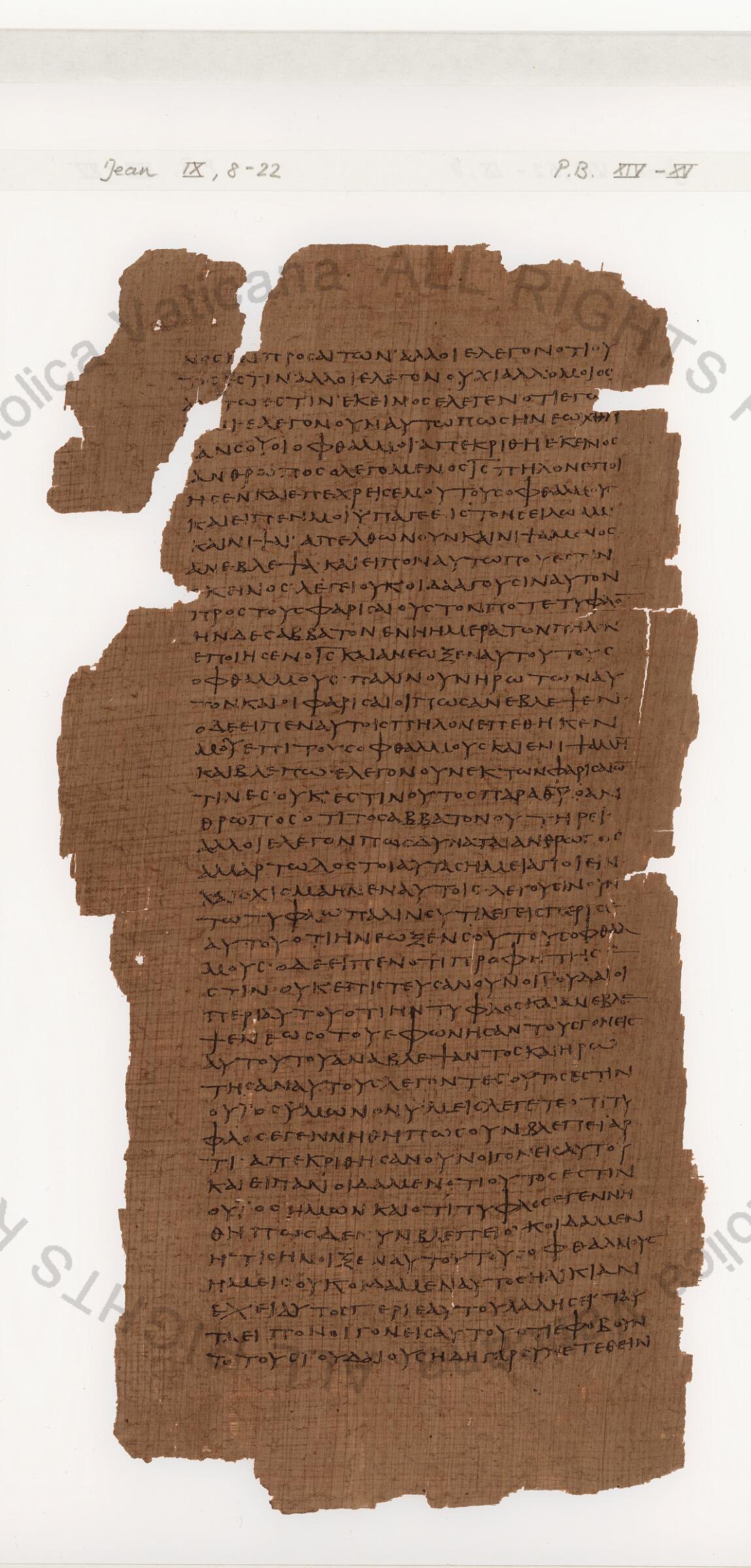
Vatican Library, Pap. Hanna 1 (Mater Verbi), DigiVatLib image 88, frame 2B.8v (https://digi.vatlib.it/view/MSS_Pap.Hanna.1(Mater.Verbi)/0088), cropped to the frame. NTVMR page 880 (folio 56v). 9:8 begins on the previous page; 9:22 continues on the next page. Checked on the image: near the top ανθρωπος ο λεγομενος ι̅ς̅ πηλον εποιησεν (9:11), last line τους ιουδαιους ηδη γαρ συνετεθειν[το] (9:22), matching the transcription of this page.
9:8 νος κ̣αι προσαιτων· 9 αλλοι ελεγον οτι ου
τος εστιν· αλλοι ελεγον ουχι αλλ ομοιος
αυ̣τω εστιν· εκεινος ελεγεν οτι εγω̣
[ει]μ̣ι· 10 ελεγον ουν αυτω πως ηνεωχθη
[σ]αν σου οι οφθαλμοι· 11 απεκριθη εκεινος
ανθρωπος ο λεγομενος ι̅ς̅ πηλον εποι
ησεν και επεχρεισε μου τους οφθαλμους
και ειπεν μοι υπαγε εις τον σειλωαμ·
και νιψαι· απελθων ουν και νιψαμε̣νος
ανεβλεψα· 12 και ειπον αυτω που εστιν
ε̣κεινος· λεγει ουκ οιδα 13 αγουσιν αυτον
προς τους φαρισαιους τον ποτε τυφλον·
14 ην δε σαββατον εν η ημερα τον πηλον
εποιησεν ο ι̅ς̅ και ανεωξεν αυτου τους
οφθαλμους· 15 παλιν ουν ηρωτων αυ
τον και οι φαρισαιοι πως ανεβλεψεν·
ο δε ειπεν αυτοις πηλον επεθηκεν
μου επι του̣ς οφθαλμους και ενιψαμην
και βλεπω· 16 ελεγον ουν εκ των φαρισαιων
τινες· ουκ εστιν ουτος παρα θ̅υ̅ ο αν
θρωπος οτι το σαββατον ου τηρει·
αλλοι ελεγον πως δυναται ανθρωπος
αμαρτωλος τοιαυτα σημεια ποιειν
και σχισμα ην εν αυτοις· 17 λεγουσιν ουν
τω τυφλω παλιν συ τι λεγεις περι σε
αυτου οτι ηνεωξεν σου τους οφθαλ
μους· ο δε ειπεν οτι προφητης ε̣
στιν· 18 ουκ επιστευσαν ουν οι ιουδαιοι
περι αυτου οτι ην τυφλος και ανεβλε
ψεν εως οτου εφωνησαν τους γονεις
αυτου του αναβλεψαντος 19 και ηρω
τησαν αυτους λεγοντες ουτος εστιν
ο υιος υμων ον υμεις λεγετε οτι τυ
φλος εγεννηθη πως ουν βλεπει αρ
τι· 20 απεκριθησαν ουν οι γονεις αυτου
και ειπαν οιδαμεν οτι ουτος εστιν
ο υιος ημων και οτι τυφλος εγεννη
θη 21 πως δε νυν βλεπει ουκ οιδαμεν
η τις ηνοιξεν αυτου τους οφθαλμους
ημεις ουκ οιδαμεν αυτος ηλικιαν
εχει αυτος π̣ερι εαυτου λαλησει· 22 ταυ
τα ειπον οι γονεις αυτου οτι εφοβουν
το τους ιουδαιους ηδη γαρ συνετεθειν
9:8¶ The neighbours therefore, and they which before had seen him that he was blind, said, Is not this he that sat and begged? 9Some said, This is he: others said, He is like him: but he said, I am he. 10Therefore said they unto him, How were thine eyes opened? 11He answered and said, A man that is called Jesus made clay, and anointed mine eyes, and said unto me, Go to the pool of Siloam, and wash: and I went and washed, and I received sight. 12Then said they unto him, Where is he? He said, I know not. 13¶ They brought to the Pharisees him that aforetime was blind. 14And it was the sabbath day when Jesus made the clay, and opened his eyes. 15Then again the Pharisees also asked him how he had received his sight. He said unto them, He put clay upon mine eyes, and I washed, and do see. 16Therefore said some of the Pharisees, This man is not of God, because he keepeth not the sabbath day. Others said, How can a man that is a sinner do such miracles? And there was a division among them. 17They say unto the blind man again, What sayest thou of him, that he hath opened thine eyes? He said, He is a prophet. 18But the Jews did not believe concerning him, that he had been blind, and received his sight, until they called the parents of him that had received his sight. 19And they asked them, saying, Is this your son, who ye say was born blind? how then doth he now see? 20His parents answered them and said, We know that this is our son, and that he was born blind: 21But by what means he now seeth, we know not; or who hath opened his eyes, we know not: he is of age; ask him: he shall speak for himself. 22These words spake his parents, because they feared the Jews: for the Jews had agreed already, that if any man did confess that he was Christ, he should be put out of the synagogue.
Where on the image
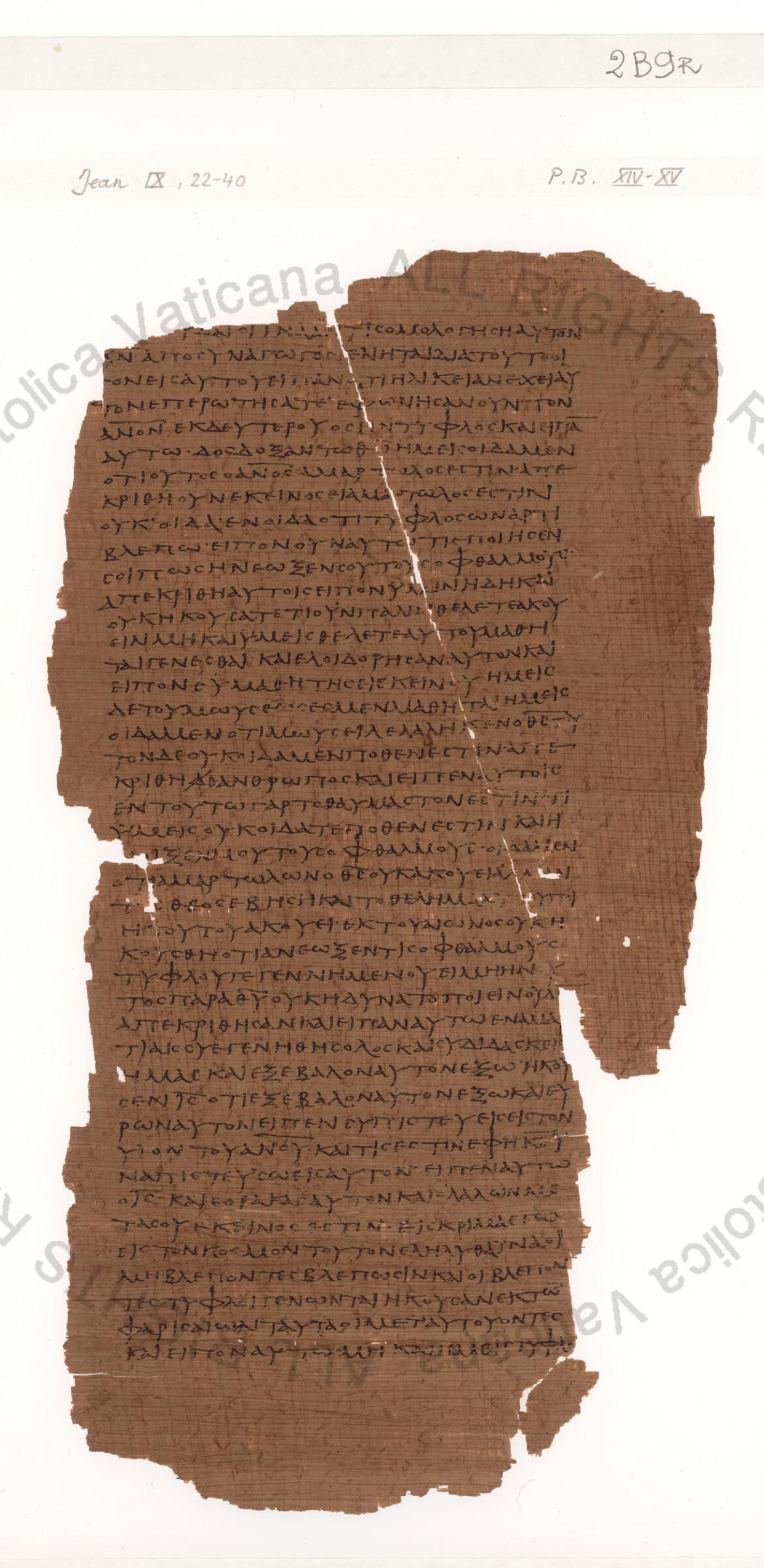
Vatican Library, Pap. Hanna 1 (Mater Verbi), DigiVatLib image 89, frame 2B.9r (https://digi.vatlib.it/view/MSS_Pap.Hanna.1(Mater.Verbi)/0089), cropped to the frame. NTVMR page 890 (folio 57r). 9:22 begins on the previous page; 9:40 continues on the next page. Not written in this papyrus: John 9:38. The NTVMR transcription marks this verse as empty at this point of the text, so the English leaves it out. Checked on the image: near the top εφωνησαν ουν τον α̅ν̅ο̅ν̅ εκ δευτερου (9:24), last line ειπον αυτω μη και ημεις τυφλοι (9:40), matching the transcription of this page.
9:22 [το οι ιο]υ̣δαιοι ινα αν τις ομολογηση αυτον
χ̣̣̅ν̅ αποσυναγωγος γενηται 23 δια τουτο οι
γ̣ονεις αυτου ειπαν οτι ηλικειαν εχει αυ
τον επερωτησατε· 24 εφωνησαν ουν τον
α̅ν̅ο̅ν̅ εκ δευτερου ος ην τυφλος και ειπαν
αυτω· δος δοξαν τω θ̅ω̅ ημεις οιδαμεν
οτι ουτος ο α̅ν̅ο̅ς̅ αμαρτω̣λος εστιν· 25 απε
κριθη ουν εκεινος ει αμαρ̣τωλος εστιν
ουκ οιδα· εν οιδα οτι τυφλος ων αρτι
βλεπω· 26 ειπον ουν αυτω τι εποιησεν
σοι πως ηνεωξεν σου τους οφθαλμους·
27 απεκριθη αυτοις ειπον υμιν ηδη και
ουκ ηκουσατε τι ουν παλιν θελετε ακου
ειν μη και υμεις θελετε αυτου μαθη
ται γενεσθαι· 28 και ελοιδορησαν αυτον και
ειπον συ μαθητης ει εκεινου ημεις
δε του μωυσεως εσμεν μαθηται 29 ημεις
οιδαμεν οτι μωυσει λελαληκεν ο θ̅ς̅ το̣υ
τον δε ουκ οιδαμεν ποθεν εστιν· 30 απε
κριθη δε̣ ανθρωπος και ειπεν αυτοις
εν τουτω γαρ το θαυμαστον εστιν ο̣τι
υμεις ουκ οιδατε ποθεν εστιν και η
ν̣ο̣ιξεν μου τους οφθαλμους· 31 οιδαμεν
οτι αμαρτωλων ο θ̅ς̅ ουκ ακουει αλλ ε̣αν
τι̣ς θεοσεβης η και το θελημα αυτου ποι
η τουτου ακουει· 32 εκ του αιωνος ουκ η
κουσθη οτι ανεωξεν τις οφθαλμους
τυφλου γεγεννημενου 33 ει μη ην ο̣υ
τος παρα θ̅υ̅ ουκ ηδυνατο ποιειν ουδ[ε]ν
34 απεκριθησαν και ειπαν αυτω εν αμαρ̣
τιαις συ εγενηθης ολος και συ διδασκεις̣
ημας και εξεβαλον αυτον εξω· 35 ηκου
σεν ι̅ς̅ οτι εξεβαλον αυτον εξω και ευ
ρων αυτον ειπεν συ πιστευεις εις τον
υιον του α̅ν̅ο̅υ̅· 36 και τις εστιν εφη κ̅ε̅ ι
να πιστευσω εις αυτον· 37 ειπεν αυτω
ο ι̅ς̅· και εορακας αυτον και ο λαλων με
τα σου εκεινος εστιν· 39 εις κριμα εγω
εις τον κοσμον τουτον εληλυθα ινα οι
μη βλεποντες βλεπωσιν και οι βλεπον
τες τυφλοι γενωνται· 40 ηκουσαν εκ των
φαρισαιων ταυτα οι μετ αυτου οντες
και ειπον αυτω· μη και ημεις τυφλο̣[ι]
9:22These words spake his parents, because they feared the Jews: for the Jews had agreed already, that if any man did confess that he was Christ, he should be put out of the synagogue. 23Therefore said his parents, He is of age; ask him. 24Then again called they the man that was blind, and said unto him, Give God the praise: we know that this man is a sinner. 25He answered and said, Whether he be a sinner or no, I know not: one thing I know, that, whereas I was blind, now I see. 26Then said they to him again, What did he to thee? how opened he thine eyes? 27He answered them, I have told you already, and ye did not hear: wherefore would ye hear it again? will ye also be his disciples? 28Then they reviled him, and said, Thou art his disciple; but we are Moses’ disciples. 29We know that God spake unto Moses: as for this fellow, we know not from whence he is. 30The man answered and said unto them, Why herein is a marvellous thing, that ye know not from whence he is, and yet he hath opened mine eyes. 31Now we know that God heareth not sinners: but if any man be a worshipper of God, and doeth his will, him he heareth. 32Since the world began was it not heard that any man opened the eyes of one that was born blind. 33If this man were not of God, he could do nothing. 34They answered and said unto him, Thou wast altogether born in sins, and dost thou teach us? And they cast him out. 35Jesus heard that they had cast him out; and when he had found him, he said unto him, Dost thou believe on the Son of God? 36He answered and said, Who is he, Lord, that I might believe on him? 37And Jesus said unto him, Thou hast both seen him, and it is he that talketh with thee. 39¶ And Jesus said, For judgment I am come into this world, that they which see not might see; and that they which see might be made blind. 40And some of the Pharisees which were with him heard these words, and said unto him, Are we blind also?
Where on the image
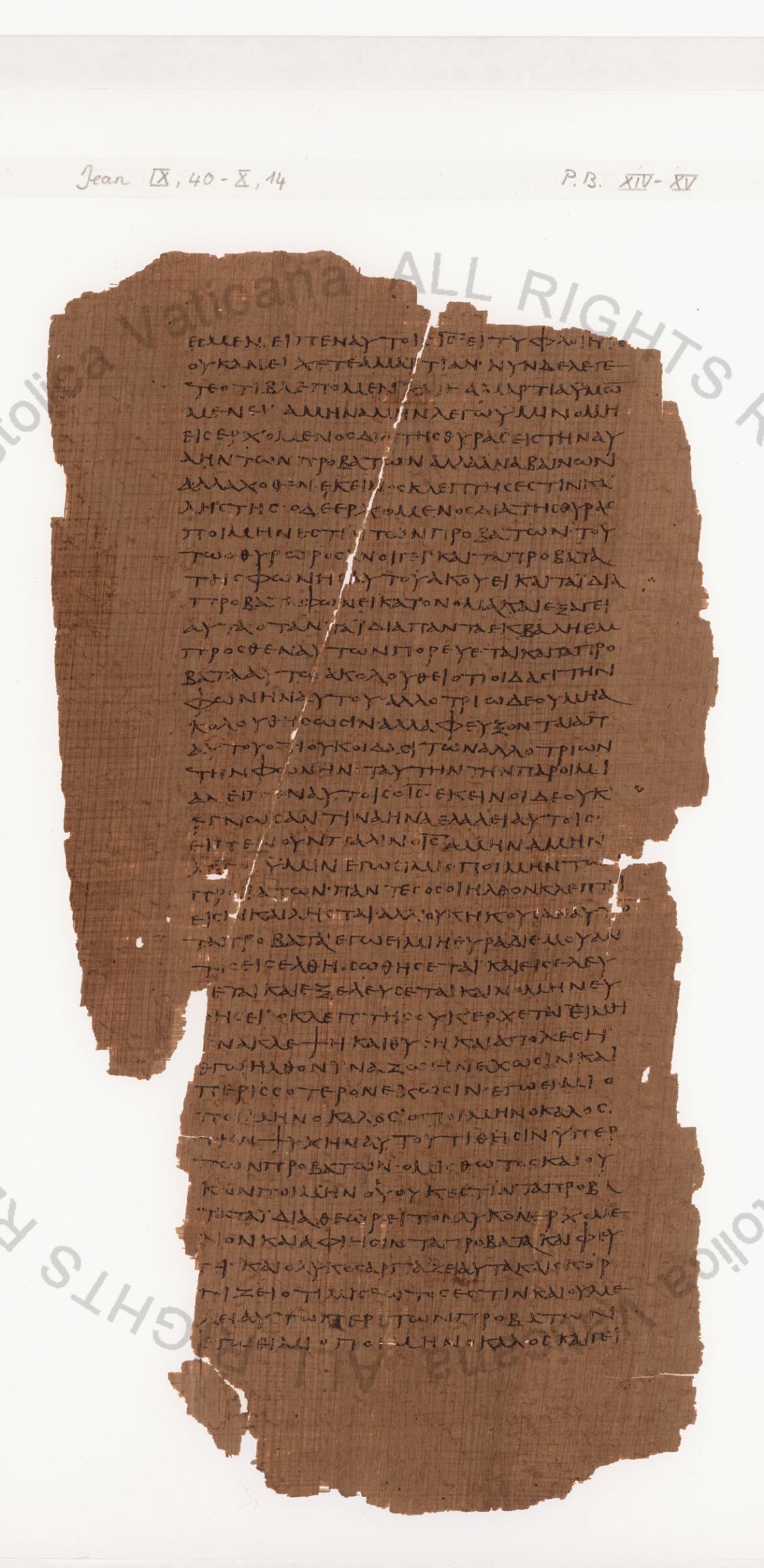
Vatican Library, Pap. Hanna 1 (Mater Verbi), DigiVatLib image 90, frame 2B.9v (https://digi.vatlib.it/view/MSS_Pap.Hanna.1(Mater.Verbi)/0090), cropped to the frame. NTVMR page 900 (folio 57v). 9:40 begins on the previous page; 10:14 continues on the next page. Checked on the image: first line εσμεν ειπεν αυτοις ι̅ς̅ ει τυφλοι ητε, last line ο ποιμην ο καλος και γει[νωσκω] (10:14), matching the transcription of this page. John 10:7: P75 reads εγω ειμι ο ποιμην των προβατων, with ποιμην ("shepherd") where the KJV has "the door of the sheep".
9:40 εσμεν. 41 ειπεν αυτοις ι̅ς̅· ει τυφλοι ητ̣ε̣
ουκ αν ειχετε αμαρτιαν· νυν δε λεγε
τε οτι βλεπομεν και η αμαρτια υμων
μενει· 10:1 αμην αμην λεγω υμιν ο μη
εισερχομενος δια της θυρας εις την αυ
λην των προβατων αλλα αναβαινων
αλλαχοθεν. εκεινος κλεπτης εστιν και̣
ληστης· 2 ο δε ερχομενος δια της θυρας
ποιμην εστιν των προβατων· 3 του
τω ο θυρωρος α̣νοιγει· και τα προβατα
της φωνης αυτου ακουει και τα ιδια
προβατα φωνει κατ ονομα και εξαγει
αυτα· 4 οταν τα ιδια παντα εκβαλη εμ
προσθεν αυτων πορευεται και τα προ
βατα αυτω ακολουθει οτι οιδασι την
φωνην αυτου· 5 αλλοτριω δε ου μη α
κολουθησωσιν· αλλα φευξονται απ
αυτου οτι ουκ οιδασι των αλλοτριων
την φωνην· 6 ταυτην την παροιμι
αν ειπεν αυτοις ο ι̅ς̅. εκεινοι δε ουκ
εγνωσαν τινα ην α ελαλει αυτοις·
7 ειπεν ουν παλιν ο ι̅ς̅ αμην αμην
λεγω̣ υμιν εγω ειμι ο ποιμην των̣
προβατων· 8 παντες οσοι ηλθον κλεπτα̣ι
εισιν̣ και λησται· αλλ ουκ ηκουσαν αυτ̣οι̣
τα προβατα· 9 εγω ειμι η θυρα δι εμου αν
τις εισελθη. σωθησεται· και εισελευ
[σ]εται και εξελευσεται και νομην ευ
ρ̣ησει· 10 ο κλεπτης ουκ ερχεται τι μη
ι̣να κλεψη και θυση και απολεση·
εγω ηλθον ινα ζωην εχωσιν και
περισσοτερον εχωσιν· 11 εγω ειμι ο
ποιμην ο καλος· ο ποιμην ο καλος.
την ψυχην αυτου τιθησιν υπερ
των προβατων· 12 ο μισθωτος και ου
κ ω̣ν ποιμην ου ουκ εστιν τα προβα
τα τα ιδια. θεωρει τον λυκον ερχομε
νον και αφιησιν τα προβατα και φευ
γει· και ο λυκος αρπαζει αυτα και σκορ
πιζει 13 οτι μισθωτος εστιν και ου με
λει αυτων περι των προβατων
14 εγω ειμι ο ποιμην ο καλος και γει
9:40And some of the Pharisees which were with him heard these words, and said unto him, Are we blind also? 41Jesus said unto them, If ye were blind, ye should have no sin: but now ye say, We see; therefore your sin remaineth. 10:1Verily, verily, I say unto you, He that entereth not by the door into the sheepfold, but climbeth up some other way, the same is a thief and a robber. 2But he that entereth in by the door is the shepherd of the sheep. 3To him the porter openeth; and the sheep hear his voice: and he calleth his own sheep by name, and leadeth them out. 4And when he putteth forth his own sheep, he goeth before them, and the sheep follow him: for they know his voice. 5And a stranger will they not follow, but will flee from him: for they know not the voice of strangers. 6This parable spake Jesus unto them: but they understood not what things they were which he spake unto them. 7Then said Jesus unto them again, Verily, verily, I say unto you, I am the door of the sheep. 8All that ever came before me are thieves and robbers: but the sheep did not hear them. 9I am the door: by me if any man enter in, he shall be saved, and shall go in and out, and find pasture. 10The thief cometh not, but for to steal, and to kill, and to destroy: I am come that they might have life, and that they might have it more abundantly. 11I am the good shepherd: the good shepherd giveth his life for the sheep. 12But he that is an hireling, and not the shepherd, whose own the sheep are not, seeth the wolf coming, and leaveth the sheep, and fleeth: and the wolf catcheth them, and scattereth the sheep. 13The hireling fleeth, because he is an hireling, and careth not for the sheep. 14I am the good shepherd, and know my sheep, and am known of mine.
Notes
- Greek: the NTVMR diplomatic transcription, line by line as on the papyrus. Square brackets enclose letters that are lost or illegible and were supplied by the transcribers; a dot under a letter marks it as uncertain; [...] marks a gap. Nomina sacra and numerals keep the scribe's overline. Spelling is the scribe's (no accents or breathings). Words broken at a line end stay broken as on the papyrus. Corrections are not shown: the text is the first hand.
- English: the King James Version (1611), whole verses, for every verse that has text on the page. A verse that begins on one page and ends on the next is given in full on both. The KJV translates a later form of the Greek text, so its wording does not always match the papyrus; material differences (such as verses the papyrus does not have) are noted in the section.
Cite
Sources
- Source: Papyrus Hanna 1 (Mater Verbi), Vatican Library: photographs from DigiVatLib; Greek from the INTF NTVMR transcription of P75; English from the King James Version (holding institution)
- Critical edition: INTF NTVMR diplomatic transcription (CC BY 4.0)
← previous · → next · v cycle view · l back to library