P75 (Papyrus Hanna 1): Luke 13:4-14:3 (fols. 27v-28v)
Introduction
P75 is a papyrus codex of Luke and John copied in Egypt around 175-225, the oldest known copy of Luke and one of the oldest of John. It was bought by Martin Bodmer in the 1950s and published as Papyrus Bodmer XIV-XV; in 2006 it was given to the Vatican Library, where it is kept as Papyrus Hanna 1 (Mater Verbi). Its text is very close to that of Codex Vaticanus, written some 150 years later. Where Luke ends and John begins (folio 44r) both titles stand on the same page.
About 51 leaves survive, many damaged at the top and edges, especially in Luke 3-7. Lost: Luke 1:1-3:17, most of 3:23-4:33, 5:11-36, 6:5-10, 7:33-34 and 7:44-45 (and parts of 7:36-49), 17:16-19, 18:19-22:3; John 11:46-47, 12:1-2, 13:11-14:7 and everything after 15:10 except small fragments. Each section below is one page: the photograph, the NTVMR diplomatic transcription line by line, and the King James Version of every verse on the page. Where P75 lacks a verse or words that the KJV has (for example John 5:4 or the account of the adulteress, John 7:53-8:11), the section says so. Six damaged pages (folios 7v, 11r, 39v, 58r, 58v and 64v) are left out because their text could not be matched to the photographs with certainty.
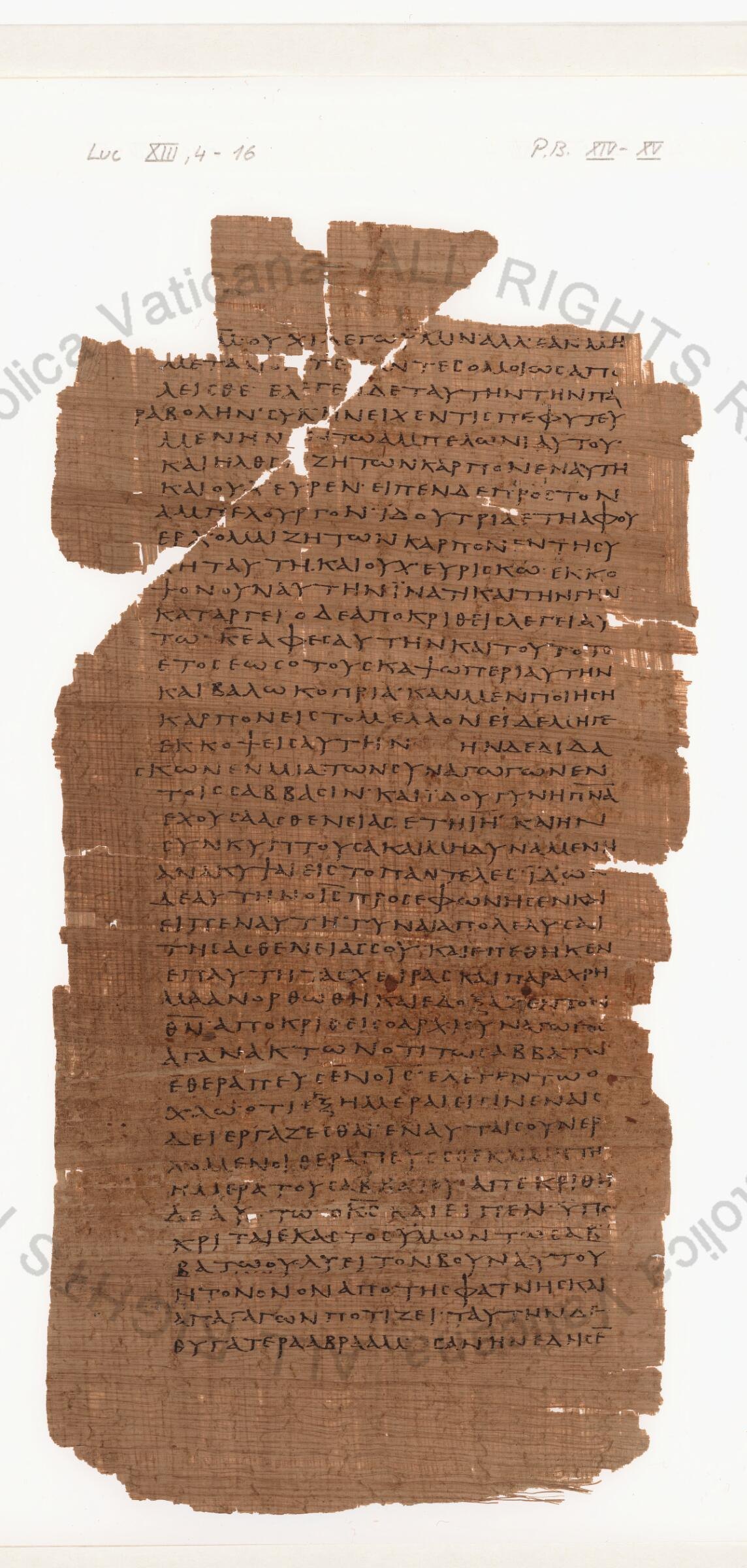
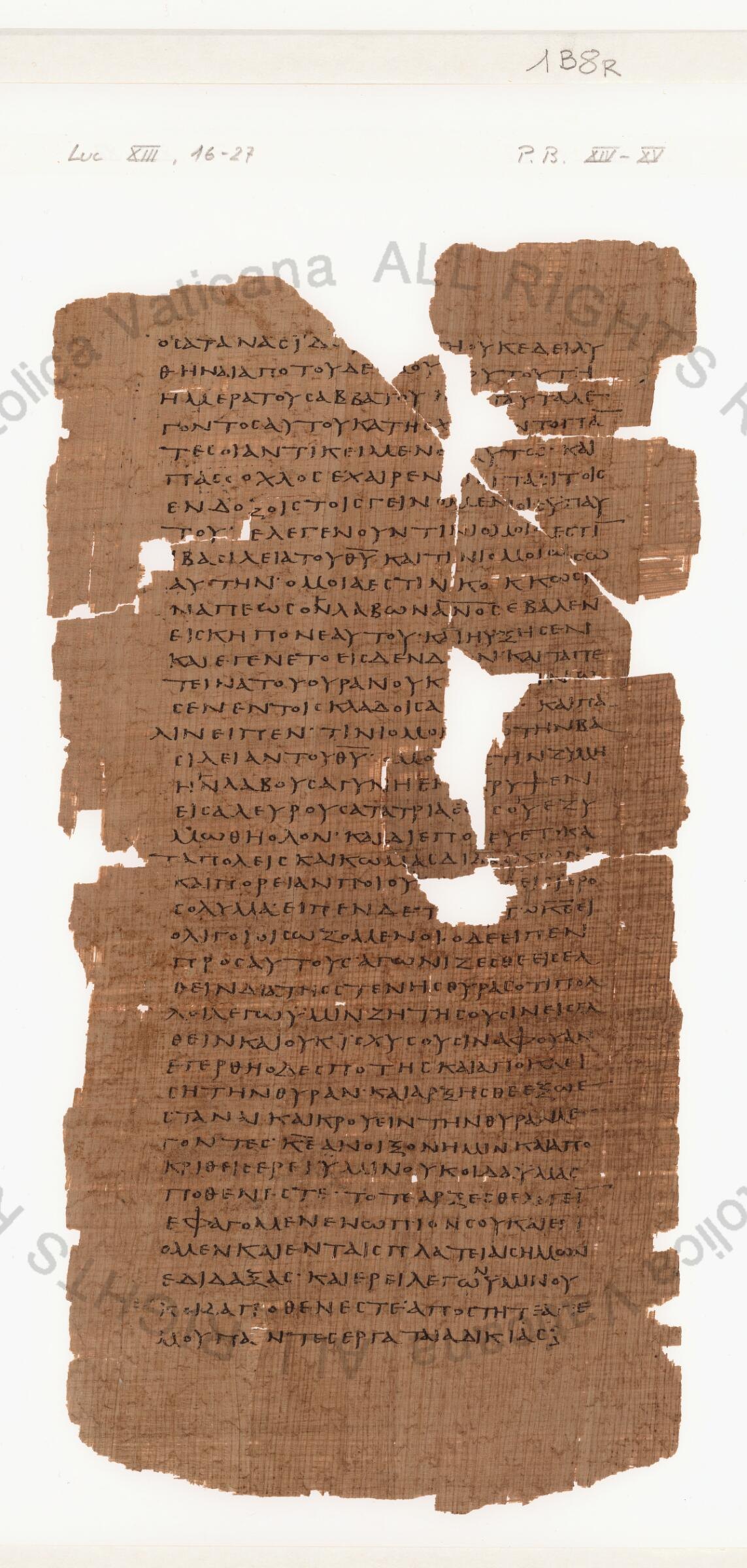
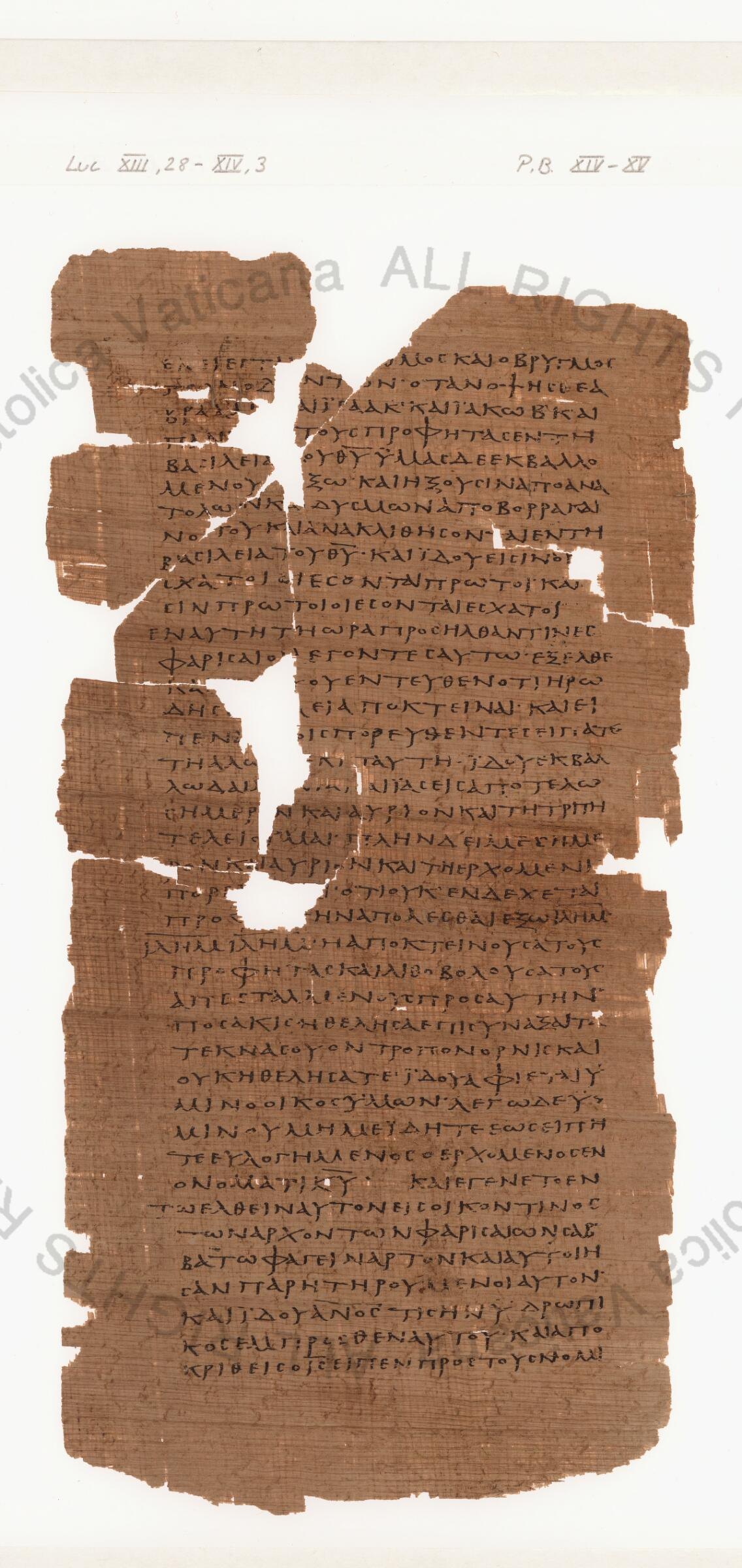
This entry covers fols. 27v-28v (Luke 13:4-14:3), shown on the Vatican Library's photographs (frames 1B.7v to 1B.8v).
How was this verified? (Provenance)
Where on the image
Vatican Library, Pap. Hanna 1 (Mater Verbi), DigiVatLib image 38, frame 1B.7v (https://digi.vatlib.it/view/MSS_Pap.Hanna.1(Mater.Verbi)/0038), cropped to the frame. NTVMR page 370 (folio 27v). 13:4 begins on the previous page; 13:16 continues on the next page. Checked on the image: near the top και ηλθεν ζητων καρπον εν αυτη και ουχ ευρεν (13:6), last line θυγατερα αβρααμ ουσαν ην εδησεν (13:16), matching the transcription of this page.
13:4 [ι̅λ̅η̅]μ̅· 5 ουχι λεγω υμιν· αλλ εαν μη
μετανοη̣τε π̣α̣ντες ομοιως· απο̣
λεισθε· 6 ελεγεν̣ δε ταυτην την πα
ραβολην· συκην ειχεν τις πεφυτευ
μενην [ε]ν τω αμπελωνι αυτου·
και ηλθε̣ν̣ ζητων καρπον εν αυτη
και ουχ ευρεν· 7 ειπεν δε προς τον
αμπελουργον· ιδου τρια ετη αφ ου
ερχομαι ζητων καρπον ε̣ν τη συ
κ̣η ταυτη. και ουχ ευρισκω· εκκο
ψον ουν αυτην ινατι και την γην
καταργει· 8 ο δε αποκριθεις λεγει αυ̣
τω· κ̅ε̅ αφες αυτην και τουτο το
ετος εως οτου σκαψω περι αυτην
και βαλω κοπρια· 9 καν μεν ποιηση
καρπον εις το μελλον ει δε μη γε
εκκοψεις αυτην· 10 ην δε διδα
σκων εν μια των συναγωγων εν
τοις σαββασιν· 11 και ιδου γυνη π̅ν̅α̅
εχουσα ασθενειας. ετη ι̅η̅· και ην
συνκυπτουσα και μη δυναμενη
ανακυψαι εις το παντελες· 12 ιδων̣
δε αυτην ο ι̅ς̅ προσεφωνησεν και
ειπεν αυτη· γυναι απολελυσαι
της ασθενειας σου· 13 και επεθηκεν
επ αυτη τας χειρας και παραχρη
μα ανορθωθη και εδοξαζεν τον
θ̅ν̅· 14 αποκριθ̣εις ο αρχισυναγωγος
αγανακτων οτι τω σαββατω·
εθεραπευσεν ο ι̅ς̅· ελεγεν τω ο
χλω· οτι εξ ημεραι εισ̣ιν εν αις
δει εργαζεσθαι· εν αυταις ουν ερ
χομενοι θεραπευε̣σθε και μη̣ τη
ημερα του σαββατου· 15 απεκριθη
δε αυ[1]τω ο κ̅ς̅ και ειπεν· υπο̣
κριται εκαστος υμων τω σαβ
βατω ου λυει τον βουν αυτου
η τον ονον απο της φατνης και
απαγαγων ποτιζει· 16 ταυτην δε
θυγατερα αβρααμ [.]σαν ην εδησεν
13:4Or those eighteen, upon whom the tower in Siloam fell, and slew them, think ye that they were sinners above all men that dwelt in Jerusalem? 5I tell you, Nay: but, except ye repent, ye shall all likewise perish. 6¶ He spake also this parable; A certain man had a fig tree planted in his vineyard; and he came and sought fruit thereon, and found none. 7Then said he unto the dresser of his vineyard, Behold, these three years I come seeking fruit on this fig tree, and find none: cut it down; why cumbereth it the ground? 8And he answering said unto him, Lord, let it alone this year also, till I shall dig about it, and dung it: 9And if it bear fruit, well: and if not, then after that thou shalt cut it down. 10And he was teaching in one of the synagogues on the sabbath. 11¶ And, behold, there was a woman which had a spirit of infirmity eighteen years, and was bowed together, and could in no wise lift up herself. 12And when Jesus saw her, he called her to him, and said unto her, Woman, thou art loosed from thine infirmity. 13And he laid his hands on her: and immediately she was made straight, and glorified God. 14And the ruler of the synagogue answered with indignation, because that Jesus had healed on the sabbath day, and said unto the people, There are six days in which men ought to work: in them therefore come and be healed, and not on the sabbath day. 15The Lord then answered him, and said, Thou hypocrite, doth not each one of you on the sabbath loose his ox or his ass from the stall, and lead him away to watering? 16And ought not this woman, being a daughter of Abraham, whom Satan hath bound, lo, these eighteen years, be loosed from this bond on the sabbath day?
Where on the image
Vatican Library, Pap. Hanna 1 (Mater Verbi), DigiVatLib image 39, frame 1B.8r (https://digi.vatlib.it/view/MSS_Pap.Hanna.1(Mater.Verbi)/0039), cropped to the frame. NTVMR page 380 (folio 28r). 13:16 begins on the previous page. Checked on the image: near the top τη ημερα του σαββατου (13:16), last line μου παντες εργαται αδικιας (13:27), matching the transcription of this page.
13:16 ο σατανας ιδο̣υ̣ [ι̅η̅ ε]τ̣η ουκ εδει λυ
θηναι απο του δε[σ]μ̣ου [τ]ο̣υτου τη
ημερα του σαββατου 17 κ̣[αι] τ̣αυτα λε
γοντος αυτου κατησχ[υνο]ντο παν
τες οι αντικειμενο̣[ι] α̣υτω· και
πας ο̣ οχλος εχαιρεν [ε]π̣ι π̣ασι τοις
ενδοξοις τοις γεινομενοις υπ αυ
του· 18 ελεγεν ουν τινι ομοια̣ εστιν
η̣ βασιλεια του θ̅υ̅ και τινι ομοιωσω
αυτην· 19 ομοια εστιν κοκκω σι
ναπεως ον λαβων α̅ν̅ο̅ς̅ εβαλεν
εις κηπον εαυτου· και ηυξησεν
και εγενετο εις δενδ[ρο]ν· και τα πε
τεινα του ουρανου κ[ατεσκ]η̣νω
σεν εν τοις κλαδοις α[υτο]υ̣· 20 και πα
λιν ειπεν· τινι ομοι[ωσ]ω̣ την βα
σιλειαν του θ̅υ̅· 21 ο̣μο[ια ε]σ̣τιν ζυμη
ην λαβουσα γυνη εν̣[ε]κ̣ρυψεν
εις αλευρου σατα τρια εω̣ς ου εζυ
μωθη ολον· 22 και διεπο[ρ]ευετο κα
τα πολεις και κωμας διδα̣σ̣κων̣
και πορειαν ποιου[μενο]ς̣ εις̣ ιερο
σολυμα· 23 ειπεν δε τ[ις αυ]τω κ̅ε̅ ει
ολιγοι οι σωζομενοι. ο δε ειπεν
προς αυτους· 24 αγωνιζεσθε εισελ
θειν δια της στενης θυρας οτι πολ
λοι λεγω υμιν ζητησουσιν εισε̣λ
θειν και ουκ ισχυσουσιν 25 αφ ου αν
εγερθη ο δεσποτης και αποκλει
ση την θυραν· και αρξησθε εξω ε
σταναι και κρουειν την θυραν λε
γοντες· κ̅ε̅ ανοιξον ημιν και απο
κριθεις ερει υμιν ουκ οιδα υμας
ποθεν ε̣στε· 26 τοτε αρξεσθε λε̣γειν
εφαγομεν ενωπιον σου και επ̣ι
ομεν και εν ταις πλατειαις ημων
εδιδαξας· 27 και ερει λεγω υμιν ου
κ οιδα ποθεν εστε· αποστητε απ ε
μου παντες εργαται αδικιας·
13:16And ought not this woman, being a daughter of Abraham, whom Satan hath bound, lo, these eighteen years, be loosed from this bond on the sabbath day? 17And when he had said these things, all his adversaries were ashamed: and all the people rejoiced for all the glorious things that were done by him. 18¶ Then said he, Unto what is the kingdom of God like? and whereunto shall I resemble it? 19It is like a grain of mustard seed, which a man took, and cast into his garden; and it grew, and waxed a great tree; and the fowls of the air lodged in the branches of it. 20And again he said, Whereunto shall I liken the kingdom of God? 21It is like leaven, which a woman took and hid in three measures of meal, till the whole was leavened. 22And he went through the cities and villages, teaching, and journeying toward Jerusalem. 23Then said one unto him, Lord, are there few that be saved? And he said unto them, 24¶ Strive to enter in at the strait gate: for many, I say unto you, will seek to enter in, and shall not be able. 25When once the master of the house is risen up, and hath shut to the door, and ye begin to stand without, and to knock at the door, saying, Lord, Lord, open unto us; and he shall answer and say unto you, I know you not whence ye are: 26Then shall ye begin to say, We have eaten and drunk in thy presence, and thou hast taught in our streets. 27But he shall say, I tell you, I know you not whence ye are; depart from me, all ye workers of iniquity.
Where on the image
Vatican Library, Pap. Hanna 1 (Mater Verbi), DigiVatLib image 40, frame 1B.8v (https://digi.vatlib.it/view/MSS_Pap.Hanna.1(Mater.Verbi)/0040), cropped to the frame. NTVMR page 390 (folio 28v). 14:3 continues on the next page. Checked on the image: first line εκει εσται ο κλαυθμος και ο βρυγμος, last line ο ι̅ς̅ ειπεν προς τους νομι[κους] (14:3), matching the transcription of this page.
13:28 εκ̣ει εστα̣ι̣ [ο κλαυ]θ̣μος και ο βρυγμος
τω̣ν̣ οδ[ο]ντω̣ν· οταν οψησθ̣ε α
βρααμ̣ [κ]αι ισαακ και ιακωβ και
παν[τας] τους προφητας εν τη
βασιλεια̣ [τ]ου θ̅υ̅ υμας δε εκβαλλο
μενου[ς ε]ξω· 29 και ηξουσιν απο ανα
τολων κα̣ι̣ δυσμων απο βορρα και
νοτ̣ου κα̣ι ανακλιθησοντ̣αι εν τη
βασιλεια του θ̅υ̅· 30 και ιδου εισιν οι [ε]
σχατοι ο̣ι εσονται πρωτοι· και [ει]
σιν πρωτοι οι εσονται εσχατοι
31 εν αυτη τη ωρα προσηλθαν τινες
φαρισαιοι̣ λ̣εγοντες αυτω· εξελθε
και̣ [πορε]υ̣ου εντευθεν οτι ηρω
δης σ̣[ε θε]λ̣ει αποκτειναι· 32 και ει
πεν α̣[υτ]οις πορευθεντες ειπατε
τη αλω̣[π]ε̣κι ταυτη· ιδου εκβαλ
λω δαιμ̣[ο]ν̣ι̣α κ̣αι ιασεις αποτελω
σημερ[ο]ν και αυριον και τη τριτη
τελειο̣υ̣μαι· 33 πλην δει με σημε
ρ̣ον και αυριον και τη ερχομενη̣
πορε̣υ̣[εσθ]α̣ι· οτι ουκ ενδεχεται
προφ̣[η]τ̣ην απολεσθαι εξω ι̅λ̅η̅μ̅·
34 ι̅λ̅η̅μ̅ ι̅λ̅η̅μ̅· η αποκτεινουσα τους
προφητας και λιθοβολουσα τους
απεσταλμενους προς αυτην·
ποσακις ηθελησα επισυναξαι τα̣
τεκνα σου ον τροπον ορνις και
ουκ ηθελησατε· 35 ιδου αφιεται υ
μιν ο οικος υμων· λεγω δε υ
μιν ου μη με ιδητε εως ειπη
τε ευλογημενος ο ερχομενος εν
ονοματι κ̅υ̅· 14:1 και εγενετο εν
τω ελθειν αυτον εις οικον τινος
τ̣ων αρχοντων φαρισαιων σαβ
βατω φαγειν αρτον και αυτοι η
σαν παρητηρουμενοι αυτον·
2 και ιδου α̅ν̅ο̅ς̅ τις ην υδρωπι
κος εμπροσθεν αυτου· 3 και απο
κριθεις ο ι̅ς̅ ειπεν προς τους νομι
13:28There shall be weeping and gnashing of teeth, when ye shall see Abraham, and Isaac, and Jacob, and all the prophets, in the kingdom of God, and you yourselves thrust out. 29And they shall come from the east, and from the west, and from the north, and from the south, and shall sit down in the kingdom of God. 30And, behold, there are last which shall be first, and there are first which shall be last. 31¶ The same day there came certain of the Pharisees, saying unto him, Get thee out, and depart hence: for Herod will kill thee. 32And he said unto them, Go ye, and tell that fox, Behold, I cast out devils, and I do cures to day and to morrow, and the third day I shall be perfected. 33Nevertheless I must walk to day, and to morrow, and the day following: for it cannot be that a prophet perish out of Jerusalem. 34O Jerusalem, Jerusalem, which killest the prophets, and stonest them that are sent unto thee; how often would I have gathered thy children together, as a hen doth gather her brood under her wings, and ye would not! 35Behold, your house is left unto you desolate: and verily I say unto you, Ye shall not see me, until the time come when ye shall say, Blessed is he that cometh in the name of the Lord. 14:1And it came to pass, as he went into the house of one of the chief Pharisees to eat bread on the sabbath day, that they watched him. 2And, behold, there was a certain man before him which had the dropsy. 3And Jesus answering spake unto the lawyers and Pharisees, saying, Is it lawful to heal on the sabbath day?
Notes
- Greek: the NTVMR diplomatic transcription, line by line as on the papyrus. Square brackets enclose letters that are lost or illegible and were supplied by the transcribers; a dot under a letter marks it as uncertain; [...] marks a gap. Nomina sacra and numerals keep the scribe's overline. Spelling is the scribe's (no accents or breathings). Words broken at a line end stay broken as on the papyrus. Corrections are not shown: the text is the first hand.
- English: the King James Version (1611), whole verses, for every verse that has text on the page. A verse that begins on one page and ends on the next is given in full on both. The KJV translates a later form of the Greek text, so its wording does not always match the papyrus; material differences (such as verses the papyrus does not have) are noted in the section.
Cite
Sources
- Source: Papyrus Hanna 1 (Mater Verbi), Vatican Library: photographs from DigiVatLib; Greek from the INTF NTVMR transcription of P75; English from the King James Version (holding institution)
- Critical edition: INTF NTVMR diplomatic transcription (CC BY 4.0)
← previous · → next · v cycle view · l back to library