P75 (Papyrus Hanna 1): Luke 14:3-15:3 (fols. 29r-30r)
Introduction
P75 is a papyrus codex of Luke and John copied in Egypt around 175-225, the oldest known copy of Luke and one of the oldest of John. It was bought by Martin Bodmer in the 1950s and published as Papyrus Bodmer XIV-XV; in 2006 it was given to the Vatican Library, where it is kept as Papyrus Hanna 1 (Mater Verbi). Its text is very close to that of Codex Vaticanus, written some 150 years later. Where Luke ends and John begins (folio 44r) both titles stand on the same page.
About 51 leaves survive, many damaged at the top and edges, especially in Luke 3-7. Lost: Luke 1:1-3:17, most of 3:23-4:33, 5:11-36, 6:5-10, 7:33-34 and 7:44-45 (and parts of 7:36-49), 17:16-19, 18:19-22:3; John 11:46-47, 12:1-2, 13:11-14:7 and everything after 15:10 except small fragments. Each section below is one page: the photograph, the NTVMR diplomatic transcription line by line, and the King James Version of every verse on the page. Where P75 lacks a verse or words that the KJV has (for example John 5:4 or the account of the adulteress, John 7:53-8:11), the section says so. Six damaged pages (folios 7v, 11r, 39v, 58r, 58v and 64v) are left out because their text could not be matched to the photographs with certainty.
This entry covers fols. 29r-30r (Luke 14:3-15:3), shown on the Vatican Library's photographs (frames 1B.9r to 1B.10r).
How was this verified? (Provenance)
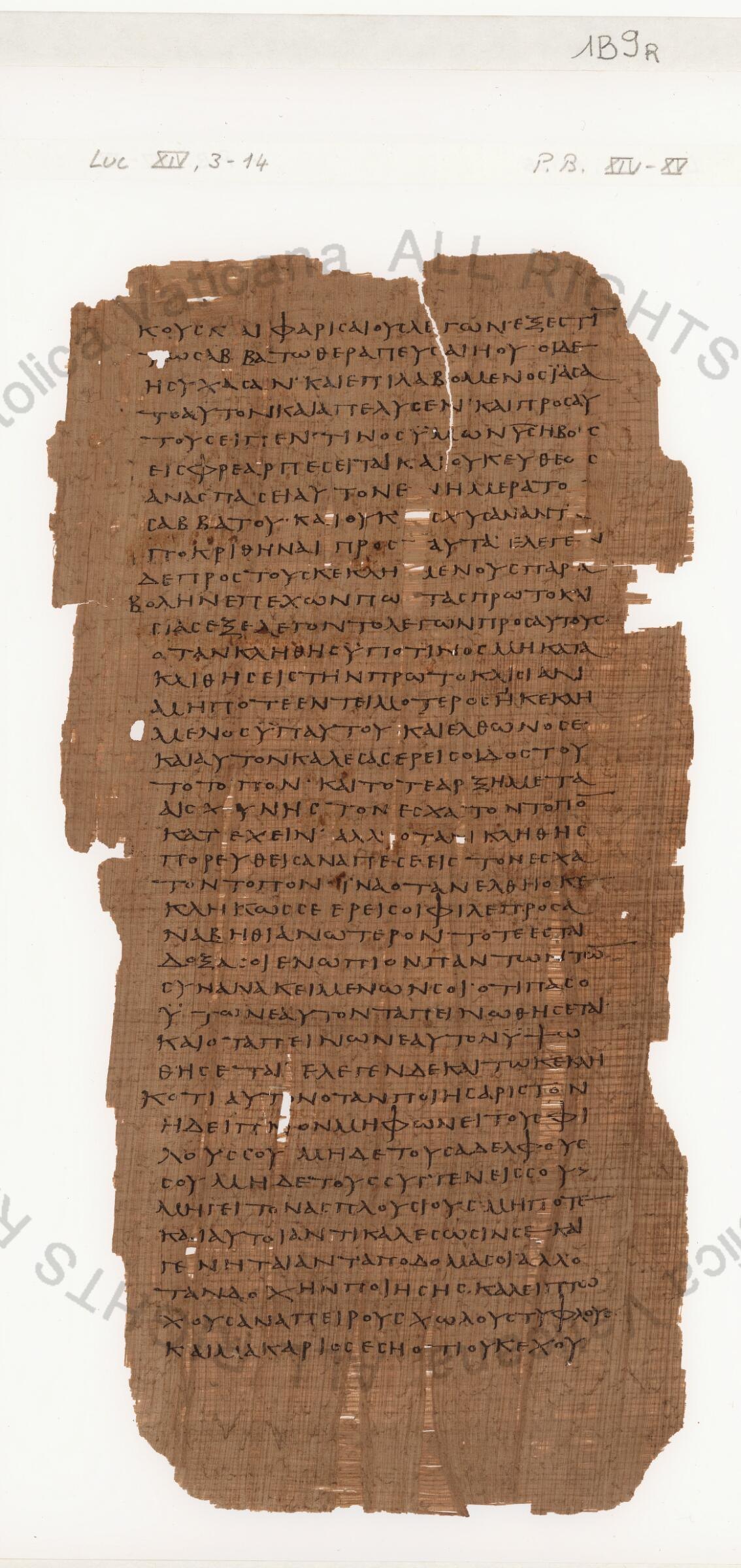
Where on the image
Vatican Library, Pap. Hanna 1 (Mater Verbi), DigiVatLib image 41, frame 1B.9r (https://digi.vatlib.it/view/MSS_Pap.Hanna.1(Mater.Verbi)/0041), cropped to the frame. NTVMR page 400 (folio 29r). 14:3 begins on the previous page; 14:14 continues on the next page. Checked on the image: first line κους και φαρισαιους λεγων εξεστιν, last line και μακαριος εση οτι ουκ εχου[σιν] (14:14), matching the transcription of this page.
14:3 κους και φαρισαιους λεγων· εξεστιν
τ̣ω σαββατω θεραπευσαι η ου· 4 οι δε
ησυχασαν· και επιλαβομενος ιασα
το αυτον και απελυσεν· 5 και προς αυ
τους ειπεν· τινος υμων υ̅ς̅ η βου̣ς
εις φρεαρ πεσειται και ουκ ευθεω̣ς
ανασπασει αυτον εν̣ ημερα του̣
σαββατου· 6 και ουκ [ι]σχυσαν αντα̣
ποκριθηναι προς τ̣αυτα· 7 ελεγεν̣
δε προς τους κεκλημ̣ενους παρα
βολην επεχων πω[ς] τας πρωτοκλι
σιας εξελεγοντο λεγων προς αυτους·
8 οταν κληθης υπο τινος μη κατα
κλιθης εις την πρωτοκλισιαν
μηποτε εντειμοτερος η κεκλη
μενος υπ αυτου· 9 και ελθων ο σε
και αυτον καλεσας ερει σοι δος του
το τοπον· και τοτε αρξη μετα
αισχυνης τον εσχατον τοπον
κατεχειν· 10 αλλ οταν̣ κληθης
πορευθεις αναπεσε εις τον εσχα
τον τοπον· ινα οταν ελθη ο κε
κληκως σε ερει σοι φιλε προσα
ναβηθι ανωτερον· τοτε εσται
δοξα σοι ενωπιον παντων των
συνανακειμενων σοι· 11 οτι πας ο
υψ̣ων εαυτον ταπεινωθησεται·
και ο ταπεινων εαυτον υψω
θησεται· 12 ελεγεν δε και τω κεκλη
κοτι αυτο̣ν οταν ποιης αριστον
η δειπνον μη φωνει τους φι
λους σου μηδε τους αδελφους
σου μηδε τους συγγενεις σου
μη γειτονας πλουσιους· μηποτε
και αυτοι αντικαλεσωσιν σε και
γενηται ανταποδομα σοι· 13 αλλ ο
ταν δοχην ποιησης. καλει πτω
χους αναπειρους χωλους τυφλους·
14 και μακαριος εση οτι ουκ εχου
14:3And Jesus answering spake unto the lawyers and Pharisees, saying, Is it lawful to heal on the sabbath day? 4And they held their peace. And he took him, and healed him, and let him go; 5And answered them, saying, Which of you shall have an ass or an ox fallen into a pit, and will not straightway pull him out on the sabbath day? 6And they could not answer him again to these things. 7¶ And he put forth a parable to those which were bidden, when he marked how they chose out the chief rooms; saying unto them, 8When thou art bidden of any man to a wedding, sit not down in the highest room; lest a more honourable man than thou be bidden of him; 9And he that bade thee and him come and say to thee, Give this man place; and thou begin with shame to take the lowest room. 10But when thou art bidden, go and sit down in the lowest room; that when he that bade thee cometh, he may say unto thee, Friend, go up higher: then shalt thou have worship in the presence of them that sit at meat with thee. 11For whosoever exalteth himself shall be abased; and he that humbleth himself shall be exalted. 12¶ Then said he also to him that bade him, When thou makest a dinner or a supper, call not thy friends, nor thy brethren, neither thy kinsmen, nor thy rich neighbours; lest they also bid thee again, and a recompence be made thee. 13But when thou makest a feast, call the poor, the maimed, the lame, the blind: 14And thou shalt be blessed; for they cannot recompense thee: for thou shalt be recompensed at the resurrection of the just.
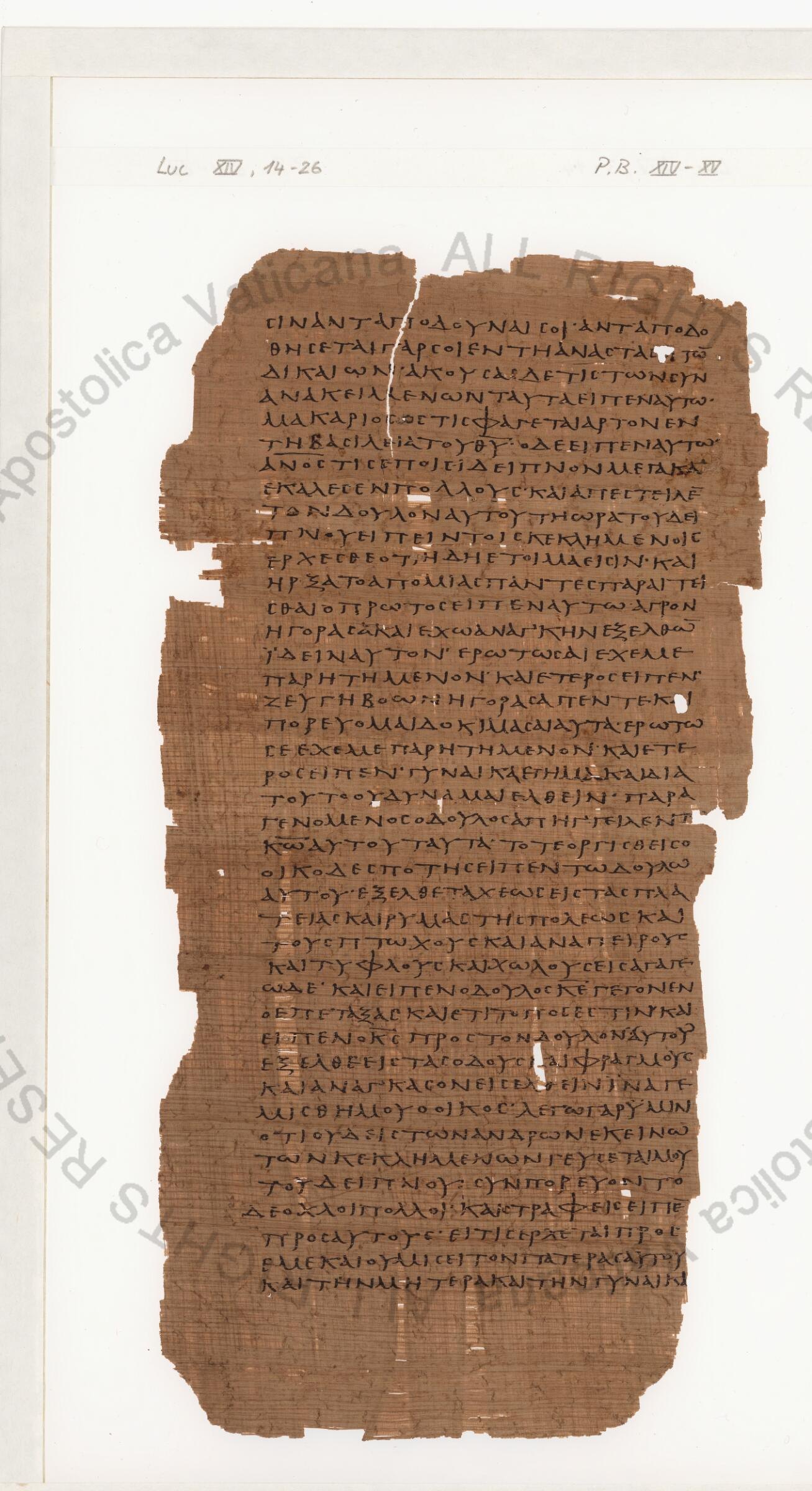
Where on the image
Vatican Library, Pap. Hanna 1 (Mater Verbi), DigiVatLib image 42, frame 1B.9v (https://digi.vatlib.it/view/MSS_Pap.Hanna.1(Mater.Verbi)/0042), cropped to the frame. NTVMR page 410 (folio 29v). 14:14 begins on the previous page; 14:26 continues on the next page. Checked on the image: first line σιν ανταποδουναι σοι ανταποδο[θησεται], last line και την μητερα και την γυναικα (14:26), matching the transcription of this page.
14:14 σιν ανταποδουναι σοι· ανταποδο
θησεται γαρ σοι εν τη αναστασ̣ε̣ι των
δικαιων· 15 ακουσας̣ δε τις των συν
ανακειμενων ταυτα ειπεν αυτω·
μακαριος οστις φαγεται αρτον εν
τη βασιλεια του θ̅υ̅· 16 ο δε ειπεν αυτω·
α̅ν̅ο̅ς̅ τις εποιει δειπνον μεγα και̣
εκαλεσεν πολλους· 17 και απεστειλεν
τον δουλον αυτου τη ωρα του δει
πνου ειπειν τοις κεκλημενοις
ερχεσθε οτι̣ ηδη ετοιμα εισιν· 18 και
ηρξατο απο μιας παντες παραιτει
σθαι ο πρωτος ειπεν αυτω· αγρον
ηγορασα και εχω αναγκην εξελθων
ιδειν αυτον· ερωτω σοι εχε με
παρητημενον· 19 και ετερος ειπεν·
ζευγη βοων ηγορασα πεντε κα̣ι
πορευομαι δοκιμασαι αυτα· ερωτω
σε εχε με παρητημενον· 20 και ετε
ρος ειπεν· γυναικα εγημα και δια
τουτο ου δυναμαι ελθειν· 21 παρα
γενομενος ο δουλος απηγγειλεν τ[ω]
κ̅ω̅ αυτου ταυτα· τοτε οργισθεις ο
οικοδεσποτης ειπεν τω δουλω
αυτου· εξελθε ταχεως εις τας πλα
τειας και ρυμας της πολεως και
τους πτωχους και αναπειρους
και τυφλους και χωλους εισαγαγε
ωδε· 22 και ειπεν ο δουλος κ̅ε̅ γεγονεν
ο επεταξας και ετι τοπος εστιν· 23 και
ειπεν ο κ̅ς̅ προς τον δουλον αυτου
εξελθε εις τας οδους κ̣αι φραγμους
και αναγκασον εισελθειν ινα γε
μισθη μου ο οικος· 24 λεγω γαρ υμιν
οτι ουδεις των ανδρων εκεινων
των κεκλημενων γευσεται μου
του δειπνου· 25 συνπορευοντο
δε οχλοι πολλοι· και στραφεις ειπεν
προς αυτους· 26 ει τις ερχεται προς
εμε και ου μισει τον πατερα ε̣αυτου
και την μητερα και την γυναικα̣
14:14And thou shalt be blessed; for they cannot recompense thee: for thou shalt be recompensed at the resurrection of the just. 15¶ And when one of them that sat at meat with him heard these things, he said unto him, Blessed is he that shall eat bread in the kingdom of God. 16Then said he unto him, A certain man made a great supper, and bade many: 17And sent his servant at supper time to say to them that were bidden, Come; for all things are now ready. 18And they all with one consent began to make excuse. The first said unto him, I have bought a piece of ground, and I must needs go and see it: I pray thee have me excused. 19And another said, I have bought five yoke of oxen, and I go to prove them: I pray thee have me excused. 20And another said, I have married a wife, and therefore I cannot come. 21So that servant came, and shewed his lord these things. Then the master of the house being angry said to his servant, Go out quickly into the streets and lanes of the city, and bring in hither the poor, and the maimed, and the halt, and the blind. 22And the servant said, Lord, it is done as thou hast commanded, and yet there is room. 23And the lord said unto the servant, Go out into the highways and hedges, and compel them to come in, that my house may be filled. 24For I say unto you, That none of those men which were bidden shall taste of my supper. 25¶ And there went great multitudes with him: and he turned, and said unto them, 26If any man come to me, and hate not his father, and mother, and wife, and children, and brethren, and sisters, yea, and his own life also, he cannot be my disciple.
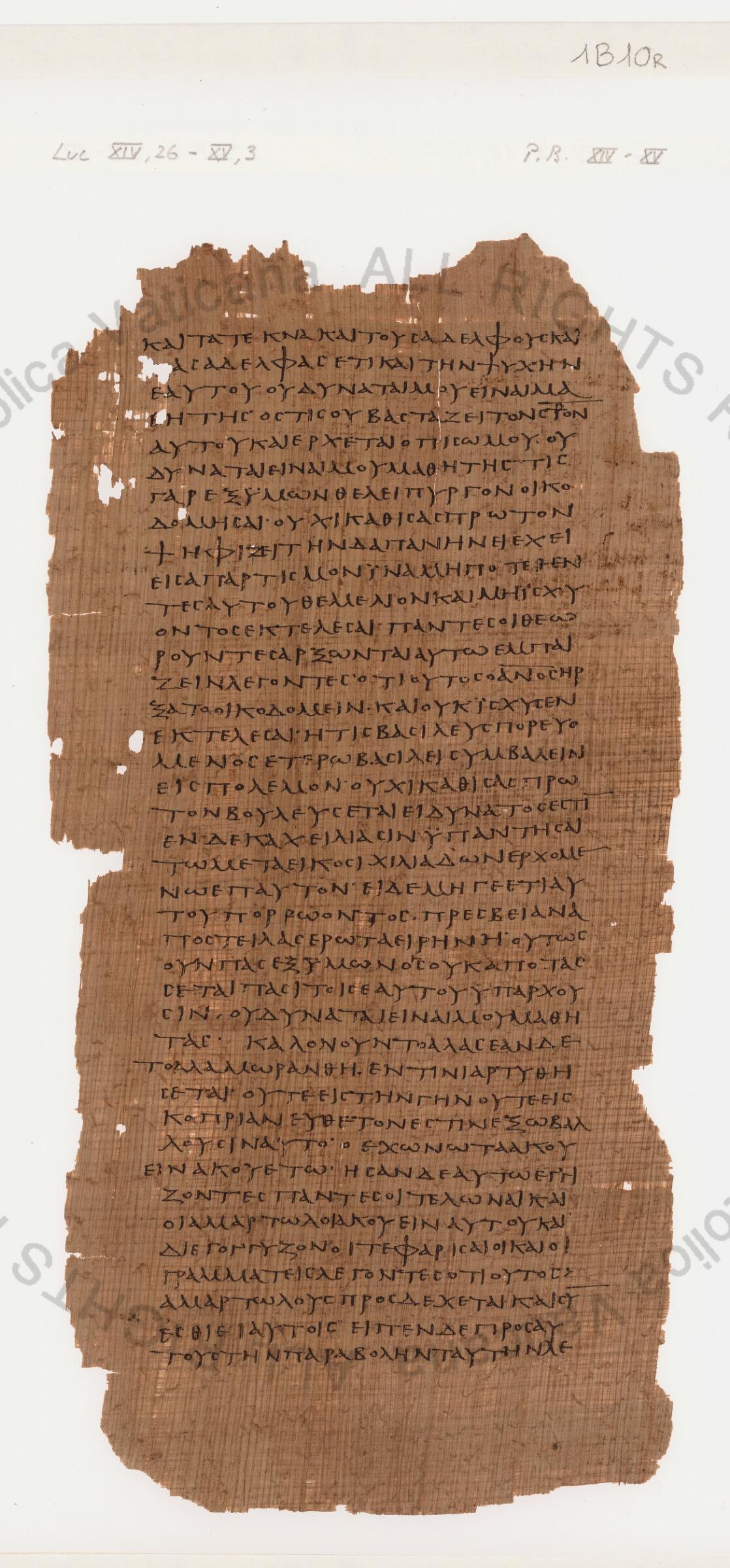
Where on the image
Vatican Library, Pap. Hanna 1 (Mater Verbi), DigiVatLib image 43, frame 1B.10r (https://digi.vatlib.it/view/MSS_Pap.Hanna.1(Mater.Verbi)/0043), cropped to the frame. NTVMR page 420 (folio 30r). 14:26 begins on the previous page; 15:3 continues on the next page. Checked on the image: first line και τα τεκνα και τους αδελφους, last line τους την παραβολην ταυτην λε[γων] (15:3), matching the transcription of this page.
14:26 και τα τεκνα και τους αδελφους και
τ̣ας αδελφας ετι και την ψυχην
εαυτου ου δυναται μου ειναι μα
θ̣ητης· 27 οστις ου βασταζει τον σ̅τ̅ρ̅ο̅ν̅
αυτου και ερχεται οπισω μου. ου
δυναται ειναι μου μαθητης· 28 τις
γαρ εξ υμων θελει πυργον οικο
δομησαι· ουχι καθισας πρωτον
ψηφισ̣ει την δαπανην ει εχει
εις απαρτισμον 29 ινα μηποτε θ̣εν
τες αυτου θεμελιον και μη ισχυ
οντος εκτελεσαι· παντες οι θεω
ρουντες αρξωνται αυτω εμπαι
ζειν 30 λεγοντες· οτι ουτος ο α̅ν̅ο̅ς̅ ηρ
ξατο οικοδομειν. και ουκ ισχυσεν
εκτελεσαι· 31 η τις βασιλευς πορευο
μενος ετερω βασιλει συμβαλειν
εις πολεμον· ουχι καθισας πρω
τον βουλευσεται ει δυνατος εστιν
εν δεκα χειλιασιν υπαντησαι
τω μετα εικοσι χιλιαδων ερχομε
νω επ αυτον· 32 ει δε μη γε ετι αυ
του πορρω οντος. πρεσβειαν α
ποστειλας ερωτα ειρηνη· 33 ουτως
ουν πας εξ υμων ος ουκ αποτασ
σεται πασι τοις εαυτου υπαρχου
σιν. ου δυναται ειναι μου μαθη
τας· 34 καλον ουν το αλας εαν δε
το αλα μωρανθη. εν τινι αρτυθη
σεται· 35 ουτε εις την γην ουτε εις
κοπριαν ευθετον εστιν εξω βαλ
λουσιν αυτο· ο εχων ωτα ακου
ειν ακουετω· 15:1 ησαν δε αυτω εγγι
ζοντες παντες οι τελωναι και
οι αμαρτωλοι ακουειν αυτου 2 και
διεγογγυζον οι τε φαρισαιοι και οι
γραμματεις λεγοντες οτι ουτος
αμαρτωλους προσδεχεται και συν
εσθιει αυτοις· 3 ειπεν δε προς αυ
τους την παραβολην ταυτην λε
14:26If any man come to me, and hate not his father, and mother, and wife, and children, and brethren, and sisters, yea, and his own life also, he cannot be my disciple. 27And whosoever doth not bear his cross, and come after me, cannot be my disciple. 28For which of you, intending to build a tower, sitteth not down first, and counteth the cost, whether he have sufficient to finish it? 29Lest haply, after he hath laid the foundation, and is not able to finish it, all that behold it begin to mock him, 30Saying, This man began to build, and was not able to finish. 31Or what king, going to make war against another king, sitteth not down first, and consulteth whether he be able with ten thousand to meet him that cometh against him with twenty thousand? 32Or else, while the other is yet a great way off, he sendeth an ambassage, and desireth conditions of peace. 33So likewise, whosoever he be of you that forsaketh not all that he hath, he cannot be my disciple. 34¶ Salt is good: but if the salt have lost his savour, wherewith shall it be seasoned? 35It is neither fit for the land, nor yet for the dunghill; but men cast it out. He that hath ears to hear, let him hear. 15:1Then drew near unto him all the publicans and sinners for to hear him. 2And the Pharisees and scribes murmured, saying, This man receiveth sinners, and eateth with them. 3¶ And he spake this parable unto them, saying,
Notes
- Greek: the NTVMR diplomatic transcription, line by line as on the papyrus. Square brackets enclose letters that are lost or illegible and were supplied by the transcribers; a dot under a letter marks it as uncertain; [...] marks a gap. Nomina sacra and numerals keep the scribe's overline. Spelling is the scribe's (no accents or breathings). Words broken at a line end stay broken as on the papyrus. Corrections are not shown: the text is the first hand.
- English: the King James Version (1611), whole verses, for every verse that has text on the page. A verse that begins on one page and ends on the next is given in full on both. The KJV translates a later form of the Greek text, so its wording does not always match the papyrus; material differences (such as verses the papyrus does not have) are noted in the section.
Cite
Sources
- Source: Papyrus Hanna 1 (Mater Verbi), Vatican Library: photographs from DigiVatLib; Greek from the INTF NTVMR transcription of P75; English from the King James Version (holding institution)
- Critical edition: INTF NTVMR diplomatic transcription (CC BY 4.0)
← previous · → next · v cycle view · l back to library