P75 (Papyrus Hanna 1): Luke 15:3-16:9 (fols. 30v-31v)
Introduction
P75 is a papyrus codex of Luke and John copied in Egypt around 175-225, the oldest known copy of Luke and one of the oldest of John. It was bought by Martin Bodmer in the 1950s and published as Papyrus Bodmer XIV-XV; in 2006 it was given to the Vatican Library, where it is kept as Papyrus Hanna 1 (Mater Verbi). Its text is very close to that of Codex Vaticanus, written some 150 years later. Where Luke ends and John begins (folio 44r) both titles stand on the same page.
About 51 leaves survive, many damaged at the top and edges, especially in Luke 3-7. Lost: Luke 1:1-3:17, most of 3:23-4:33, 5:11-36, 6:5-10, 7:33-34 and 7:44-45 (and parts of 7:36-49), 17:16-19, 18:19-22:3; John 11:46-47, 12:1-2, 13:11-14:7 and everything after 15:10 except small fragments. Each section below is one page: the photograph, the NTVMR diplomatic transcription line by line, and the King James Version of every verse on the page. Where P75 lacks a verse or words that the KJV has (for example John 5:4 or the account of the adulteress, John 7:53-8:11), the section says so. Six damaged pages (folios 7v, 11r, 39v, 58r, 58v and 64v) are left out because their text could not be matched to the photographs with certainty.
This entry covers fols. 30v-31v (Luke 15:3-16:9), shown on the Vatican Library's photographs (frames 1B.10v to 1B.11v).
How was this verified? (Provenance)
Where on the image
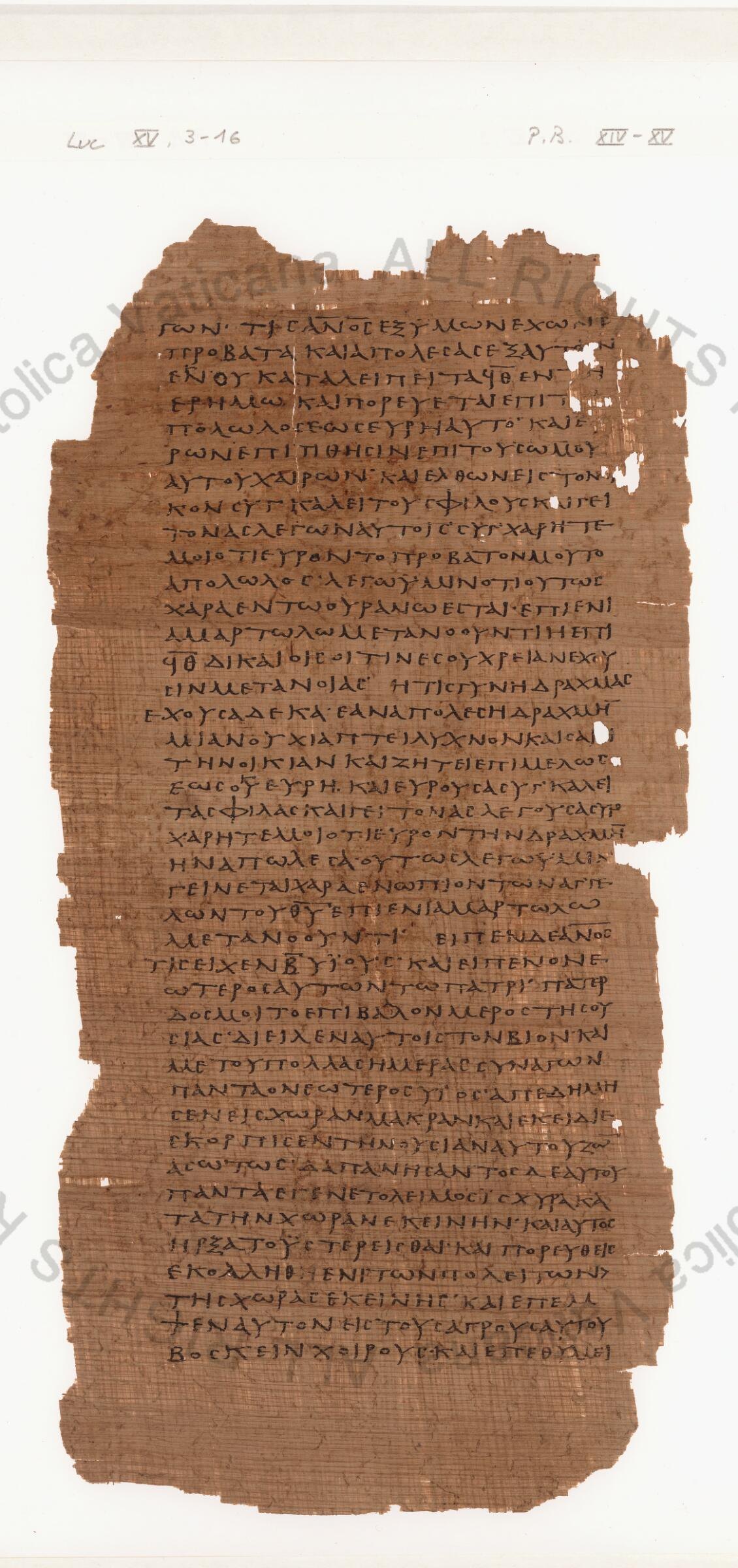
Vatican Library, Pap. Hanna 1 (Mater Verbi), DigiVatLib image 44, frame 1B.10v (https://digi.vatlib.it/view/MSS_Pap.Hanna.1(Mater.Verbi)/0044), cropped to the frame. NTVMR page 430 (folio 30v). 15:3 begins on the previous page; 15:16 continues on the next page. Checked on the image: first line γων τις α̅ν̅ο̅ς̅ εξ υμων εχων, last line βοσκειν χοιρους και επεθυμει (15:15-16), matching the transcription of this page.
15:3 γων· 4 τις α̅ν̅ο̅ς̅ εξ υμων εχων ρ̣̣̅
προβατα και απολεσας εξ αυτω̣ν
εν· ου καταλειπει τα ϙ̅θ̅ εν τ̣η̣
ερημω. και πορευεται επι τ[ο] α̣
πολωλος· εως ευρη αυτο· 5 και ε̣υ̣
ρων επιτιθησιν επι τους ωμου[ς]
αυτου χαιρων· 6 και ελθων εις τον ο̣ι̣
κον συγκαλει τους φιλους κα̣ι γει
τονας λεγων αυτοις· συγχαρητε
μοι οτι ευρον το προβατον μου το
απολωλος· 7 λεγω υμιν οτι ουτως
χαρα εν τω ουρανω εσται· επι ενι
αμαρτωλω μετανοουντι η επι
ϙ̅θ̅ δικαιοις οιτινες ου χρειαν εχο̣υ
σιν μετανοιας· 8 η τις γυνη δραχμας
εχουσα δεκα· εαν απολεση δραχμην
μιαν ουχι απτει λυχνον και σαρ̣[ο]ι
την οικιαν και ζητει επιμελως
εως ου ευρη. 9 και ευρουσα συγκαλει
τας φιλας και γειτονας λεγουσα συγ
χαρητε μοι οτι ευρον την δραχμην
ην απωλεσα· 10 ουτως λεγω υμιν̣
γεινεται χαρα ενωπιον των αγγε
λων του θ̅υ̅ επι ενι αμαρτωλω
μετανοουντι· 11 ειπεν δε α̅ν̅ο̅ς̅
τις ειχεν β̅ υιους· 12 και ειπεν ο νε
ωτερος αυτων τω πατρι· πατερ
δος μοι το επιβαλον μερος της ου
σιας· διειλεν αυτοις τον βιον· 13 και
μετ ου πολλας ημερας συναγων
παντα ο νεωτερος υιος· απεδημη
σεν εις χωραν μακραν και εκει διε
σκορπισεν την ουσιαν αυτου ζων
ασωτως· 14 δαπανησαντος δε αυτου
παντα· εγενετο λειμος ισχυρα κα
τα την χωραν εκεινην· και αυτος
ηρξατο υστερεισθαι· 15 και πορευθεις
εκολληθη ενι των πολειτων
της χωρας εκεινης· και επεμ
ψεν αυτον εις τους αγρους αυτου
βοσκειν χοιρους· 16 και επεθυμει
15:3¶ And he spake this parable unto them, saying, 4What man of you, having an hundred sheep, if he lose one of them, doth not leave the ninety and nine in the wilderness, and go after that which is lost, until he find it? 5And when he hath found it, he layeth it on his shoulders, rejoicing. 6And when he cometh home, he calleth together his friends and neighbours, saying unto them, Rejoice with me; for I have found my sheep which was lost. 7I say unto you, that likewise joy shall be in heaven over one sinner that repenteth, more than over ninety and nine just persons, which need no repentance. 8¶ Either what woman having ten pieces of silver, if she lose one piece, doth not light a candle, and sweep the house, and seek diligently till she find it? 9And when she hath found it, she calleth her friends and her neighbours together, saying, Rejoice with me; for I have found the piece which I had lost. 10Likewise, I say unto you, there is joy in the presence of the angels of God over one sinner that repenteth. 11¶ And he said, A certain man had two sons: 12And the younger of them said to his father, Father, give me the portion of goods that falleth to me. And he divided unto them his living. 13And not many days after the younger son gathered all together, and took his journey into a far country, and there wasted his substance with riotous living. 14And when he had spent all, there arose a mighty famine in that land; and he began to be in want. 15And he went and joined himself to a citizen of that country; and he sent him into his fields to feed swine. 16And he would fain have filled his belly with the husks that the swine did eat: and no man gave unto him.
Where on the image
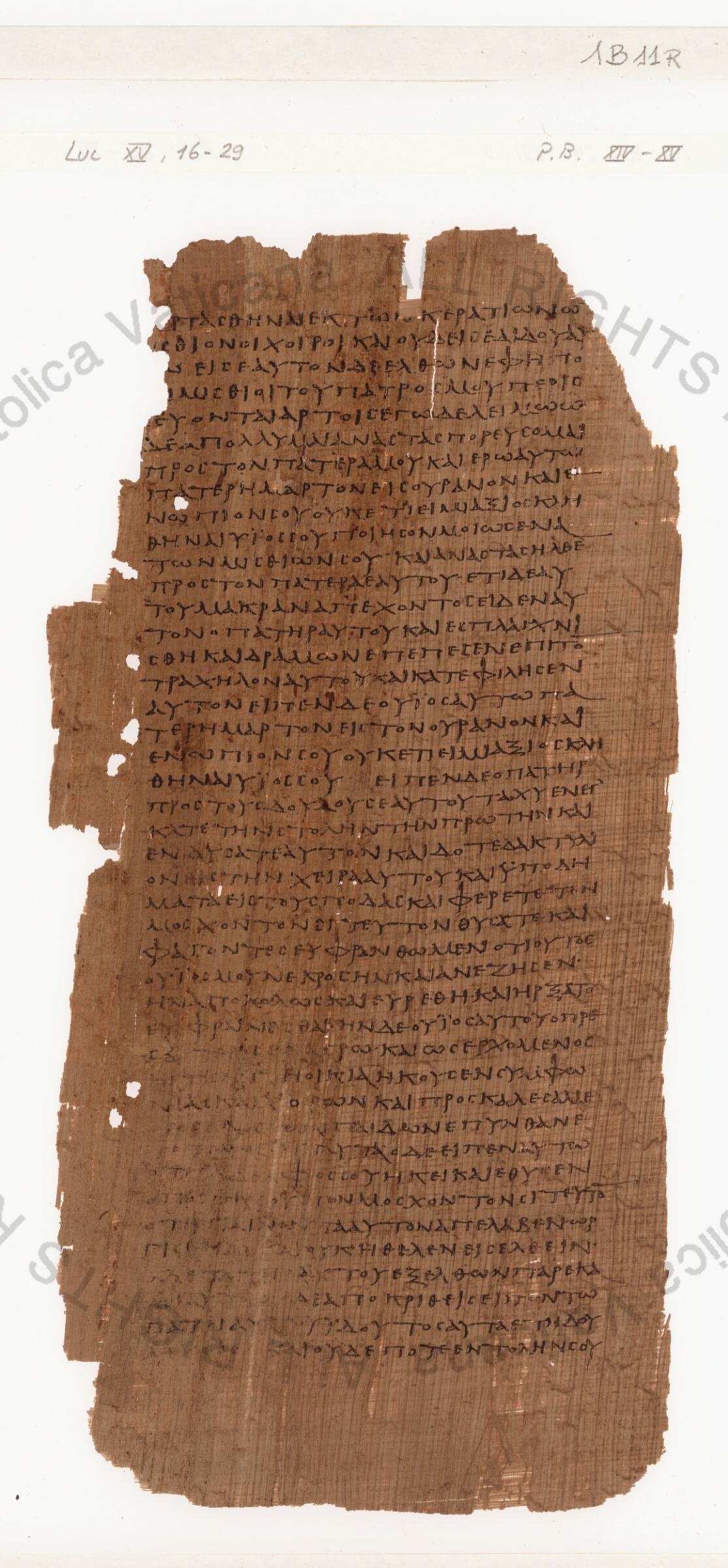
Vatican Library, Pap. Hanna 1 (Mater Verbi), DigiVatLib image 45, frame 1B.11r (https://digi.vatlib.it/view/MSS_Pap.Hanna.1(Mater.Verbi)/0045), cropped to the frame. NTVMR page 440 (folio 31r). 15:16 begins on the previous page; 15:29 continues on the next page. Checked on the image: first line [χο]ρτασθηναι εκ των κερατιων ων, last line ουδεποτε εντολην σου (15:29), matching the transcription of this page.
15:16 [χο]ρτασθηναι εκ των κερατιων ων
η̣σθιον οι χοιροι και ουδεις εδιδου αυ
[τ]ω̣· 17 εις εαυτον δε ελθων εφη πο
[σο]ι μισθιοι του πατρος μου περισ
[σ]ευονται αρτοις εγω δε λειμω ω
δε απολλυμαι 18 αναστας πορευσομαι
προς τον πατερα μου και ερω αυτω
πατερ ημαρτον εις ουρανον και ε
νωπιον σου 19 ουκετι ειμι αξιος κλη
θηναι υιος σου ποιησον μοι ως ενα
των μισθιων σου· 20 και αναστας ηλθεν
προς τον πατερα εαυτου· ετι δε αυ
του μακραν απεχοντος ειδεν αυ
τον ο πατηρ αυτου και εσπλαγχνι
σθη και δραμων επεπεσεν επι τον
τραχηλον αυτου και κατεφιλησεν
αυτον 21 ειπεν δε ο υιος αυτω πα
τερ ημαρτον εις τον ουρανον και
ενωπιον σου ουκετι ειμι αξιος κλη
θηναι υιος σου· 22 ειπεν δε ο πατηρ
προς τους δουλους εαυτου ταχυ ενεγ
κατε την στολην την πρωτην και
ενδυσατε αυτον και δοτε δακτυλι
ον ε̣ις την χειρα αυτου και υποδη
ματα εις τους ποδας 23 και φερετε τον
μοσχον τον σιτευτον θυσατε και
φαγοντες ευφρανθωμεν 24 οτι ουτος
ο υιος μου νεκρος ην και ανεζησεν·
ην απολολως και ευρεθη και ηρξατο
ευφραινεσθαι· 25 ην δε ο υιος αυτου ο πρε
σβ[υ]τερο̣ς εν̣ αγρω· και ως ερχομενος
ηγγισε̣ν τη οικια ηκουσεν συμφω
νιας και χορων 26 και προσκαλεσαμε
ν̣ος ε̣ν̣α̣ τ̣ων παιδων επυνθανε
το τι α̣ν̣ ε̣ι̣η̣ ταυτα· 27 ο δε ειπεν αυτω
οτι ο αδελφος σου ηκει και εθυσεν
ο πα̣τηρ̣ σου τον μοσχον τον σιτευτον
οτι υ̣γιαινοντα αυτον απελαβεν· 28 ωρ
γισθ̣η̣ δ̣ε̣ κ̣αι ουκ ηθελεν εισελθειν·
ο̣ δε π̣ατη̣ρ̣ αυτου εξελθων παρεκα
λ̣ε̣ι αυτον̣· 29 ο̣ δε αποκριθεις ειπεν τω
πατρι αυ̣τ̣ου ιδου τοσαυτα ετη δου
λ̣ε̣υ̣ω̣ σ̣[οι] κ̣αι ουδεποτε εντολην σου
15:16And he would fain have filled his belly with the husks that the swine did eat: and no man gave unto him. 17And when he came to himself, he said, How many hired servants of my father’s have bread enough and to spare, and I perish with hunger! 18I will arise and go to my father, and will say unto him, Father, I have sinned against heaven, and before thee, 19And am no more worthy to be called thy son: make me as one of thy hired servants. 20And he arose, and came to his father. But when he was yet a great way off, his father saw him, and had compassion, and ran, and fell on his neck, and kissed him. 21And the son said unto him, Father, I have sinned against heaven, and in thy sight, and am no more worthy to be called thy son. 22But the father said to his servants, Bring forth the best robe, and put it on him; and put a ring on his hand, and shoes on his feet: 23And bring hither the fatted calf, and kill it; and let us eat, and be merry: 24For this my son was dead, and is alive again; he was lost, and is found. And they began to be merry. 25Now his elder son was in the field: and as he came and drew nigh to the house, he heard musick and dancing. 26And he called one of the servants, and asked what these things meant. 27And he said unto him, Thy brother is come; and thy father hath killed the fatted calf, because he hath received him safe and sound. 28And he was angry, and would not go in: therefore came his father out, and intreated him. 29And he answering said to his father, Lo, these many years do I serve thee, neither transgressed I at any time thy commandment: and yet thou never gavest me a kid, that I might make merry with my friends:
Where on the image
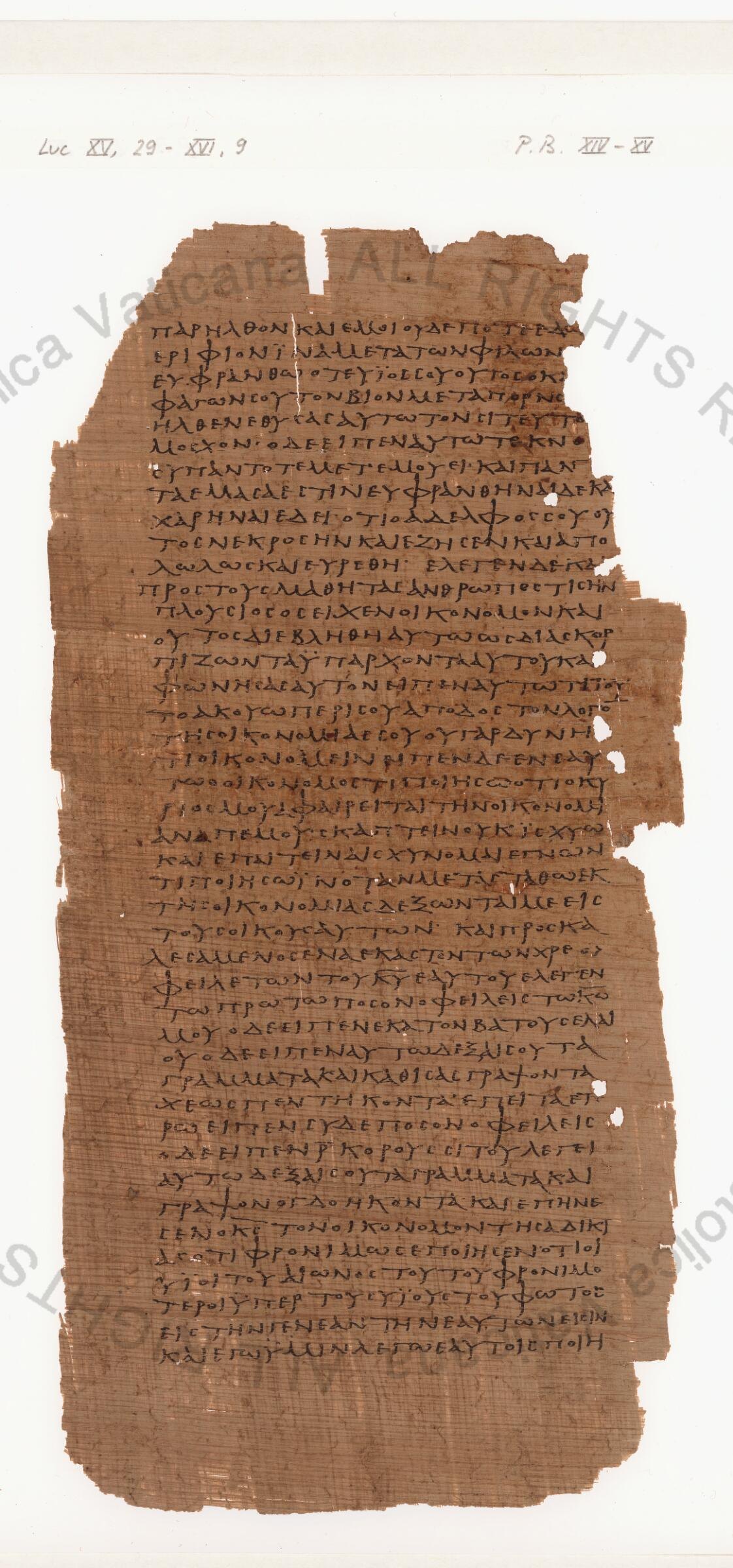
Vatican Library, Pap. Hanna 1 (Mater Verbi), DigiVatLib image 46, frame 1B.11v (https://digi.vatlib.it/view/MSS_Pap.Hanna.1(Mater.Verbi)/0046), cropped to the frame. NTVMR page 450 (folio 31v). 15:29 begins on the previous page; 16:9 continues on the next page. Checked on the image: first line παρηλθον και εμοι ουδεποτε εδω[κας], near the foot εις την γενεαν την εαυτων εισιν (16:8), matching the transcription of this page.
15:29 παρηλθον και εμοι ουδεποτε εδω̣[κας]
εριφιον ινα μετα των φιλων [μου]
ευφρανθω 30 οτε υιος σου ουτος ο κα̣[τα]
φαγων σου τον βιον μετα πορνω̣[ν]
ηλθεν εθυσας αυτω τον σιτευτο[ν]
μοσχον· 31 ο δε ειπεν αυτω τεκνο[ν]
συ παντοτε μετ εμου ει· και παντ̣[α]
τα εμα σα εστιν 32 ευφρανθηναι δε κα[ι]
χαρηναι εδει· οτι ο αδελφος σου ου
τος νεκρος ην και εζησεν και απο
λωλως και ευρεθη· 16:1 ελεγεν δε και̣
προς τους μαθητας ανθρωπος τις ην
πλουσιος ος ειχεν οικονομον και
ουτος διεβληθη αυτω ως διασκορ
πιζων τα υπαρχοντα αυτου 2 κα[ι]
φωνησας αυτον ειπεν αυτω τι του
το ακουω περι σου αποδος τον λογον
της οικονομιας σου ου γαρ δυνη [ε]
τι οικονομειν 3 ειπεν δε εν εαυ
τω ο οικονομος τι ποιησω οτι ο κυ
ριος μου αφαιρειται την οικονομι
αν απ εμου· σκαπτειν ουκ ισχυω
και επαιτειν αισχυνομαι 4 εγνων
τι ποιησω ιν οταν μετασταθω εκ
της οικονομιας δεξωνται με εις
τους οικους αυτων· 5 και προσκα
λεσαμενος ενα εκαστον των χρεο
φειλετων του κ̅υ̅ εαυτου ελεγεν
τω πρωτω ποσον οφειλεις τω κ̅ω̅
μου 6 ο δε ειπεν εκατον βατους ελαι
ου ο δε ειπεν αυτω δεξαι σου τα
γραμματα και καθισας γραψον τα
χεως πεντηκοντα· 7 επειτα ετε̣
ρω ειπεν συ δε ποσον οφειλεις
ο δε ειπεν ρ̅ κορους σιτου λεγει
αυτω δεξαι σου τα γραμματα και
γραψον ογδοηκοντα· 8 και επηνε
σεν ο κ̅ς̅ τον οικονομον της αδικι
ας οτι φρονιμως εποιησεν· οτι οι
υιοι του αιωνος τουτου φρονιμο
τεροι υπερ τους υιους του φωτος
εις την γενεαν την εαυτων εισιν·
9 και εγω υμιν λεγω εαυτοις ποιη
15:29And he answering said to his father, Lo, these many years do I serve thee, neither transgressed I at any time thy commandment: and yet thou never gavest me a kid, that I might make merry with my friends: 30But as soon as this thy son was come, which hath devoured thy living with harlots, thou hast killed for him the fatted calf. 31And he said unto him, Son, thou art ever with me, and all that I have is thine. 32It was meet that we should make merry, and be glad: for this thy brother was dead, and is alive again; and was lost, and is found. 16:1And he said also unto his disciples, There was a certain rich man, which had a steward; and the same was accused unto him that he had wasted his goods. 2And he called him, and said unto him, How is it that I hear this of thee? give an account of thy stewardship; for thou mayest be no longer steward. 3Then the steward said within himself, What shall I do? for my lord taketh away from me the stewardship: I cannot dig; to beg I am ashamed. 4I am resolved what to do, that, when I am put out of the stewardship, they may receive me into their houses. 5So he called every one of his lord’s debtors unto him, and said unto the first, How much owest thou unto my lord? 6And he said, An hundred measures of oil. And he said unto him, Take thy bill, and sit down quickly, and write fifty. 7Then said he to another, And how much owest thou? And he said, An hundred measures of wheat. And he said unto him, Take thy bill, and write fourscore. 8And the lord commended the unjust steward, because he had done wisely: for the children of this world are in their generation wiser than the children of light. 9And I say unto you, Make to yourselves friends of the mammon of unrighteousness; that, when ye fail, they may receive you into everlasting habitations.
Notes
- Greek: the NTVMR diplomatic transcription, line by line as on the papyrus. Square brackets enclose letters that are lost or illegible and were supplied by the transcribers; a dot under a letter marks it as uncertain; [...] marks a gap. Nomina sacra and numerals keep the scribe's overline. Spelling is the scribe's (no accents or breathings). Words broken at a line end stay broken as on the papyrus. Corrections are not shown: the text is the first hand.
- English: the King James Version (1611), whole verses, for every verse that has text on the page. A verse that begins on one page and ends on the next is given in full on both. The KJV translates a later form of the Greek text, so its wording does not always match the papyrus; material differences (such as verses the papyrus does not have) are noted in the section.
Cite
Sources
- Source: Papyrus Hanna 1 (Mater Verbi), Vatican Library: photographs from DigiVatLib; Greek from the INTF NTVMR transcription of P75; English from the King James Version (holding institution)
- Critical edition: INTF NTVMR diplomatic transcription (CC BY 4.0)
← previous · → next · v cycle view · l back to library