P75 (Papyrus Hanna 1): Luke 16:9-17:2 (fols. 32r-32v)
Introduction
P75 is a papyrus codex of Luke and John copied in Egypt around 175-225, the oldest known copy of Luke and one of the oldest of John. It was bought by Martin Bodmer in the 1950s and published as Papyrus Bodmer XIV-XV; in 2006 it was given to the Vatican Library, where it is kept as Papyrus Hanna 1 (Mater Verbi). Its text is very close to that of Codex Vaticanus, written some 150 years later. Where Luke ends and John begins (folio 44r) both titles stand on the same page.
About 51 leaves survive, many damaged at the top and edges, especially in Luke 3-7. Lost: Luke 1:1-3:17, most of 3:23-4:33, 5:11-36, 6:5-10, 7:33-34 and 7:44-45 (and parts of 7:36-49), 17:16-19, 18:19-22:3; John 11:46-47, 12:1-2, 13:11-14:7 and everything after 15:10 except small fragments. Each section below is one page: the photograph, the NTVMR diplomatic transcription line by line, and the King James Version of every verse on the page. Where P75 lacks a verse or words that the KJV has (for example John 5:4 or the account of the adulteress, John 7:53-8:11), the section says so. Six damaged pages (folios 7v, 11r, 39v, 58r, 58v and 64v) are left out because their text could not be matched to the photographs with certainty.
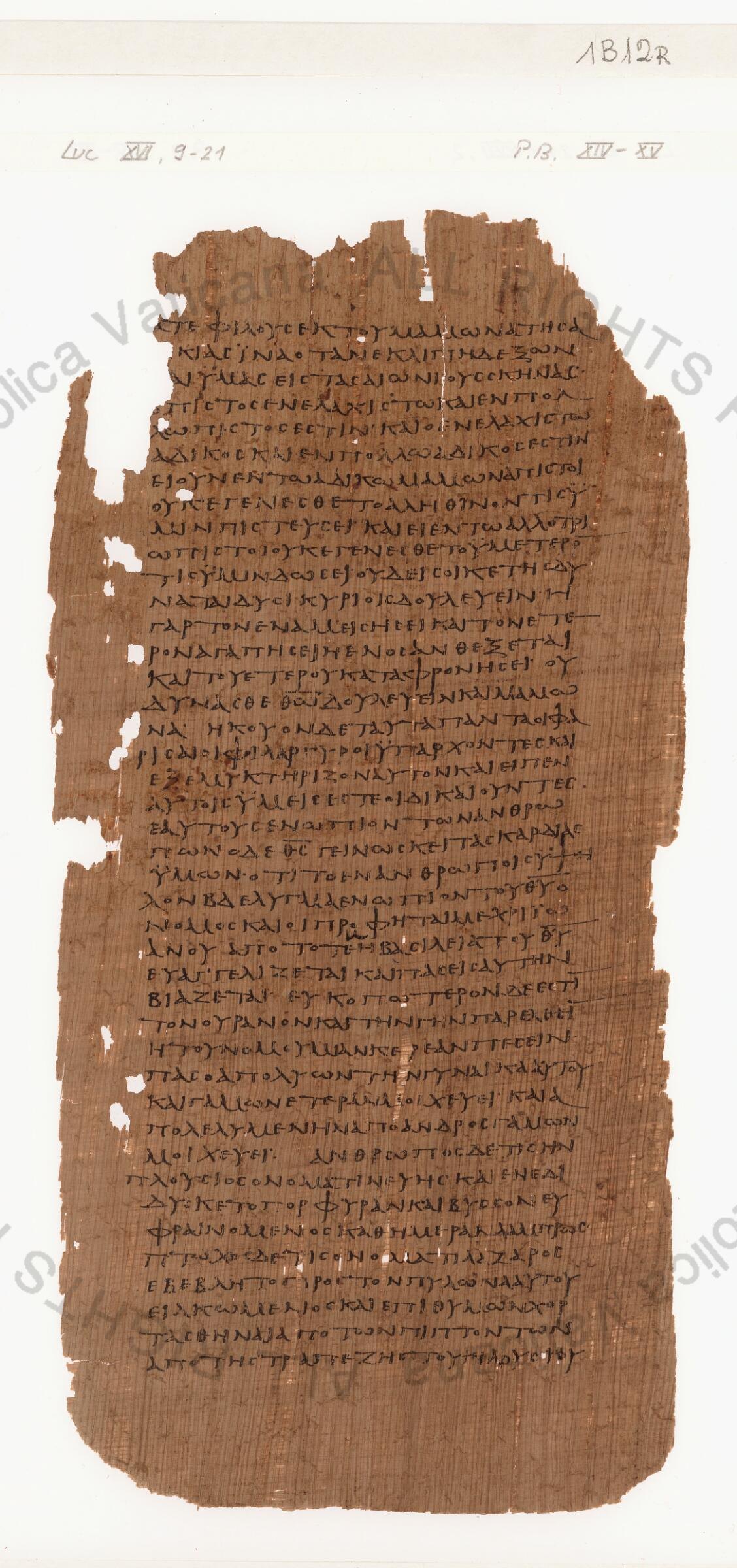
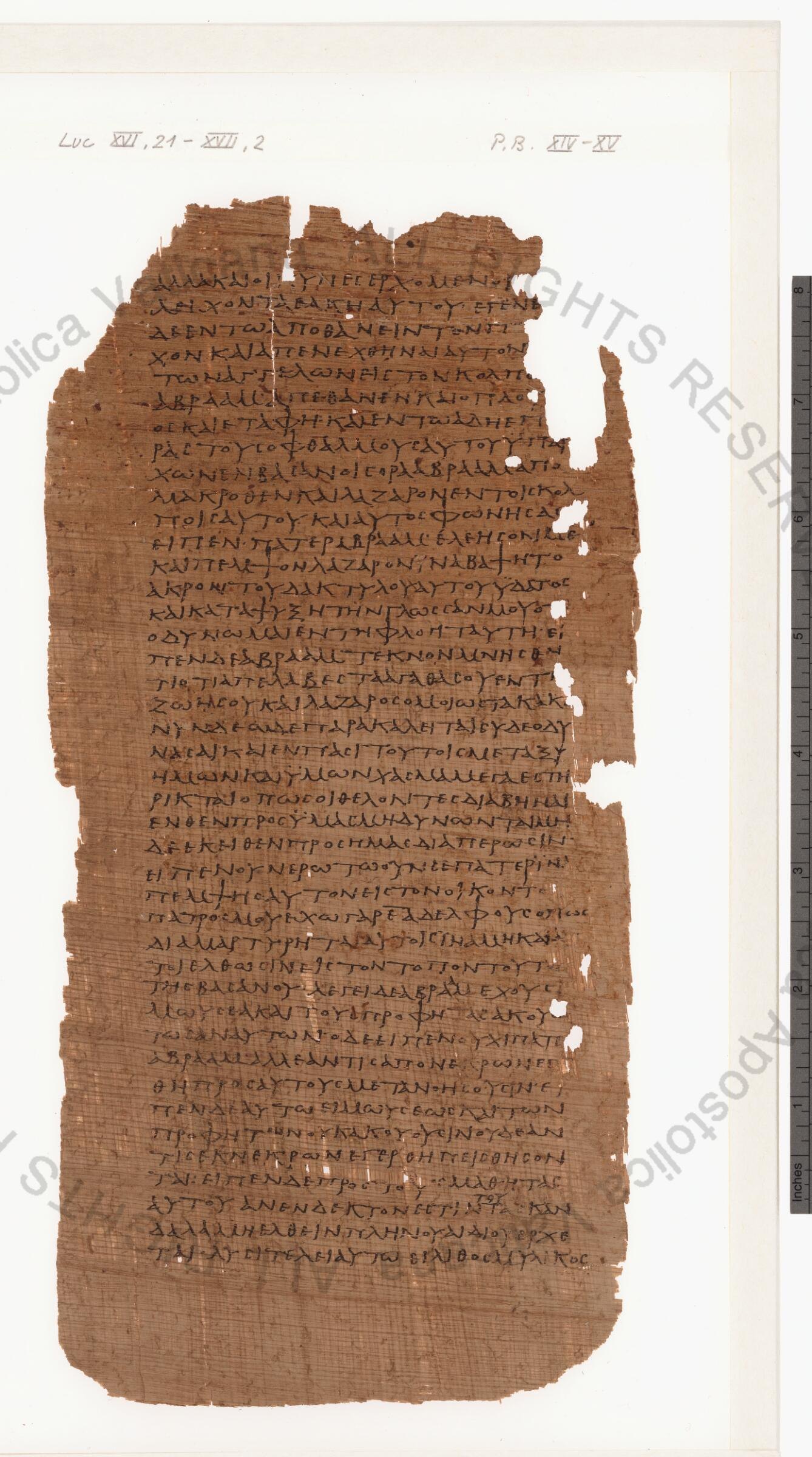
This entry covers fols. 32r-32v (Luke 16:9-17:2), shown on the Vatican Library's photographs (frames 1B.12r to 1B.12v).
How was this verified? (Provenance)
Where on the image
Vatican Library, Pap. Hanna 1 (Mater Verbi), DigiVatLib image 47, frame 1B.12r (https://digi.vatlib.it/view/MSS_Pap.Hanna.1(Mater.Verbi)/0047), cropped to the frame. NTVMR page 460 (folio 32r). 16:9 begins on the previous page; 16:21 continues on the next page. Checked on the image: near the top ουκ εγενεσθε το αληθινον τις υμιν πιστευσει (16:11), near the foot απο των πιπτοντων (16:21), matching the transcription of this page. Luke 16:19: P75 gives the rich man a name, ονοματι νευης ("named Neues"), which the KJV and almost all other manuscripts do not have.
16:9 [σ]α̣τε φιλους εκ του μαμωνα της α
[δι]κιας ινα οταν εκλιπη δεξων
[τ]αι υμας εις τας αιωνιους σκηνας·
10 ο πιστος εν ελαχιστω και εν πολ
λω πιστος εστιν· και ο εν ελαχιστω
αδικος και εν πολλω αδικος εστιν
11 ει ουν εν τω αδικω μαμωνα πιστοι
ουκ εγενεσθε το αληθινον τις υ
μιν πιστευσει· 12 και ει εν τω αλλοτρι
ω πιστοι ουκ εγενεσθε το υμετερον
τις υμιν δωσει· 13 ουδεις οικετης δυ
ναται δυσι κυριοις δουλευειν· η
γαρ τον ενα μεισησει και τον ετε
ρον αγαπησει η ενος ανθεξεται
και του ετερου καταφρονησει· ου
δυνασθε θ̅ω̅ δουλευειν και μαμω
να· 14 ηκουον δε ταυτα παντα οι φα
ρισαιοι φιλαργυροι υπαρχοντες και
εξεμυκτηριζον αυτον 15 και ειπεν
αυτοις υμεις εστε οι δικαιουντες
εαυτους ενωπιον των ανθρω
πων ο δε θ̅ς̅ γεινωσκει τας καρδιας
υμων· οτι το εν ανθρωποις υψη
λον βδελυγμα ενωπιον του θ̅υ̅ 16 ο
νομος και οι προφηται μεχρι ιω
ανου απο τοτε η βασιλεια του θ̅υ̅
ευαγγελιζεται και πας εις αυτην
βιαζεται· 17 ευκοπωτερον δε εστιν
τον ουρανον και την γην παρελθειν
η του νομου μιαν κερεαν πεσειν·
18 πας ο απολυων την γυναικα αυτου
και γαμων ετεραν μοιχευει· και α
πολελυμενην απο ανδρος γαμων
μοιχευει: 19 ανθρωπος δε τις ην
πλουσιος ονοματι νευης και ενεδι
δυσκετο πορφυραν και βυσσον ευ
φραινομενος καθ ημεραν λαμπρως·
20 πτωχος δε τις ονοματι λαζαρος
εβεβλητο προς τον πυλωνα αυτου
ειλκωμενος 21 και επιθυμων χορ
τασθηναι απο των πιπτοντων
απο της τραπεζης του [...]
16:9And I say unto you, Make to yourselves friends of the mammon of unrighteousness; that, when ye fail, they may receive you into everlasting habitations. 10He that is faithful in that which is least is faithful also in much: and he that is unjust in the least is unjust also in much. 11If therefore ye have not been faithful in the unrighteous mammon, who will commit to your trust the true riches? 12And if ye have not been faithful in that which is another man’s, who shall give you that which is your own? 13¶ No servant can serve two masters: for either he will hate the one, and love the other; or else he will hold to the one, and despise the other. Ye cannot serve God and mammon. 14And the Pharisees also, who were covetous, heard all these things: and they derided him. 15And he said unto them, Ye are they which justify yourselves before men; but God knoweth your hearts: for that which is highly esteemed among men is abomination in the sight of God. 16The law and the prophets were until John: since that time the kingdom of God is preached, and every man presseth into it. 17And it is easier for heaven and earth to pass, than one tittle of the law to fail. 18Whosoever putteth away his wife, and marrieth another, committeth adultery: and whosoever marrieth her that is put away from her husband committeth adultery. 19¶ There was a certain rich man, which was clothed in purple and fine linen, and fared sumptuously every day: 20And there was a certain beggar named Lazarus, which was laid at his gate, full of sores, 21And desiring to be fed with the crumbs which fell from the rich man’s table: moreover the dogs came and licked his sores.
Where on the image
Vatican Library, Pap. Hanna 1 (Mater Verbi), DigiVatLib image 48, frame 1B.12v (https://digi.vatlib.it/view/MSS_Pap.Hanna.1(Mater.Verbi)/0048), cropped to the frame. NTVMR page 470 (folio 32v). 16:21 begins on the previous page; 17:2 continues on the next page. Checked on the image: near the top εις τον κολπον (16:22); in the lower part μεταξυ ημων και υμων χασμα μεγα εστηρικται (16:26), matching the transcription of this page.
16:21 αλλα και οι κ̣υνες ερχομενοι [επε]
λειχον τα ελκη αυτου· 22 εγενε[το]
δε εν τω αποθανειν τον πτ̣[ω]
χον και απενεχθηναι αυτον [υπο]
των αγγελων εις τον κολπο̣[ν]
αβρααμ απεθανεν και ο πλου̣[σι]
ος και εταφη· 23 και εν τω αδη επ[α]
ρας τους οφθαλμους αυτου υπαρ̣
χων εν βασανοις ορα αβρααμ απο
μακροθεν και λαζαρον εν τοις κολ
ποις αυτου. 24 και αυτος φωνησας̣
ειπεν· πατερ αβρααμ ελεησον με
και πεμψον λαζαρον ινα βαψη το
ακρον του δακτυλου αυτου υδατος
και καταψυξη την γλωσσαν μου οτ̣ι̣
οδυνωμαι εν τη φλογι ταυτη· 25 ει
πεν δε αβρααμ τεκνον μνησθη̣
τι οτι απελαβες τα αγαθα σου εν τη̣
ζωη σου και λαζαρος ομοιως τα κακα̣
νυν δε ωδε παρακαλειται συ δε οδυ
νασαι· 26 και εν πασι τουτοις μεταξυ
ημων και υμων χασμα μεγα εστη
ρικται οπως οι θελοντες διαβηναι
ενθεν προς υμας μη δυνωνται μη
δε εκειθεν προς ημας διαπερωσιν·
27 ειπεν ουν ερωτω ουν σε πατερ ινα̣
πεμψης αυτον εις τον οικον το̣[υ]
πατρος μου 28 εχω γαρ ε̅ αδελφους οπως
διαμαρτυρηται αυτοις ινα μη και αυ̣
τοι ελθωσιν εις τον τοπον τουτο̣ν̣
της βασανου· 29 λεγει δε αβραμ εχουσι̣
μωυσεα και τους προφητας ακουσ̣α̣
τωσαν αυτων· 30 ο δε ειπεν ουχι πατε[ρ]
αβρααμ αλλ εαν τις απο νεκρων εγ[ερ]
θη προς αυτους μετανοησουσιν· 31 ει
πεν δε αυτω ει μωυσεως και των
προφητων ουκ ακουουσιν ουδ εαν
τις εκ νεκρων εγερθη πεισθησον
ται: 17:1 ειπεν δε προς τους μαθητας
αυτου ανενδεκτον εστιν τα σκαν
δαλα μη ελθειν πλην ουαι δι ου ερχε
ται· 2 λυσιτελει αυτω ει λιθος μυλικος
16:21And desiring to be fed with the crumbs which fell from the rich man’s table: moreover the dogs came and licked his sores. 22And it came to pass, that the beggar died, and was carried by the angels into Abraham’s bosom: the rich man also died, and was buried; 23And in hell he lift up his eyes, being in torments, and seeth Abraham afar off, and Lazarus in his bosom. 24And he cried and said, Father Abraham, have mercy on me, and send Lazarus, that he may dip the tip of his finger in water, and cool my tongue; for I am tormented in this flame. 25But Abraham said, Son, remember that thou in thy lifetime receivedst thy good things, and likewise Lazarus evil things: but now he is comforted, and thou art tormented. 26And beside all this, between us and you there is a great gulf fixed: so that they which would pass from hence to you cannot; neither can they pass to us, that would come from thence. 27Then he said, I pray thee therefore, father, that thou wouldest send him to my father’s house: 28For I have five brethren; that he may testify unto them, lest they also come into this place of torment. 29Abraham saith unto him, They have Moses and the prophets; let them hear them. 30And he said, Nay, father Abraham: but if one went unto them from the dead, they will repent. 31And he said unto him, If they hear not Moses and the prophets, neither will they be persuaded, though one rose from the dead. 17:1Then said he unto the disciples, It is impossible but that offences will come: but woe unto him, through whom they come! 2It were better for him that a millstone were hanged about his neck, and he cast into the sea, than that he should offend one of these little ones.
Notes
- Greek: the NTVMR diplomatic transcription, line by line as on the papyrus. Square brackets enclose letters that are lost or illegible and were supplied by the transcribers; a dot under a letter marks it as uncertain; [...] marks a gap. Nomina sacra and numerals keep the scribe's overline. Spelling is the scribe's (no accents or breathings). Words broken at a line end stay broken as on the papyrus. Corrections are not shown: the text is the first hand.
- English: the King James Version (1611), whole verses, for every verse that has text on the page. A verse that begins on one page and ends on the next is given in full on both. The KJV translates a later form of the Greek text, so its wording does not always match the papyrus; material differences (such as verses the papyrus does not have) are noted in the section.
Cite
Sources
- Source: Papyrus Hanna 1 (Mater Verbi), Vatican Library: photographs from DigiVatLib; Greek from the INTF NTVMR transcription of P75; English from the King James Version (holding institution)
- Critical edition: INTF NTVMR diplomatic transcription (CC BY 4.0)
← previous · → next · v cycle view · l back to library