P75 (Papyrus Hanna 1): John 2:12-3:3 (fol. 46r)
Introduction
P75 is a papyrus codex of Luke and John copied in Egypt around 175-225, the oldest known copy of Luke and one of the oldest of John. It was bought by Martin Bodmer in the 1950s and published as Papyrus Bodmer XIV-XV; in 2006 it was given to the Vatican Library, where it is kept as Papyrus Hanna 1 (Mater Verbi). Its text is very close to that of Codex Vaticanus, written some 150 years later. Where Luke ends and John begins (folio 44r) both titles stand on the same page.
About 51 leaves survive, many damaged at the top and edges, especially in Luke 3-7. Lost: Luke 1:1-3:17, most of 3:23-4:33, 5:11-36, 6:5-10, 7:33-34 and 7:44-45 (and parts of 7:36-49), 17:16-19, 18:19-22:3; John 11:46-47, 12:1-2, 13:11-14:7 and everything after 15:10 except small fragments. Each section below is one page: the photograph, the NTVMR diplomatic transcription line by line, and the King James Version of every verse on the page. Where P75 lacks a verse or words that the KJV has (for example John 5:4 or the account of the adulteress, John 7:53-8:11), the section says so. Six damaged pages (folios 7v, 11r, 39v, 58r, 58v and 64v) are left out because their text could not be matched to the photographs with certainty.
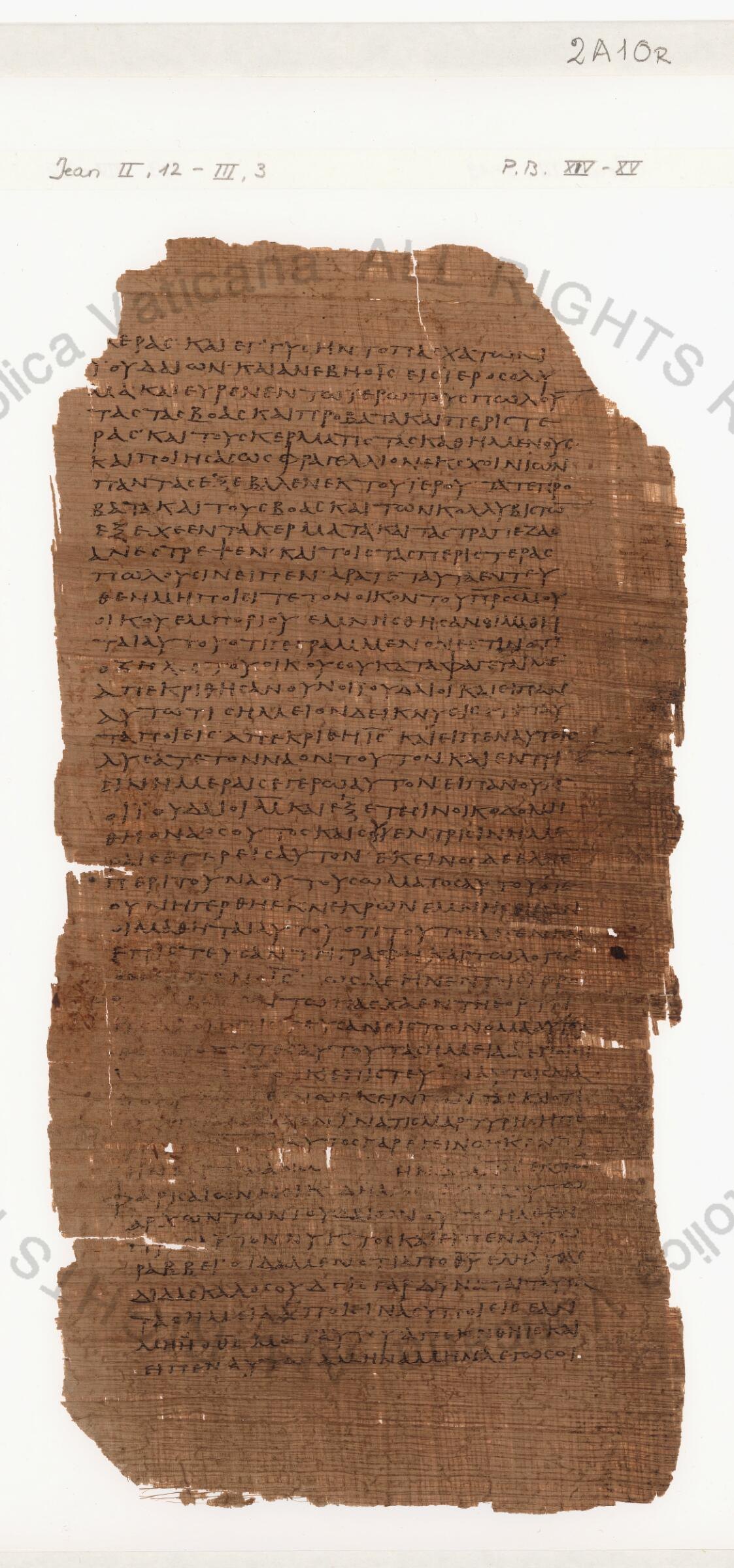
This entry covers fol. 46r (John 2:12-3:3), shown on the Vatican Library's photograph (frame 2A.10r).
How was this verified? (Provenance)
Where on the image
Vatican Library, Pap. Hanna 1 (Mater Verbi), DigiVatLib image 67, frame 2A.10r (https://digi.vatlib.it/view/MSS_Pap.Hanna.1(Mater.Verbi)/0067), cropped to the frame. NTVMR page 670 (folio 46r). 2:12 begins on the previous page; 3:3 continues on the next page. Checked on the image: near the top περι του ναου του σωματος αυτου (2:21), last line ειπεν αυτω αμην αμην λεγω σοι (3:3), matching the transcription of this page.
2:12 μ̣ερας· 13 και εγγυς ην το πασχα των
ιουδαιων· και ανεβη ο ι̅ς̅ εις ιεροσολυ
μα· 14 και ευρεν εν τω ιερω τους πωλουν
τας τας βοας και προβατα και περιστε
ρας· και τους κερματιστας καθημενους·
15 και ποιησας ως φραγελλιον εκ σχοινιων
παντας εξεβαλεν εκ του ιερου· τα τε προ
βατα και τους βοας και των κολλυβιστων
εξεχεεν τα κερματα· και τας τραπεζας
ανεστρεψεν· 16 και τοις τας περιστερας
πωλουσιν ειπεν· αρατε ταυτα εντευ
θεν μη ποιειτε τον οικον του π̅ρ̅ο̅ς̅ μου
οικου εμποριου· 17 εμνησθησαν οι μαθη
ται αυτου οτι γεγραμμενον εστιν οτι
ο ζηλο̣ς του οικου σου καταφαγεται με·
18 απεκριθησαν ουν οι ιουδαιοι και ειπαν
αυτω τι σημειον δεικνυεις οτι ταυ
τα ποιεις· 19 απεκριθη ι̅ς̅ και ειπεν αυτοις
λυσατε τον ναον τουτον. και εν τρι
σιν ημεραις εγερω αυτον· 20 ειπαν ουν
οι ιουδαιοι μ̅ και εξ ετεσιν οικοδομη
θη ο ναος ουτος και σοι εν τρισιν ημε
ραις εγερεις αυτον· 21 εκεινος δε ελεγεν
περι του ναου του σωματος αυτου 22 οτε
ουν ηγερθη εκ νεκρων εμνησθησαν
οι μαθηται αυτου οτι τουτο ελεγεν και
επιστευσαν τη γραφη και τω λογω
ο̣ν̣ ε̣ι̣πε̣ν ο ι̅ς̅· 23 ως δε ην εν τοις ιερο
σ̣ολυμοις̣ ε̣ν τω πασχα εν τη εορτη̣
πολλοι ε̣πιστε̣υσαν εις το ονομα αυτου
θε̣ω̣ρουν̣τες αυτου τα σημεια α εποιει
24 α̣υτ̣ο̣ς̣ [δ]ε̣ ι̅ς̅ ουκ επιστευεν αυτοις δια
το α̣υτ̣ο̣ν̣ γ̣ει̣νωσκειν παντας 25 και οτι
ου χρ̣ειαν ε̣ι̣χεν ινα τις μαρτυρηση πε
ρ̣ι̣ τ̣ο̣υ̣ α̣̣̅ν̣̣̅ο̣̣̅υ̣̣̅ αυτος γαρ εγεινωσκεν τι
ην εν τω α̅ν̅ω̅ 3:1 ην δε̣ α̅ν̅ο̣̣̅ς̅ εκ των
φαρισαιων νεικο̣δημος ο̣ν̣ο̣μα αυτω
αρχων των ιουδαιων 2 ουτος ηλθεν
πρ[ο]ς̣ αυτον νυκτος και ειπεν αυτω
ραββει· οιδαμεν οτι απο θ̅υ̅ εληλυθας
διδασκαλος ουδεις γαρ δυναται ταυτ̣α
τα σημεια α ποιειν α συ ποιεις εαν
μη η ο θ̅ς̅ μετ αυτο̣υ· 3 απεκριθη ι̅ς̅ και
ειπεν αυτω· αμην αμην λεγω σοι.
2:12¶ After this he went down to Capernaum, he, and his mother, and his brethren, and his disciples: and they continued there not many days. 13¶ And the Jews’ passover was at hand, and Jesus went up to Jerusalem, 14And found in the temple those that sold oxen and sheep and doves, and the changers of money sitting: 15And when he had made a scourge of small cords, he drove them all out of the temple, and the sheep, and the oxen; and poured out the changers’ money, and overthrew the tables; 16And said unto them that sold doves, Take these things hence; make not my Father’s house an house of merchandise. 17And his disciples remembered that it was written, The zeal of thine house hath eaten me up. 18¶ Then answered the Jews and said unto him, What sign shewest thou unto us, seeing that thou doest these things? 19Jesus answered and said unto them, Destroy this temple, and in three days I will raise it up. 20Then said the Jews, Forty and six years was this temple in building, and wilt thou rear it up in three days? 21But he spake of the temple of his body. 22When therefore he was risen from the dead, his disciples remembered that he had said this unto them; and they believed the scripture, and the word which Jesus had said. 23¶ Now when he was in Jerusalem at the passover, in the feast day, many believed in his name, when they saw the miracles which he did. 24But Jesus did not commit himself unto them, because he knew all men, 25And needed not that any should testify of man: for he knew what was in man. 3:1There was a man of the Pharisees, named Nicodemus, a ruler of the Jews: 2The same came to Jesus by night, and said unto him, Rabbi, we know that thou art a teacher come from God: for no man can do these miracles that thou doest, except God be with him. 3Jesus answered and said unto him, Verily, verily, I say unto thee, Except a man be born again, he can not see the kingdom of God.
Notes
- Greek: the NTVMR diplomatic transcription, line by line as on the papyrus. Square brackets enclose letters that are lost or illegible and were supplied by the transcribers; a dot under a letter marks it as uncertain; [...] marks a gap. Nomina sacra and numerals keep the scribe's overline. Spelling is the scribe's (no accents or breathings). Words broken at a line end stay broken as on the papyrus. Corrections are not shown: the text is the first hand.
- English: the King James Version (1611), whole verses, for every verse that has text on the page. A verse that begins on one page and ends on the next is given in full on both. The KJV translates a later form of the Greek text, so its wording does not always match the papyrus; material differences (such as verses the papyrus does not have) are noted in the section.
Cite
Sources
- Source: Papyrus Hanna 1 (Mater Verbi), Vatican Library: photographs from DigiVatLib; Greek from the INTF NTVMR transcription of P75; English from the King James Version (holding institution)
- Critical edition: INTF NTVMR diplomatic transcription (CC BY 4.0)
← previous · → next · v cycle view · l back to library