P75 (Papyrus Hanna 1): John 3:3-4:14 (fols. 46v-47v)
Introduction
P75 is a papyrus codex of Luke and John copied in Egypt around 175-225, the oldest known copy of Luke and one of the oldest of John. It was bought by Martin Bodmer in the 1950s and published as Papyrus Bodmer XIV-XV; in 2006 it was given to the Vatican Library, where it is kept as Papyrus Hanna 1 (Mater Verbi). Its text is very close to that of Codex Vaticanus, written some 150 years later. Where Luke ends and John begins (folio 44r) both titles stand on the same page.
About 51 leaves survive, many damaged at the top and edges, especially in Luke 3-7. Lost: Luke 1:1-3:17, most of 3:23-4:33, 5:11-36, 6:5-10, 7:33-34 and 7:44-45 (and parts of 7:36-49), 17:16-19, 18:19-22:3; John 11:46-47, 12:1-2, 13:11-14:7 and everything after 15:10 except small fragments. Each section below is one page: the photograph, the NTVMR diplomatic transcription line by line, and the King James Version of every verse on the page. Where P75 lacks a verse or words that the KJV has (for example John 5:4 or the account of the adulteress, John 7:53-8:11), the section says so. Six damaged pages (folios 7v, 11r, 39v, 58r, 58v and 64v) are left out because their text could not be matched to the photographs with certainty.
This entry covers fols. 46v-47v (John 3:3-4:14), shown on the Vatican Library's photographs (frames 2A.10v to 2A.11v).
How was this verified? (Provenance)
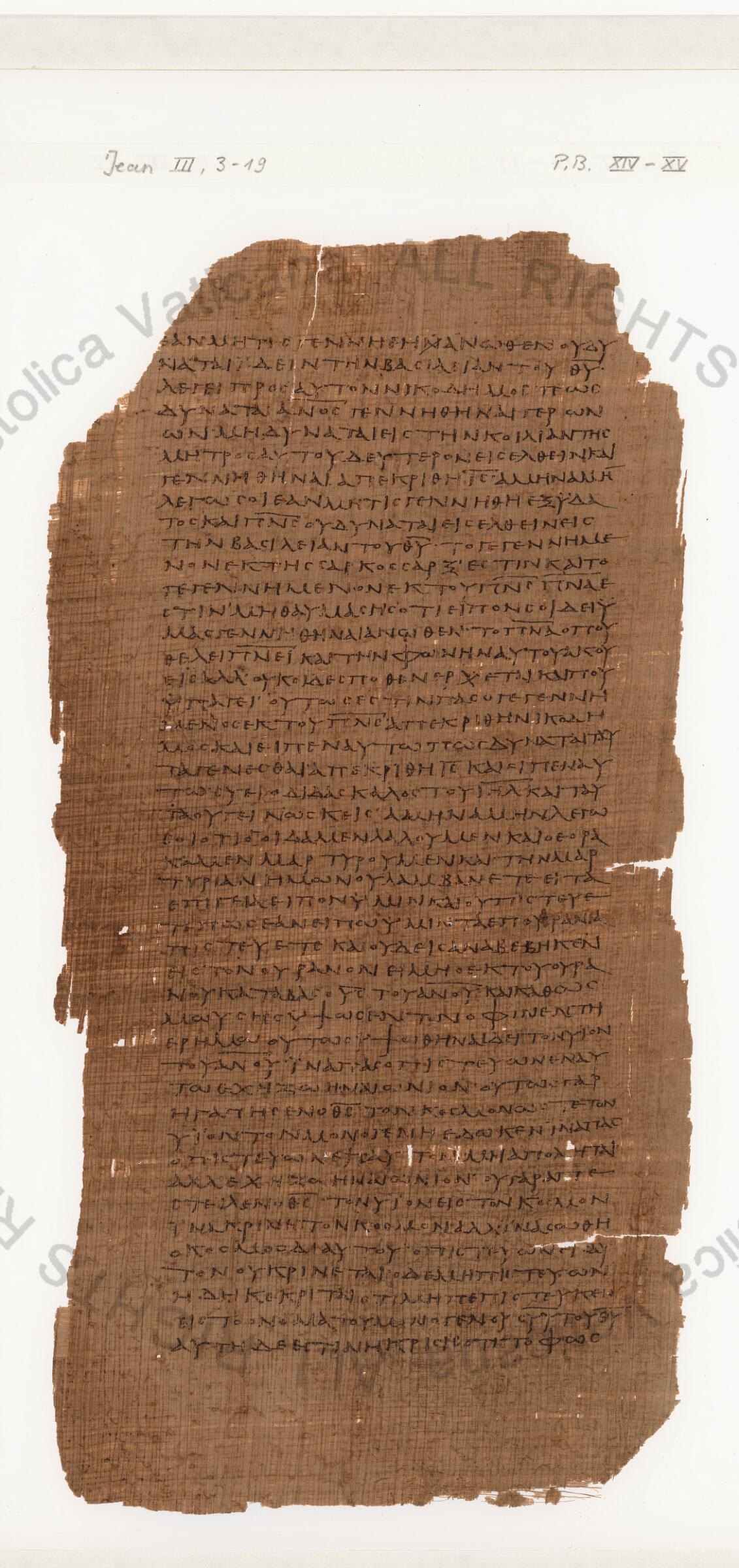
Where on the image
Vatican Library, Pap. Hanna 1 (Mater Verbi), DigiVatLib image 68, frame 2A.10v (https://digi.vatlib.it/view/MSS_Pap.Hanna.1(Mater.Verbi)/0068), cropped to the frame. NTVMR page 680 (folio 46v). 3:3 begins on the previous page; 3:19 continues on the next page. Checked on the image: near the top ινα κρινη τον κοσμον αλλ ινα σωθη ο κοσμος (3:17), near the foot εις το ονομα του μονογενους υιου του θ̅υ̅ (3:18), matching the transcription of this page.
3:3 εαν μη τις γεννηθην ανωθεν ου δυ
ναται ιδειν την βασιλειαν του θ̅υ̅·
4 λεγει προς αυτον νικοδημος· πως
δυναται α̅ν̅ο̅ς̅ γεννηθηναι γερων
ων· μη δυναται εις την κοιλιαν της
μητρος αυτου δευτερον εισελθειν και
γεννηθηναι. 5 απεκριθη ι̅ς̅· αμην αμην
λεγω σοι εαν μη τις γεννηθη εξ υδα
τος και π̅ν̅ς̅ ου δυναται εισελθειν εις
την βασιλειαν του θ̅υ̅· 6 το γεγεννημε
νον εκ της σαρκος σαρξ εστιν και το
γεγεννημενον εκ του π̅ν̅ς̅ π̅ν̅α̅ ε
στιν· 7 μη θαυμασης οτι ειπον σοι δει υ
μας γεννηθηναι ανωθεν· 8 το π̅ν̅α̅ οπου
θελει π̅ν̅ε̅ι̅ και την φωνην αυτου ακου
εις αλλ ουκ οιδες ποθεν ερχεται και που
υπαγει· ουτως εστιν πας ο γεγεννη
μενος εκ του π̅ν̅ς̅· 9 απεκριθη νικοδη
μος και ειπεν αυτω πως δυναται ταυ
τα γενεσθαι· 10 απεκριθη ι̅ς̅ και ειπεν αυ
τω· συ ει ο διδασκαλος του ι̅η̅λ̅ και ταυ
τα ου γεινωσκεις· 11 αμην αμην λεγω
σοι οτι ο οιδαμεν λαλουμεν και ο εορα
καμεν μαρτυρουμεν και την μαρ
τυριαν ημων ου λαμβανετε 12 ει τα
επιγεια ειπον υμιν και ου πιστευε
τε πως εαν ειπω υμιν τα επουρανια
πιστευετε· 13 και ουδεις αναβεβηκεν
εις τον ουρανον ει μη ο εκ του ουρα
νου καταβας ο υ̅ς̅ του α̅ν̅ο̅υ̅· 14 και καθως
μωυσης υψωσεν τον οφιν εν τη
ερημω ουτως υψωθηναι δει τον υιον
του α̅ν̅ο̅υ̅· 15 ινα πας ο πιστευων εν αυ
τω εχη ζωην αιωνιον· 16 ουτως γαρ
ηγαπησεν ο θ̅ς̅ τον κοσμον ωστε τον
υιον τον μονογενη εδωκεν ινα πας
ο πιστευων επ αυτον μη αποληται·
αλλ εχη ζωην αιωνιον· 17 ου γαρ απε
στειλεν ο θ̅ς̅ τον υιον εις τον κοσμον
ινα κρινη τον κοσμον· αλλ ινα σωθη
ο κοσμος δι αυτου· 18 ο πιστευων εις αυ
τον ου κρινεται· ο δε μη πιστευων
ηδη κεκριται οτι μη πεπιστευκεν
εις το ονομα του μονογενους υ̅υ̅ του θ̅υ̅·
19 αυτη δε εστιν η κρισις οτι το φως
3:3Jesus answered and said unto him, Verily, verily, I say unto thee, Except a man be born again, he can not see the kingdom of God. 4Nicodemus saith unto him, How can a man be born when he is old? can he enter the second time into his mother’s womb, and be born? 5Jesus answered, Verily, verily, I say unto thee, Except a man be born of water and of the Spirit, he can not enter into the kingdom of God. 6That which is born of the flesh is flesh; and that which is born of the Spirit is spirit. 7Marvel not that I said unto thee, Ye must be born again. 8The wind bloweth where it listeth, and thou hearest the sound thereof, but canst not tell whence it cometh, and whither it goeth: so is every one that is born of the Spirit. 9Nicodemus answered and said unto him, How can these things be? 10Jesus answered and said unto him, Art thou a master of Israel, and knowest not these things? 11Verily, verily, I say unto thee, We speak that we do know, and testify that we have seen; and ye receive not our witness. 12If I have told you earthly things, and ye believe not, how shall ye believe, if I tell you of heavenly things? 13And no man hath ascended up to heaven, but he that came down from heaven, even the Son of man which is in heaven. 14¶ And as Moses lifted up the serpent in the wilderness, even so must the Son of man be lifted up: 15That whosoever believeth in him should not perish, but have eternal life. 16¶ For God so loved the world, that he gave his only begotten Son, that whosoever believeth in him should not perish, but have everlasting life. 17For God sent not his Son into the world to condemn the world; but that the world through him might be saved. 18¶ He that believeth on him is not condemned: but he that believeth not is condemned already, because he hath not believed in the name of the only begotten Son of God. 19And this is the condemnation, that light is come into the world, and men loved darkness rather than light, because their deeds were evil.
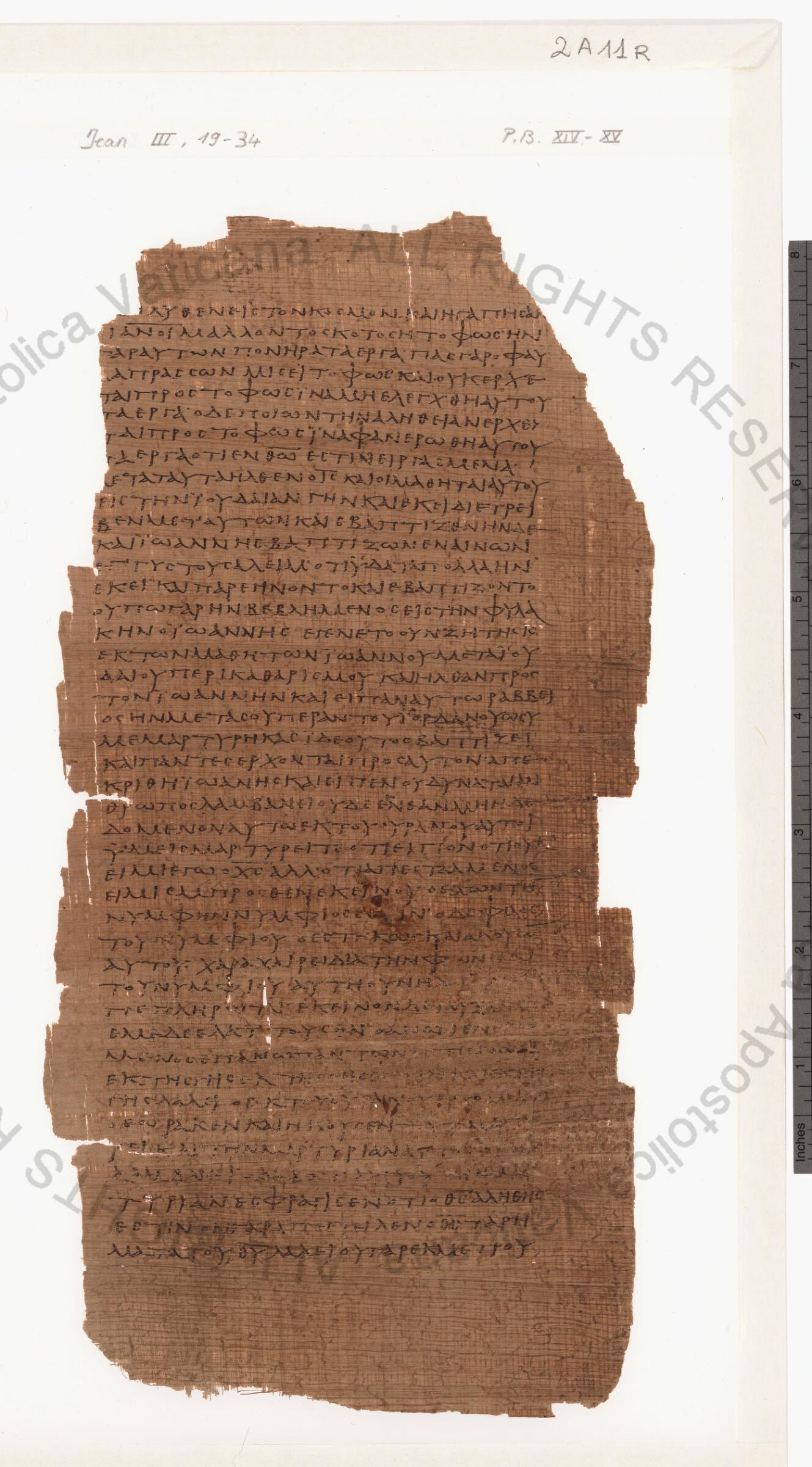
Where on the image
Vatican Library, Pap. Hanna 1 (Mater Verbi), DigiVatLib image 69, frame 2A.11r (https://digi.vatlib.it/view/MSS_Pap.Hanna.1(Mater.Verbi)/0069), cropped to the frame. NTVMR page 690 (folio 47r). 3:19 begins on the previous page; 3:34 continues on the next page. Checked on the image: first line [ε]ληλυθεν εις τον κοσμον και ηγαπησαν, last line θ̅υ̅ λαλει ου γαρ εκ μετρου (3:34), matching the transcription of this page.
3:19 [ε]λ̣η̣λυθεν εις τον κοσμον. και ηγαπησαν̣
[ο]ι α̅ν̅ο̅ι̅ μαλλον το σκοτος η το φως· ην
γ̣αρ αυτων πονηρα τα εργα· 20 πας γαρ ο φαυ
λ̣α πρασσων μισει το φως και ουκ ερχε
ται προς το φως ινα μη ελεγχθη αυτου
τα εργα· 21 ο δε ποιων την αληθειαν ερχε
ται προς το φως ινα φανερωθη αυτου
τ̣α εργα οτι εν θ̅ω̅ εστιν ειργασμενα·
22 μ̣ετα ταυτα ηλθεν ο ι̅ς̅ και οι μαθηται αυτου
εις την ιουδαιαν γην και εκει διετρει
βεν μετ αυτων και εβαπτιζεν 23 ην δε
και ιωαννης βαπτιζων εν αινων
εγγυς του σαλειμ· οτι υδατα πολλα ην
εκει· και παρεγινοντο και εβαπτιζοντο
24 ουπω γαρ ην βεβλημενος εις την φυλα
κην ο ιωαννης· 25 εγενετο ουν ζητησις
εκ των μαθητων ιωαννου μετα ιου
δαιου περι καθαρισμου 26 και ηλθαν προς
τον ιωαννην και ειπαν αυτω ραββει
ος ην μετα σου περαν του ιορδανου ω συ
μεμαρτυρηκας ιδε ουτος βαπτιζει
και παντες ερχονται προς αυτον· 27 απε
κριθη ιωανης και ειπεν ου δυναται αν
θρωπος λαμβανει ουδε εν εαν μη η δε
δομενον αυτω εκ του ουρανου· 28 αυτοι
υμεις μαρτυρειτε οτι ειπον οτι ουκ
ειμι εγω ο χ̅ς̅· αλλ οτι απεσταλμενος
ειμι εμπροσθεν εκεινου· 29 ο εχων την
νυμφην νυμφιος εστ̣ιν· ο δε φιλος
του νυμφιου ο εστηκως και ακουων
αυτου. χαρα χαιρει δια την φωνην
του νυμφιου· αυτη ουν η χα̣ρα̣ η̣ ε̣μ̣η̣
πεπληρω̣τ̣αι· 30 εκεινον δει αυξανε̣[ιν]
εμε δε ελαττουσθαι· 31 ο ανωθ̣εν ε̣ρ̣[χο]
μενος επανω παντων ε̣στιν̣· ο̣ ων̣
εκ της γης εκ της γης εσ̣τιν και εκ τ̣ης̣
γης λαλει ο εκ του ουρανου ερχομε̣ν̣ο̣ς̣
32 ο εωρακεν και ηκουσεν το̣υτ̣ο̣ μα̣ρτυ̣
ρει και την μαρτυριαν αυτο̣υ̣ ο̣υ̣δ̣ε̣[ις]
λα̣μβανει· 33 ο λαβων αυτου τ̣η̣ν μα̣ρ̣
τυριαν εσφραγισεν οτι ο θ̅ς̅ αληθης
εστιν 34 ον γαρ απε̣στειλεν ο θ̅ς̅ τα ρη
ματα του θ̅υ̅ λαλει ου γαρ εκ μετρου
3:19And this is the condemnation, that light is come into the world, and men loved darkness rather than light, because their deeds were evil. 20For every one that doeth evil hateth the light, neither cometh to the light, lest his deeds should be reproved. 21But he that doeth truth cometh to the light, that his deeds may be made manifest, that they are wrought in God. 22¶ After these things came Jesus and his disciples into the land of Judæa; and there he tarried with them, and baptized. 23¶ And John also was baptizing in Ænon near to Salim, because there was much water there: and they came, and were baptized. 24For John was not yet cast into prison. 25¶ Then there arose a question between some of John’s disciples and the Jews about purifying. 26And they came unto John, and said unto him, Rabbi, he that was with thee beyond Jordan, to whom thou barest witness, behold, the same baptizeth, and all men come to him. 27John answered and said, A man can receive nothing, except it be given him from heaven. 28Ye yourselves bear me witness, that I said, I am not the Christ, but that I am sent before him. 29He that hath the bride is the bridegroom: but the friend of the bridegroom, which standeth and heareth him, rejoiceth greatly because of the bridegroom’s voice: this my joy therefore is fulfilled. 30He must increase, but I must decrease. 31He that cometh from above is above all: he that is of the earth is earthly, and speaketh of the earth: he that cometh from heaven is above all. 32And what he hath seen and heard, that he testifieth; and no man receiveth his testimony. 33He that hath received his testimony hath set to his seal that God is true. 34For he whom God hath sent speaketh the words of God: for God giveth not the Spirit by measure unto him.
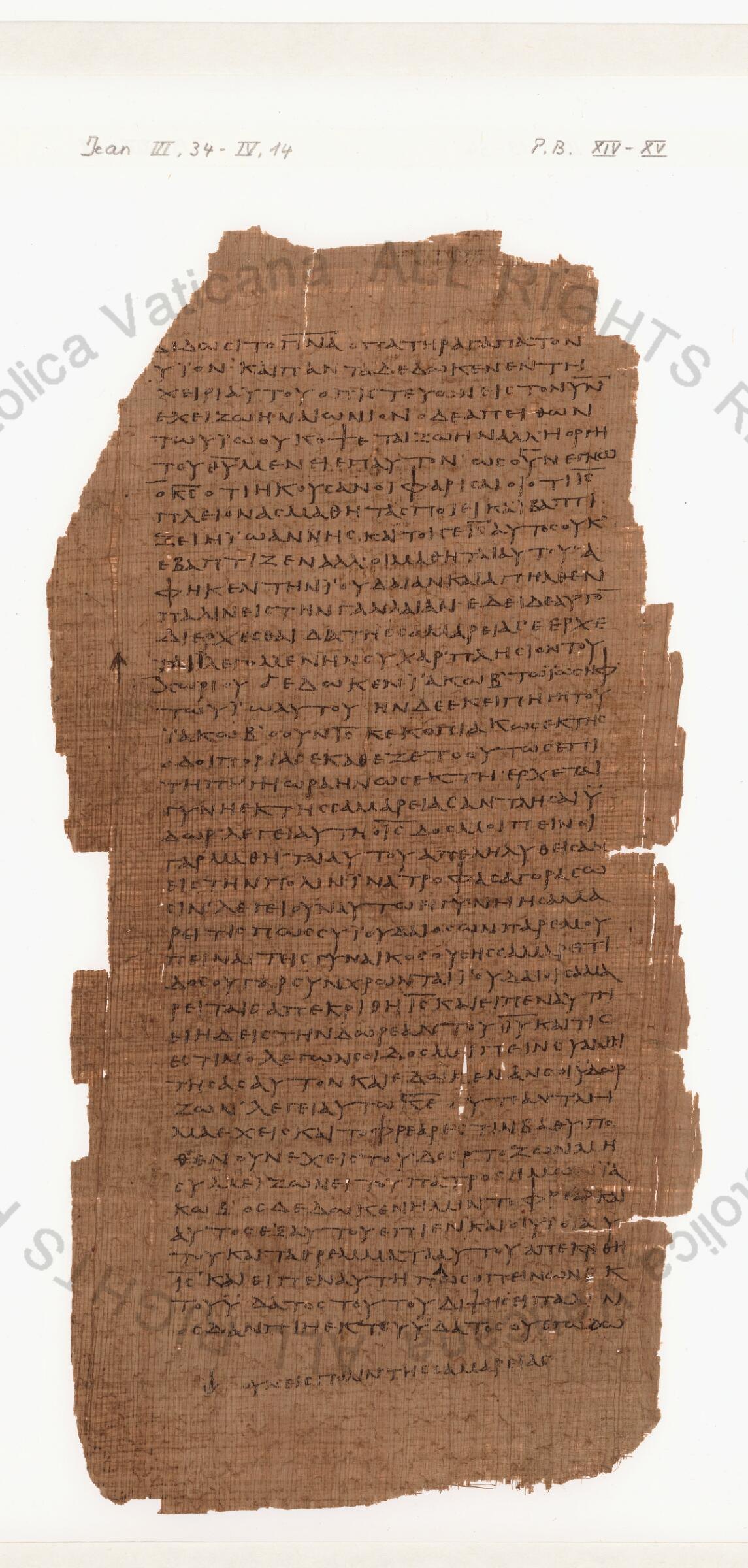
Where on the image
Vatican Library, Pap. Hanna 1 (Mater Verbi), DigiVatLib image 70, frame 2A.11v (https://digi.vatlib.it/view/MSS_Pap.Hanna.1(Mater.Verbi)/0070), cropped to the frame. NTVMR page 700 (folio 47v). 3:34 begins on the previous page; 4:14 continues on the next page. Checked on the image: first line διδωσι το π̅ν̅α̅ ο πατηρ αγαπα, last line εκ του υδατος ου εγω δω[σω] (4:14), matching the transcription of this page.
3:34 δ̣ιδωσι το π̅ν̅α̅ 35 ο πατηρ αγαπα τον
υιον· και παντα δεδωκεν εν τη
χειρι αυτου 36 ο πιστευων εις τον υ̅ν̅
εχει ζωην αιωνιον ο δε απειθων
τω υιω ουκ οψεται ζωην αλλ η οργη
του θ̅υ̅ μενει επ αυτον· 4:1 ως ουν εγνω
ο κ̅ς̅ οτι ηκουσαν οι φαρισαιοι οτι ι̅ς̅
πλειονας μαθητας ποιει και βαπτι
ζει η ιωαννης. 2 καιτοιγε ι̅ς̅ αυτος ουκ
εβαπτιζεν αλλ οι μαθηται αυτου· 3 α
φηκεν την ιουδαιαν και απηλθεν
παλιν εις την γαλιλαιαν· 4 εδει δε αυτον
διερχεσθαι δια της σαμαρειας 5 εερχε
ται λεγομενην συχαρ· πλησιον του
χωριου ο εδωκεν ιακωβ τω ιωσηφ
τω υιω αυτου· 6 ην δε εκει πηγη του
ιακωβ· ο ουν ι̅ς̅ κεκοπιακως εκ της
οδοιποριας εκαθεζετο ουτως επι
τη πηγη ωρα ην ως εκτη· 7 ερχεται
γυνη εκ της σαμαρειας αντλησαι υ
δωρ· λεγει αυτη ο ι̅ς̅ δος μοι πειν 8 οι
γαρ μαθηται αυτου απεληλυθεισαν
εις την πολιν ινα τροφας αγορασω
σιν· 9 λεγει ουν αυτω η γυνη η σαμα
ρειτις πως συ ιουδαιος ων παρ εμου
πειν αιτεις γυναικος ουσης σαμαρειτι
δος ου γαρ συνχρωνται ιουδαιοι σαμα
ρειταις· 10 απεκριθη ι̅ς̅ και ειπεν αυτη
ει ηδεις την δωρεαν του θ̅υ̅ και τις
εστιν ο λεγων σοι δος μο̣ι πειν συ αν η
τησας αυτον και εδωκεν αν σοι υδωρ
ζων· 11 λεγει αυτω κ̅ε̅ ουτε αντλη
μα εχεις και το φρεαρ εστιν βαθυ· πο
θεν ουν εχεις το υδωρ το ζων· 12 μη
συ μειζων ει του πατρος ημων ια
κωβ· ος δεδωκεν ημιν το φρεαρ και
αυτος εξ αυτου επιεν και οι υιοι αυ
του και τα θρεμματα αυτου· 13 απεκριθη
ι̅ς̅ και ειπεν αυτη πως ο πεινων εκ
του υδατος τουτου διψησει παλιν
14 ος δ αν πιη εκ του υδατος ου εγω δω
3:34For he whom God hath sent speaketh the words of God: for God giveth not the Spirit by measure unto him. 35The Father loveth the Son, and hath given all things into his hand. 36He that believeth on the Son hath everlasting life: and he that believeth not the Son shall not see life; but the wrath of God abideth on him. 4:1When therefore the Lord knew how the Pharisees had heard that Jesus made and baptized more disciples than John, 2(Though Jesus himself baptized not, but his disciples,) 3He left Judæa, and departed again into Galilee. 4And he must needs go through Samaria. 5Then cometh he to a city of Samaria, which is called Sychar, near to the parcel of ground that Jacob gave to his son Joseph. 6Now Jacob’s well was there. Jesus therefore, being wearied with his journey, sat thus on the well: and it was about the sixth hour. 7There cometh a woman of Samaria to draw water: Jesus saith unto her, Give me to drink. 8(For his disciples were gone away unto the city to buy meat.) 9Then saith the woman of Samaria unto him, How is it that thou, being a Jew, askest drink of me, which am a woman of Samaria? for the Jews have no dealings with the Samaritans. 10Jesus answered and said unto her, If thou knewest the gift of God, and who it is that saith to thee, Give me to drink; thou wouldest have asked of him, and he would have given thee living water. 11The woman saith unto him, Sir, thou hast nothing to draw with, and the well is deep: from whence then hast thou that living water? 12Art thou greater than our father Jacob, which gave us the well, and drank thereof himself, and his children, and his cattle? 13Jesus answered and said unto her, Whosoever drinketh of this water shall thirst again: 14But whosoever drinketh of the water that I shall give him shall never thirst; but the water that I shall give him shall be in him a well of water springing up into everlasting life.
Notes
- Greek: the NTVMR diplomatic transcription, line by line as on the papyrus. Square brackets enclose letters that are lost or illegible and were supplied by the transcribers; a dot under a letter marks it as uncertain; [...] marks a gap. Nomina sacra and numerals keep the scribe's overline. Spelling is the scribe's (no accents or breathings). Words broken at a line end stay broken as on the papyrus. Corrections are not shown: the text is the first hand.
- English: the King James Version (1611), whole verses, for every verse that has text on the page. A verse that begins on one page and ends on the next is given in full on both. The KJV translates a later form of the Greek text, so its wording does not always match the papyrus; material differences (such as verses the papyrus does not have) are noted in the section.
Cite
Sources
- Source: Papyrus Hanna 1 (Mater Verbi), Vatican Library: photographs from DigiVatLib; Greek from the INTF NTVMR transcription of P75; English from the King James Version (holding institution)
- Critical edition: INTF NTVMR diplomatic transcription (CC BY 4.0)
← previous · → next · v cycle view · l back to library