P75 (Papyrus Hanna 1): John 5:9-6:7 (fols. 49v-50v)
Introduction
P75 is a papyrus codex of Luke and John copied in Egypt around 175-225, the oldest known copy of Luke and one of the oldest of John. It was bought by Martin Bodmer in the 1950s and published as Papyrus Bodmer XIV-XV; in 2006 it was given to the Vatican Library, where it is kept as Papyrus Hanna 1 (Mater Verbi). Its text is very close to that of Codex Vaticanus, written some 150 years later. Where Luke ends and John begins (folio 44r) both titles stand on the same page.
About 51 leaves survive, many damaged at the top and edges, especially in Luke 3-7. Lost: Luke 1:1-3:17, most of 3:23-4:33, 5:11-36, 6:5-10, 7:33-34 and 7:44-45 (and parts of 7:36-49), 17:16-19, 18:19-22:3; John 11:46-47, 12:1-2, 13:11-14:7 and everything after 15:10 except small fragments. Each section below is one page: the photograph, the NTVMR diplomatic transcription line by line, and the King James Version of every verse on the page. Where P75 lacks a verse or words that the KJV has (for example John 5:4 or the account of the adulteress, John 7:53-8:11), the section says so. Six damaged pages (folios 7v, 11r, 39v, 58r, 58v and 64v) are left out because their text could not be matched to the photographs with certainty.
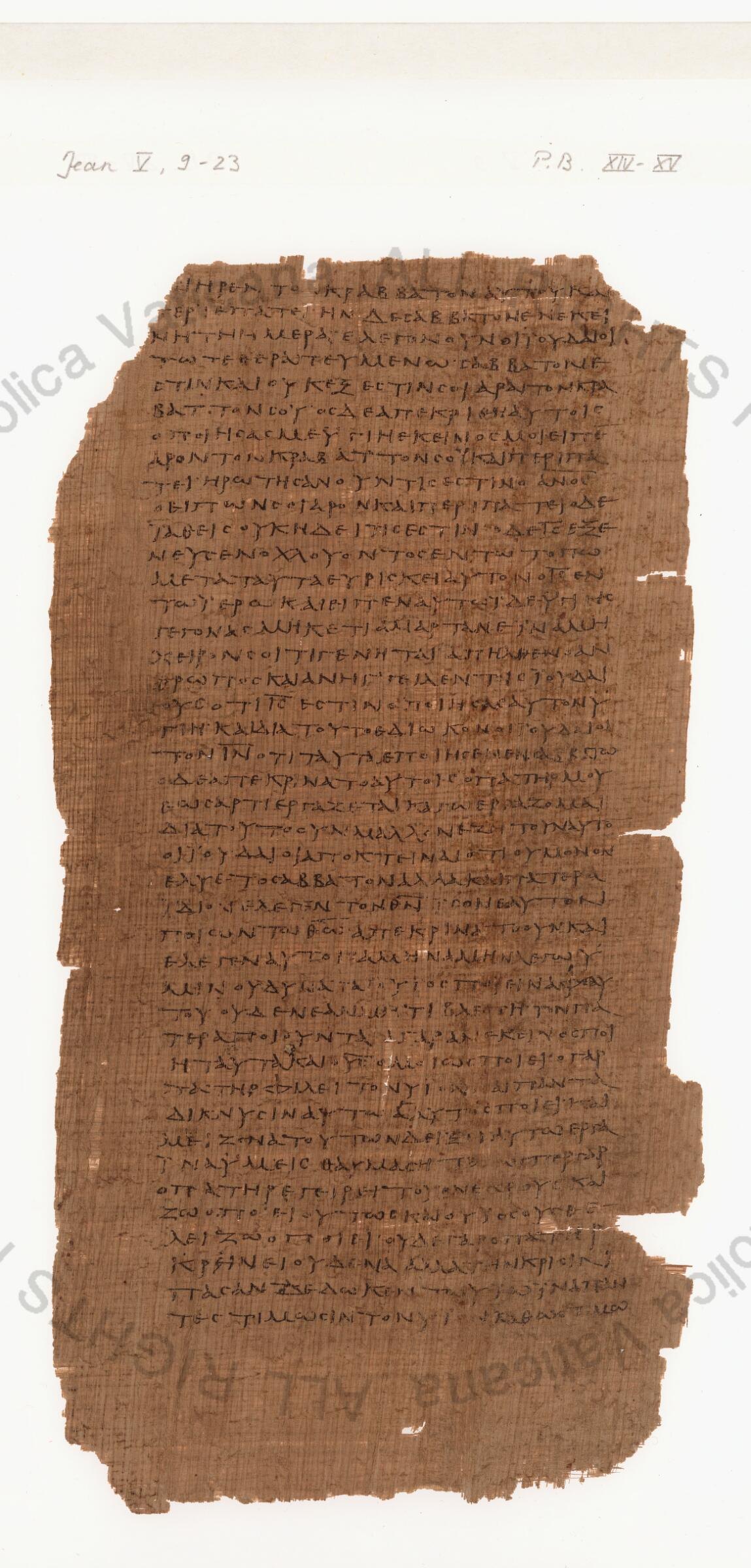
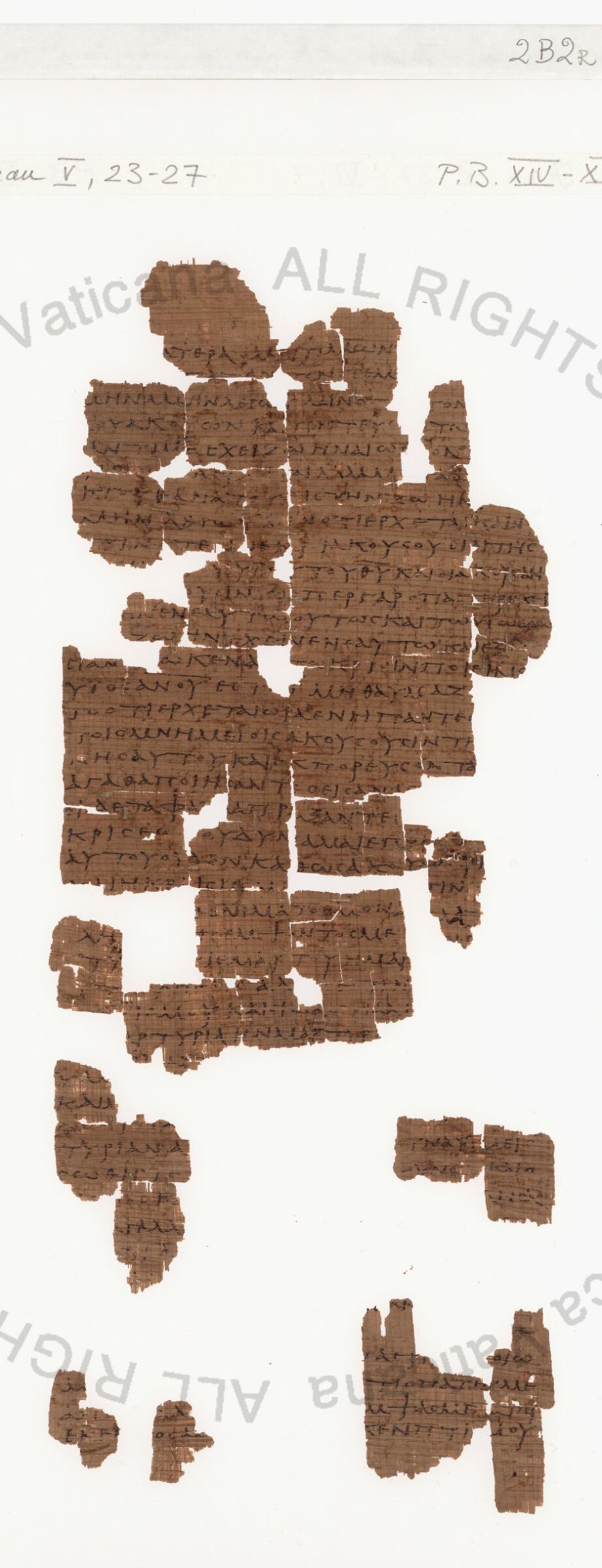
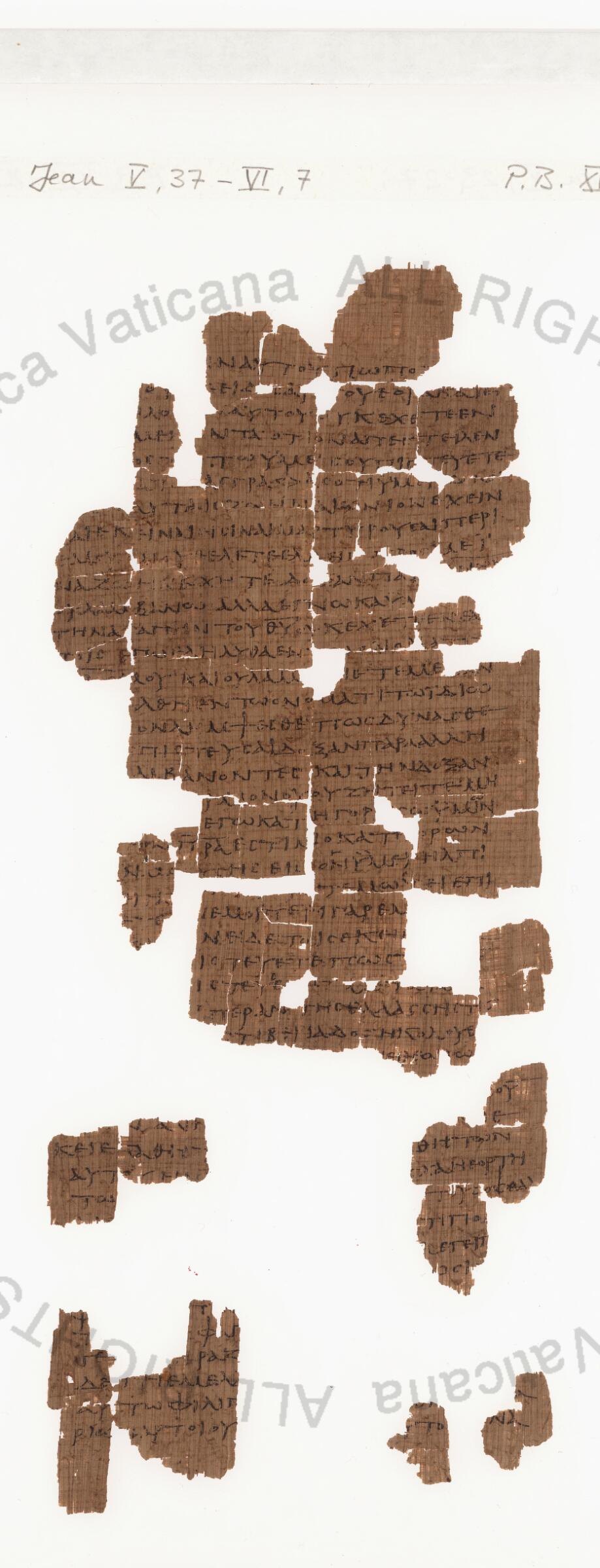
This entry covers fols. 49v-50v (John 5:9-6:7), shown on the Vatican Library's photographs (frames 2B.1v to 2B.2v).
How was this verified? (Provenance)
Where on the image
Vatican Library, Pap. Hanna 1 (Mater Verbi), DigiVatLib image 74, frame 2B.1v (https://digi.vatlib.it/view/MSS_Pap.Hanna.1(Mater.Verbi)/0074), cropped to the frame. NTVMR page 740 (folio 49v). 5:9 begins on the previous page; 5:23 continues on the next page. Checked on the image: first line [κ]αι ηρεν τον κραββατον αυτου και, last line [παν]τες τιμωσιν τον υιον καθως τιμω[σι] (5:23), matching the transcription of this page.
5:9 [κ]α̣ι ηρεν τον̣ κραββατον αυτου και̣
π̣εριεπατει· ην δε σαββατον εν εκει
νη τη ημερα· 10 ελεγον ουν οι ιουδαιοι
τω τεθεραπευμενω· σαββατον ε
στιν και ουκ εξεστιν σοι αραι τον κρα
βαττον σου· 11 ος δε απεκριθη αυτοις
ο ποιησας με υγιη εκεινος μοι ειπεν
αρον τον κραβαττον σοι και περιπα
τει· 12 ηρωτησαν ουν τις εστιν ο α̅ν̅ο̅ς̅
ο ειπων σοι αρον και περιπατει 13 ο δε
ιαθεις ουκ ηδει τις εστιν· ο δε ι̅ς̅ εξε
νευσεν οχλου οντος εν τω τοπω·
14 μετα ταυτα ευρισκει αυτον ο ι̅ς̅ εν
τω ιερω και ειπεν αυτω ιδε υγιης
γεγονας μηκετι αμαρτανε ινα μη
χειρον σοι τι γενηται· 15 απηλθεν ο αν
θ̣ρωπος και ανηγγειλεν το̣ις ιουδαι
ους οτι ι̅ς̅ εστιν ο ποιησας αυτον υ
γιη· 16 και δια τουτο εδιωκον οι ιουδαιοι
τον ι̅ν̅ οτι ταυτα εποιησεν εν σαββατω
17 ο δε απεκρινατο αυτοις ο πατηρ μου
εως αρτι εργαζεται καγω εργαζομαι
18 δια τουτο ουν μαλλον εζητουν αυτον
οι ιουδαιοι αποκτειναι οτι ου μονον
ελυε το σαββατον αλλα και πατερα
ιδιον ελεγεν τον θ̅ν̅ ισον εαυτον
ποιων τω θ̅ω̅· 19 απεκρινατο ουν και
ελεγεν αυτοις αμην αμην λεγω υ
μιν ου δυναται ο υιος ποιειν αφ αυ
του ουδεν εαν μη τι βλεπη τον πα
τερα ποιουντα α γαρ αν εκεινος ποι
η ταυτα και ο υ̅ς̅ ομοιως ποιει· 20 ο γαρ
πατηρ φιλει τον υιον κ̣αι παντα
δικνυσιν αυτω α αυτος ποιει· και
μειζονα τουτων δειξει αυτω εργα
ινα υμεις θαυμασητε̣ 21 ωσπερ γαρ
ο πατηρ εγειρει τους̣ νεκρους και
ζωοποι̣ει ουτως και ο υιος ους θε
λει ζωοποιει· 22 ουδε γαρ ο πατηρ
κρεινει ουδενα αλλα την κρισιν
πασαν τεδωκεν τω υιω 23 ινα παν
τες τιμωσιν τον υιον καθως τιμω
5:9And immediately the man was made whole, and took up his bed, and walked: and on the same day was the sabbath. 10¶ The Jews therefore said unto him that was cured, It is the sabbath day: it is not lawful for thee to carry thy bed. 11He answered them, He that made me whole, the same said unto me, Take up thy bed, and walk. 12Then asked they him, What man is that which said unto thee, Take up thy bed, and walk? 13And he that was healed wist not who it was: for Jesus had conveyed himself away, a multitude being in that place. 14Afterward Jesus findeth him in the temple, and said unto him, Behold, thou art made whole: sin no more, lest a worse thing come unto thee. 15The man departed, and told the Jews that it was Jesus, which had made him whole. 16And therefore did the Jews persecute Jesus, and sought to slay him, because he had done these things on the sabbath day. 17¶ But Jesus answered them, My Father worketh hitherto, and I work. 18Therefore the Jews sought the more to kill him, because he not only had broken the sabbath, but said also that God was his Father, making himself equal with God. 19Then answered Jesus and said unto them, Verily, verily, I say unto you, The Son can do nothing of himself, but what he seeth the Father do: for what things soever he doeth, these also doeth the Son likewise. 20For the Father loveth the Son, and sheweth him all things that himself doeth: and he will shew him greater works than these, that ye may marvel. 21For as the Father raiseth up the dead, and quickeneth them; even so the Son quickeneth whom he will. 22For the Father judgeth no man, but hath committed all judgment unto the Son: 23That all men should honour the Son, even as they honour the Father. He that honoureth not the Son honoureth not the Father which hath sent him.
Where on the image
Vatican Library, Pap. Hanna 1 (Mater Verbi), DigiVatLib image 75, frame 2B.2r (https://digi.vatlib.it/view/MSS_Pap.Hanna.1(Mater.Verbi)/0075), cropped to the frame. NTVMR page 750 (folio 50r). 5:23 begins on the previous page; 5:37 continues on the next page. Checked on the image: near the top υιος α̅ν̅ο̅υ̅ εστιν μη θαυμαζετε τουτο οτι ερχεται ωρα (5:27-28), matching the transcription of this page.
5:23 [σιν τον π]α̣τερα· ο μη̣ τιμων [τον υιον ου]
[τιμα τον] π̣α̣τ̣ε̣ρ̣[α] τον πεμ[ψαντα αυτον]
24 [α]μ̣ην αμην λεγω υ̣μιν οτ̣[ι ο] τον [λογον]
μ̣ου ακουων και̣ πιστευω̣ν̣ τω [πεμ]
[ψ]α̣ντι με εχει ζωην αιων̣[ι]ον [και εις]
[κ]ρ̣ι̣σ̣ι̣ν̣ [ου]κ̣ ε̣ρ̣χ̣ε̣τ̣αι αλλα μ[ε]τ̣αβ[εβηκεν]
[ε]κ του θανατου ε̣ις την ζωην̣ 25 [αμην]
[α]μην λεγω υ̣μ̣ιν οτι ερχεται και νυ̣[ν]
[εσ]τιν ο̣τε [ο]ι ν̣εκρο̣ι ακουσουσιν της
[φωνης] τ̣ο̣υ υιο̣υ̣ του θ̅υ̅ και οι ακουσαν
[τες ζησ]ουσιν· 26 ωσπερ γαρ ο πατ̣ηρ εχει
[ζω]η̣ν εν εαυτω ουτως και τω υ̣ιω εδω
[κεν] ζ̣ωην εχειν εν εαυτω· 27 και εξο̣υ̣
σιαν [εδ]ωκεν α[υ]τ̣ω κρισιν ποιειν ο̣[τι]
υιος α̅ν̅ο̅υ̅ εστι̣ν̣· 28 μη θαυμαζ[ετε του]
το οτι ερχεται ωρα εν η παντες̣ [οι εν]
τοις μνημειοις ακουσουσιν τη̣[ς φω]
ν̣ης αυτου 29 και εκπορευσοντα[ι οι τα]
αγαθα ποιησαντες εις αν̣α̣[στασιν ζωης]
οι δε τα φαυ̣λ̣α πραξαντες̣ [εις αναστασιν]
κρισεω̣[ς] 30 ου δυναμαι εγω ποι̣ε̣[ιν απ εμ]
αυτου ουδεν· καθως ακουω κ̣ρι[νω]
κ̣α̣ι η κρι̣[σ]ις η̣ ε̣μη̣ [δικαια εσ]τ̣ιν· [οτι]
[ου ζητω το] θ̣ελημα το εμον α̣[λ]λο τ̣[ο θε]
λη[μα του] πεμψαντος με· 31 [εα]ν̣ ε̣[γω μαρ]
τυ[ρω πε]ρ̣ι εμαυτου η μαρ[τυρια μου ουκ ε]
στ[ιν] α̣λ̣η̣θ̣η̣ς· 32 αλ[λο]ς̣ ε[σ]τιν [ο μαρτυρων]
[περ]ι εμου και οιδ̣α ο̣τι αλη̣[θης εστιν]
[η μ]α̣ρτυρια ην μαρτυρε̣[ι περι εμου]
33 υμε̣ι̣[ς] απ̣[εσταλκατε προς ιωαννην]
και μ̣[εμαρτυρηκεν τη αληθεια] 34 [εγω]
δε̣ [ο]υ̣ π̣α̣[ρα α̅ν̅ο̅υ̅ λαμβανω την μαρ]
τυριαν· α[λλα ταυτα λεγ]ω̣ ινα υμεις
σωθητε 35 [εκεινος ην ο λ]υ̣χ̣νος ο καιο
μ̣ε̣ν̣ος κα̣[ι φαινων υμεις δε ηθε]λ̣ησα
[τε] α̣γαλλ[ιαθηναι προς ωραν εν τω]
[φω]τ̣ι̣ α[υτου] 36 [εγω δε εχω την μαρτυρι]
[αν] μ̣[ειζω του ι]ω̣α̣ν̣[νου τα γαρ ε]ρ̣
[γα α δεδωκεν μοι ο πατηρ ινα] τ̣ε̣
[λειωσω αυτα αυτα] τ̣α εργ̣[α α π]οιω
μ[αρτυρει περι εμου ο]τι ο πατηρ με
απ̣ε̣[στ]αλ[κεν] 37 [και ο πε]μψας με πατηρ
εκει[ν]ος μ[εμαρτυρη]κεν πε̣ρι [ε]μ̣ου
5:23That all men should honour the Son, even as they honour the Father. He that honoureth not the Son honoureth not the Father which hath sent him. 24Verily, verily, I say unto you, He that heareth my word, and believeth on him that sent me, hath everlasting life, and shall not come into condemnation; but is passed from death unto life. 25Verily, verily, I say unto you, The hour is coming, and now is, when the dead shall hear the voice of the Son of God: and they that hear shall live. 26For as the Father hath life in himself; so hath he given to the Son to have life in himself; 27And hath given him authority to execute judgment also, because he is the Son of man. 28Marvel not at this: for the hour is coming, in the which all that are in the graves shall hear his voice, 29And shall come forth; they that have done good, unto the resurrection of life; and they that have done evil, unto the resurrection of damnation. 30I can of mine own self do nothing: as I hear, I judge: and my judgment is just; because I seek not mine own will, but the will of the Father which hath sent me. 31If I bear witness of myself, my witness is not true. 32¶ There is another that beareth witness of me; and I know that the witness which he witnesseth of me is true. 33Ye sent unto John, and he bare witness unto the truth. 34But I receive not testimony from man: but these things I say, that ye might be saved. 35He was a burning and a shining light: and ye were willing for a season to rejoice in his light. 36¶ But I have greater witness than that of John: for the works which the Father hath given me to finish, the same works that I do, bear witness of me, that the Father hath sent me. 37And the Father himself, which hath sent me, hath borne witness of me. Ye have neither heard his voice at any time, nor seen his shape.
Where on the image
Vatican Library, Pap. Hanna 1 (Mater Verbi), DigiVatLib image 76, frame 2B.2v (https://digi.vatlib.it/view/MSS_Pap.Hanna.1(Mater.Verbi)/0076), cropped to the frame. NTVMR page 760 (folio 50v). 5:37 begins on the previous page; 6:7 continues on the next page. Checked on the image: near the top τον λογον αυτου ουκ εχετε μενοντα (5:38), matching the transcription of this page.
5:37 [ουτε φων]η̣ν αυτου πωποτ̣[ε ακη]
[κοατε] ου̣[τ]ε̣ ειδ̣[ο]ς αυτ̣ου εορ̣α̣κατ̣ε
38 [και το]ν̣ λο[γο]ν̣ αυτου ο̣υκ εχετε εν
[υμιν] μεν̣[ο]ντα· οτι ον απεστειλεν
[εκειν]ος τ̣[ο]υ̣τω υμει̣ς ου πιστευετε
39 [εραυν]ατε̣ τ̣ας γραφας οτι υμε̣ι̣[ς] δ̣ο̣κε̣ι̣
[τε εν] αυταις ζωην αιωνιον εχειν
[κ]αι εκειναι εισιν αι μαρτυρουσαι περι
εμου 40 [κ]αι ου θελετε ελθ̣ειν̣ π̣ρ̣ος̣ μ̣ε ι
να ζωην εχητε 41 δο̣ξ̣αν παρ̣[α α̅]ν̅ω̅ν̣̣̅
ο̣υ λαμβανω· 42 αλλα εγνωκα υμ̣[ας οτι]
την αγ̣απην του θ̅υ̅ ουκ εχετε εν εα[υ]
τοις· 43 εγω εληλυθα εν [τ]ω̣ ονομ̣ατ̣ι̣ τ̣[ου]
[π̅]ρ̣̣̅[ο̅]ς̣̣̅ μ̣ου· και ου λαμ[βα]ν̣ετε με [ε]α̣ν
[αλλος] ε̣λθη εν τω ονοματι τω ιδιω
[εκειν]ον λημψεσθε· 44 πως δυνασθε
[υμει]ς̣ πιστευσαι δοξαν παρα αλλη
[λων λα]μβανοντες· και την δοξαν
[την παρα το]υ̣ μονου ου ζητειτε· 45 μη
[δοκειτε οτι] εγω κατηγορ[η]σω υμιν
[προς] τ̣ον π̅ρ̅α̅ εστιν ο κατη̣[γ]ορων
[υμω]ν μω̣υσης εις̣ ον υμεις̣ ηλπι
[κατε] 46 ει γα[ρ επιστε]υ̣[ε]τε̣ μωυ̣σ̣ει επι
[στευ]ετ̣ε [α]ν̣ εμοι περι γαρ εμ[ου εκει]
[νος εγ]ρ̣α̣[ψε]ν. 47 ει δε τοις εκειν̣[ου γρα]μ̣
[μασιν ου π]ιστευετε πως τ̣[οις εμοι]ς̣
[ρημασιν π]ιστευε[τ]ε· 6:1 μετ̣α̣ τ̣α̣[υτ]α̣
[απηλθεν ο ι̅ς̅] περαν τ̣ης θαλασσης τη̣ς
[γαλιλαιας τη]ς̣ τιβε̣ρ̣ιαδος· 2 ηκολουθ[ει]
[δε αυτω οχλος πολυς οτ]ι̣ εθεωρ̣ω[ν]
[τα σημεια α εποιει επι των ασθεν]ουν
[τω]ν̣ 3 αν̣η̣[λθεν δε εις το ορος ι̅ς̅ κα]ι̣ ε
κει εκ̣αθητ̣[ο μετα των μ]α̣θητων
αυτου̣ 4 ην̣ [δε εγγυς το πα]σ̣χα η εορτη
τω[ν ιουδαιων] 5 [επαρας ουν] τους οφθαλ̣
μ̣ο̣[υς ο ι̅ς̅ και θεασαμενος ο]τι πολ̣[υς]
[οχλος ερχεται προς αυτον] λ̣εγει π̣[ρος]
φ[ιλιππον] π̣[οθεν αγορασ]ω̣σι[ν αρ]
τ̣[ους ιν]α̣ φα̣γ[ωσιν ουτοι] 6 [τουτο δε ελε]
γε[ν π]ε̣ιραζ[ων αυτον αυτος γαρ η]
δει τι εμελλ̣[εν ποιειν] 7 [απεκριθη]
αυτω φιλιπ̣[πος διακοσι]ω̣ν̣ [δην]α̣
ριων̣ αρτοι ου[κ αρκουσιν α]υ̣το[ις ι]να
5:37And the Father himself, which hath sent me, hath borne witness of me. Ye have neither heard his voice at any time, nor seen his shape. 38And ye have not his word abiding in you: for whom he hath sent, him ye believe not. 39¶ Search the scriptures; for in them ye think ye have eternal life: and they are they which testify of me. 40And ye will not come to me, that ye might have life. 41I receive not honour from men. 42But I know you, that ye have not the love of God in you. 43I am come in my Father’s name, and ye receive me not: if another shall come in his own name, him ye will receive. 44How can ye believe, which receive honour one of another, and seek not the honour that cometh from God only? 45Do not think that I will accuse you to the Father: there is one that accuseth you, even Moses, in whom ye trust. 46For had ye believed Moses, ye would have believed me: for he wrote of me. 47But if ye believe not his writings, how shall ye believe my words? 6:1After these things Jesus went over the sea of Galilee, which is the sea of Tiberias. 2And a great multitude followed him, because they saw his miracles which he did on them that were diseased. 3And Jesus went up into a mountain, and there he sat with his disciples. 4And the passover, a feast of the Jews, was nigh. 5¶ When Jesus then lifted up his eyes, and saw a great company come unto him, he saith unto Philip, Whence shall we buy bread, that these may eat? 6And this he said to prove him: for he himself knew what he would do. 7Philip answered him, Two hundred pennyworth of bread is not sufficient for them, that every one of them may take a little.
Notes
- Greek: the NTVMR diplomatic transcription, line by line as on the papyrus. Square brackets enclose letters that are lost or illegible and were supplied by the transcribers; a dot under a letter marks it as uncertain; [...] marks a gap. Nomina sacra and numerals keep the scribe's overline. Spelling is the scribe's (no accents or breathings). Words broken at a line end stay broken as on the papyrus. Corrections are not shown: the text is the first hand.
- English: the King James Version (1611), whole verses, for every verse that has text on the page. A verse that begins on one page and ends on the next is given in full on both. The KJV translates a later form of the Greek text, so its wording does not always match the papyrus; material differences (such as verses the papyrus does not have) are noted in the section.
Cite
Sources
- Source: Papyrus Hanna 1 (Mater Verbi), Vatican Library: photographs from DigiVatLib; Greek from the INTF NTVMR transcription of P75; English from the King James Version (holding institution)
- Critical edition: INTF NTVMR diplomatic transcription (CC BY 4.0)
← previous · → next · v cycle view · l back to library