P75 (Papyrus Hanna 1): John 6:7-7:17 (fols. 51r-53r)
Introduction
P75 is a papyrus codex of Luke and John copied in Egypt around 175-225, the oldest known copy of Luke and one of the oldest of John. It was bought by Martin Bodmer in the 1950s and published as Papyrus Bodmer XIV-XV; in 2006 it was given to the Vatican Library, where it is kept as Papyrus Hanna 1 (Mater Verbi). Its text is very close to that of Codex Vaticanus, written some 150 years later. Where Luke ends and John begins (folio 44r) both titles stand on the same page.
About 51 leaves survive, many damaged at the top and edges, especially in Luke 3-7. Lost: Luke 1:1-3:17, most of 3:23-4:33, 5:11-36, 6:5-10, 7:33-34 and 7:44-45 (and parts of 7:36-49), 17:16-19, 18:19-22:3; John 11:46-47, 12:1-2, 13:11-14:7 and everything after 15:10 except small fragments. Each section below is one page: the photograph, the NTVMR diplomatic transcription line by line, and the King James Version of every verse on the page. Where P75 lacks a verse or words that the KJV has (for example John 5:4 or the account of the adulteress, John 7:53-8:11), the section says so. Six damaged pages (folios 7v, 11r, 39v, 58r, 58v and 64v) are left out because their text could not be matched to the photographs with certainty.
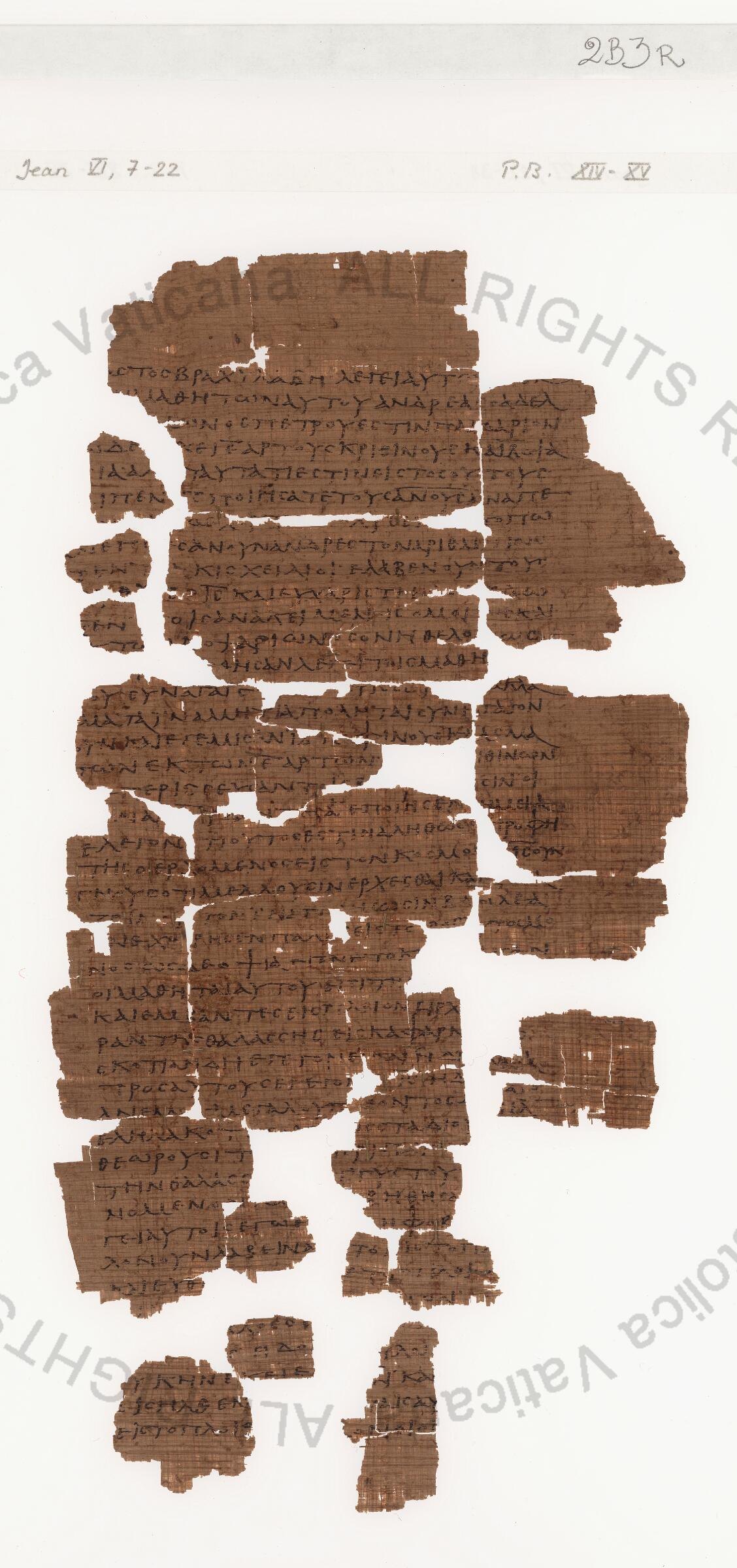
This entry covers fols. 51r-53r (John 6:7-7:17), shown on the Vatican Library's photographs (frames 2B.3r to 2B.5r).
How was this verified? (Provenance)
Where on the image
Vatican Library, Pap. Hanna 1 (Mater Verbi), DigiVatLib image 77, frame 2B.3r (https://digi.vatlib.it/view/MSS_Pap.Hanna.1(Mater.Verbi)/0077), cropped to the frame. NTVMR page 770 (folio 51r). 6:7 begins on the previous page; 6:22 continues on the next page. Checked on the image: first line [π]αστος βραχυ λαβη λεγει αυτω εκ, then των μαθητων αυτου ανδρεας (6:7-8), matching the transcription of this page.
6:7 [εκ]α̣στος βραχυ λαβη· 8 λεγει αυτω̣ [εις] ε̣κ̣
[τω]ν̣ μαθητων αυτου ανδρεας̣ ο αδελ
[φος σι]μ̣ωνος πετρου 9 εστιν παιδαριον
ω̣δε [ος ε]χει ε̅ αρτους κριθινους και β̅ οψα
ρ̣ια· αλ̣[λα] ταυτα τι εστιν εις τοσουτους·
10 [ε]ιπεν [ο] ι̣̣̅ς̅ ποιησατε τους α̅ν̅ο̅υ̅ς̅ αναπε
[σ]ε̣ι̣[ν] η̣[ν] δε χο̣ρ̣τ[ος] π̣ο̣λυ̣ς εν̣ [τω] τ̣οπω
α̣νεπε̣σαν ουν ανδρες τον αριθμο̣ν̣ ω̣ς
π̣εντα̣κισχειλιοι· 11 ελαβεν ουν τους
[α]ρ̣τ̣ο̣υ̣ς ο ι̅ς̅ και ευχαριστησ̣α̣ς̣ δ̣[ι]ε̣δω
κ̣εν τ̣οις ανακειμενο̣ις· ομοιω̣ς και
[ε]κ̣ τω̣ν̣ οψαριων οσον ηθελον̣ 12 ως δ̣ε̣
[ενε]π̣[λη]σ̣θ̣ησαν λεγει τοις μαθη[ταις αυ]
[τ]ου συναγαγ̣ε̣[τε τα π]ε̣ρ̣ισ̣σε̣υ̣[οντ]α̣ κλα
[σ]ματα ινα μη τι αποληται 13 συνηγαγον
ο̣υν και εγεμισαν ι̅β̣̣̅ κ̣ο̣φινους κλ̣ασμα
των εκ των ε̅ αρτων τ̣[ων κρ]ιθινων
[α] ε̣περισσευσαν το̣ι̣ς̣ β̣[εβ]ρ̣[ωκο]σιν· 14 οι
[ου]ν α̅ν̣̣̅[ο̅ι̅] ιδ̣ο̣ν̣τ̣ε̣ς α εποιησεν [σ]ημεια
ελεγον [ο]τι ουτος εστιν αληθως ο̣ π̣ροφη
της ο ερχομενος εις τον κοσμον̣ 15 ι̅ς̅ ουν
γνο̣υς οτι μελλουσιν ερχεσθαι και̣ α̣ρ̣[π]α̣
ζ̣ειν̣ α̣υ̣τον ινα π[ο]ι̣ησωσιν βασ̣ιλεα·
α̣νεχωρησεν παλι[ν] εις το [ο]ρ̣ο̣ς̣ α̣υ̣τος μο
νος 16 ως δε οψια ε̣γε̣νετο κ[ατεβ]η̣σ̣α̣ν
οι μαθηται αυτου επι τη[ν θαλασσαν]
17 και εμβαντες εις πλοιον ηρχ[οντο πε]
ραν της θαλασσης εις καφαρν̣[αουμ και]
σκοτια ηδη εγεγονει̣ και ηδη̣ [ουπ]ω̣
προς αυτους εγεγον̣[ει] ο̣ ι̅ς̅ 18 η δ[ε θα]λ̣ασσα
α̣νεμο̣υ̣ μεγαλου πνεοντος δ̣[ιηγειρ]ατ̣ο
19 εληλακοτε̣ς̣ ο̣υ̣[ν] ω̣ς σταδιου̣[ς κ̅ε̅] η λ̅
θεωρουσι τ[ον ι̅ν̅] π̣ε̣ριπα̣του̣[ντα επι]
την θαλασσ[αν και ε]γγυς του [πλοιου γει]
νομενον̣ κ̣α̣[ι εφο]βηθησα[ν] 20 [ο δε λε]
γει αυτοις εγω ε̣[ιμι μ]η φοβ[εισθε] 21 [ηθε]
λον ουν λαβειν α[υ]τον̣ ε̣ις το πλ̣[οιον]
και ευθε̣[ως εγεν]ετο̣ τ̣ο πλοιον̣ [επι]
[τ]η̣[ς γης εις ην υπη]γον· 22 τ̣[η επαυ]
[ριον ο ο]χ̣λος ο ε̣[στηκ]ω̣[ς περαν της θα]
[λασση]ς· ειδο[ν οτι] π̣λοι[αριον αλλο]
[ο]υκ ην εκ̣ει ε[ι μη ε]ν̣· και̣ [οτι ου συν]
εισηλθεν [τοις μαθη]ταις αυ̣[του ο ι̅ς̅]
εις το πλοιο[ν αλλα] μ̣ονοι οι [μαθηται]
6:7Philip answered him, Two hundred pennyworth of bread is not sufficient for them, that every one of them may take a little. 8One of his disciples, Andrew, Simon Peter’s brother, saith unto him, 9There is a lad here, which hath five barley loaves, and two small fishes: but what are they among so many? 10And Jesus said, Make the men sit down. Now there was much grass in the place. So the men sat down, in number about five thousand. 11And Jesus took the loaves; and when he had given thanks, he distributed to the disciples, and the disciples to them that were set down; and likewise of the fishes as much as they would. 12When they were filled, he said unto his disciples, Gather up the fragments that remain, that nothing be lost. 13Therefore they gathered them together, and filled twelve baskets with the fragments of the five barley loaves, which remained over and above unto them that had eaten. 14Then those men, when they had seen the miracle that Jesus did, said, This is of a truth that prophet that should come into the world. 15¶ When Jesus therefore perceived that they would come and take him by force, to make him a king, he departed again into a mountain himself alone. 16And when even was now come, his disciples went down unto the sea, 17And entered into a ship, and went over the sea toward Capernaum. And it was now dark, and Jesus was not come to them. 18And the sea arose by reason of a great wind that blew. 19So when they had rowed about five and twenty or thirty furlongs, they see Jesus walking on the sea, and drawing nigh unto the ship: and they were afraid. 20But he saith unto them, It is I; be not afraid. 21Then they willingly received him into the ship: and immediately the ship was at the land whither they went. 22¶ The day following, when the people which stood on the other side of the sea saw that there was none other boat there, save that one whereinto his disciples were entered, and that Jesus went not with his disciples into the boat, but that his disciples were gone away alone;
Where on the image
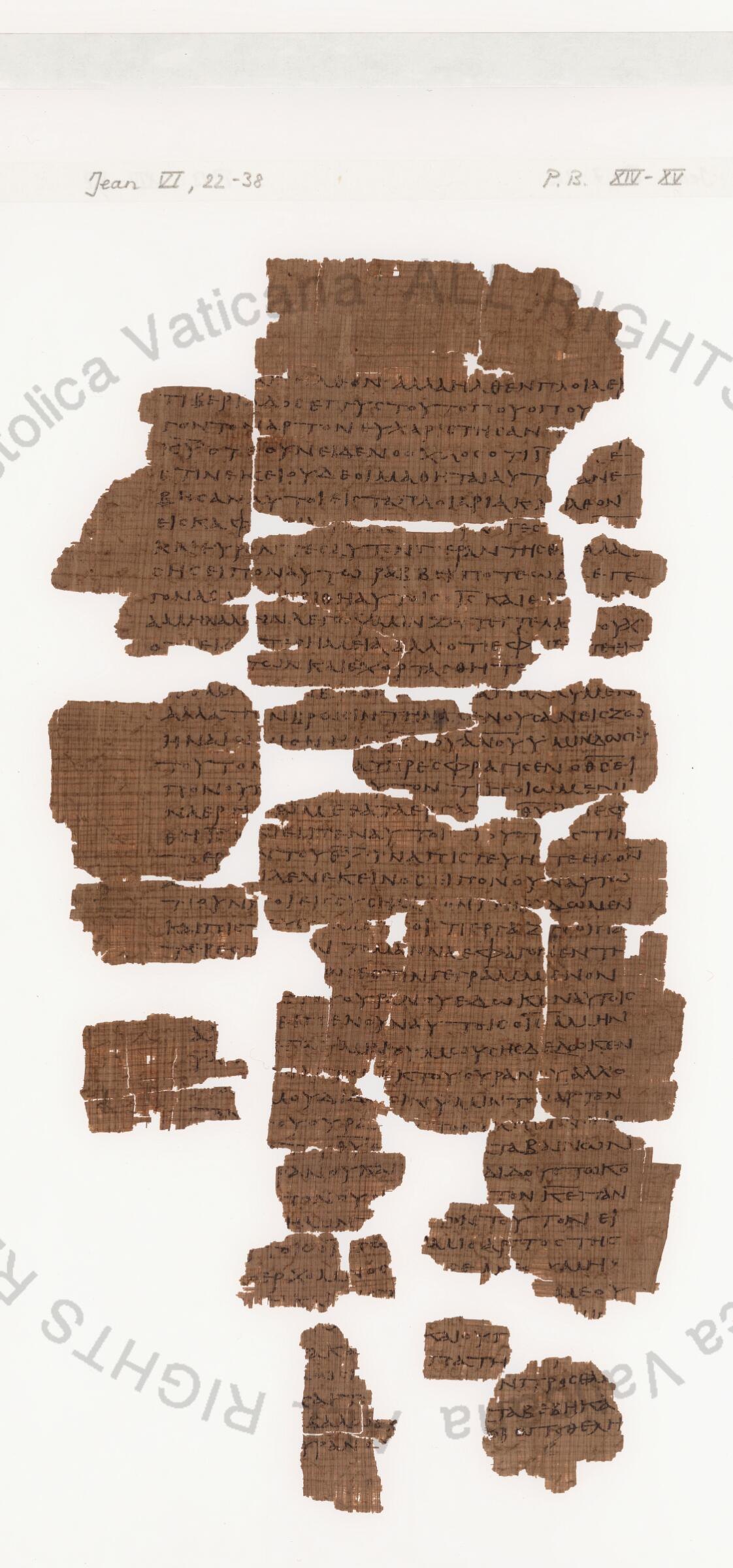
Vatican Library, Pap. Hanna 1 (Mater Verbi), DigiVatLib image 78, frame 2B.3v (https://digi.vatlib.it/view/MSS_Pap.Hanna.1(Mater.Verbi)/0078), cropped to the frame. NTVMR page 780 (folio 51v). 6:22 begins on the previous page; 6:38 continues on the next page. Checked on the image: near the top οι μαθηται αυτου (6:22), matching the transcription of this page.
6:22 [αυτου] α̣πηλθον· 23 αλλα ηλθεν πλοια εκ̣
τιβεριαδος εγγυς του τοπου οπου [ε]φ̣[α]
γον τον αρτον ευχαρι̣στησαντ[ος το]υ̣
κ̅υ̅· 24 οτε ουν ειδεν ο οχλος οτι ι̅ς̣̣̅ [ου]κ̣ ε
στιν εκει ουδε οι μαθηται αυτ[ου] ανε
βησαν αυτοι εις τα πλοιαρια κα[ι] η̣λθον
εις καφ[αρ]ν̣α̣ο̣υ̣μ̣ ζ̣[ητο]υ̣ν̣τες τ̣[ο]ν̣ ι̣̣̅ν̣̣̅
25 και ευροντες αυτον περαν της θαλασ̣
σης ειπον αυτω ραββει ποτε ωδε γε
γονας 26 α̣π̣ε̣κριθη αυτοις ο ι̅ς̅ και ειπ̣εν̣
αμην αμην λεγω υμιν ζητειτε με̣ ουχ
οτ̣ι̣ ειδε̣τε σημεια αλλ οτι εφα̣γ̣ετε εκ
[των αρ]των και εχορτασθητε 27 [εργαζε]
σ̣θ̣ε̣ μη̣ [τ]η̣ν̣ βρ̣ωσ[ι]ν̣ [τ]η̣ν̣ απ̣ολλυμενη̣[ν]
αλλα την βρωσιν την μ̣ενουσαν εις ζω
ην αιων̣ιον ην ο̣ υ̅ς̅ τ̣ου α̅ν̅ο̅υ̅ υμιν δωσει·
τουτον̣ [γαρ ο π]ατηρ εσφραγισεν ο θ̅ς̅· 28 ει
πον ουν̣ [προς α]υτον· τι ποιωμεν ι
να εργα[ζ]ωμεθα τα εργα τ̣[ο]υ̣ θ̅υ̅· 29 α̣π̣εκρ[ι]
θη ι̅ς̅ κ̣α̣ι ειπεν αυτοις̣ τ̣ο̣υτ[ο] ε̣στιν̣
τ̣ο ερ[γο]ν του θ̅υ̅· ινα πιστευητε εις ον
απ̣[εστε]ιλεν εκεινος· 30 ειπον ουν αυτω
τι ουν ποιεις συ σημε̣ι̣ον ινα ι̣δωμεν
και πιστ̣ε̣υσω̣μεν̣ σ̣οι· τι εργαζη 31 οι πα
τερες η[μω]ν το μαννα εφαγον̣ εν τη̣
[ερημω καθ]ως εστιν γεγραμμενον
[αρτον ε]κ̣ τ̣ου ουρανου εδωκεν αυτοις
[φαγειν] 32 ειπεν ουν αυτοις ο ι̅ς̅ αμην
αμ̣[ην λ]εγω υμιν ου μωυσης δεδωκεν
υμ̣[ιν το]ν αρ̣τον̣ εκ του ουρανου αλλ ο
π̣α̣[τηρ] μ̣ου διδ[ω]σιν υμιν τον̣ αρτον
τ̣ο̣ν̣ [εκ] τ̣ου ουραν̣[ο]υ̣ τον̣ α̣λη̣θ̣ινον̣ 33 ο
[γαρ αρτο]ς̣ το̣υ θ̅υ̅ ε[στιν ο κ]α̣ταβαινων
[εκ του ου]ρανου και [ζωην] διδους τω κο
[σμω] 34 [ει]πον ουν̣ [προς αυ]τον κ̅ε̅ παν
[τοτε δος] ημιν τ̣[ον αρ]τ̣ον τουτον 35 ει
[πεν α]υ̣τοις ο̣ ι̅[ς̅] ε̣γω [ε]ι̣μι ο αρτος της
[ζωης] ο ερχομε̣ν̣ος [προ]ς εμε̣ ο̣υ̣ μη
[πεινασ]η και [ο π]ι̣σ̣τ̣[ευων εις ε]με ου
[μη διψησει] π̣ω̣[ποτε] 36 [αλλ ειπον υ]μ̣ι̣ν̣
[οτι και εω]ρ̣ακα̣[τε με] και ου π̣[ιστευε]
[τε] 37 [παν ο δι]δ̣ωσι[ν μοι ο] πατη[ρ π]ρ̣[ος]
[εμε ηξει] κ̣αι το[ν ερχομενο]ν προς εμ[ε]
[ου μη εκ]βαλω εξ̣[ω] 38 [οτι κ]α̣ταβεβηκα
[απο του ο]υρανου̣ [ουχ ινα π]οιω το θελη
6:22¶ The day following, when the people which stood on the other side of the sea saw that there was none other boat there, save that one whereinto his disciples were entered, and that Jesus went not with his disciples into the boat, but that his disciples were gone away alone; 23(Howbeit there came other boats from Tiberias nigh unto the place where they did eat bread, after that the Lord had given thanks:) 24When the people therefore saw that Jesus was not there, neither his disciples, they also took shipping, and came to Capernaum, seeking for Jesus. 25And when they had found him on the other side of the sea, they said unto him, Rabbi, when camest thou hither? 26Jesus answered them and said, Verily, verily, I say unto you, Ye seek me, not because ye saw the miracles, but because ye did eat of the loaves, and were filled. 27Labour not for the meat which perisheth, but for that meat which endureth unto everlasting life, which the Son of man shall give unto you: for him hath God the Father sealed. 28Then said they unto him, What shall we do, that we might work the works of God? 29Jesus answered and said unto them, This is the work of God, that ye believe on him whom he hath sent. 30They said therefore unto him, What sign shewest thou then, that we may see, and believe thee? what dost thou work? 31Our fathers did eat manna in the desert; as it is written, He gave them bread from heaven to eat. 32Then Jesus said unto them, Verily, verily, I say unto you, Moses gave you not that bread from heaven; but my Father giveth you the true bread from heaven. 33For the bread of God is he which cometh down from heaven, and giveth life unto the world. 34Then said they unto him, Lord, evermore give us this bread. 35And Jesus said unto them, I am the bread of life: he that cometh to me shall never hunger; and he that believeth on me shall never thirst. 36But I said unto you, That ye also have seen me, and believe not. 37All that the Father giveth me shall come to me; and him that cometh to me I will in no wise cast out. 38For I came down from heaven, not to do mine own will, but the will of him that sent me.
Where on the image
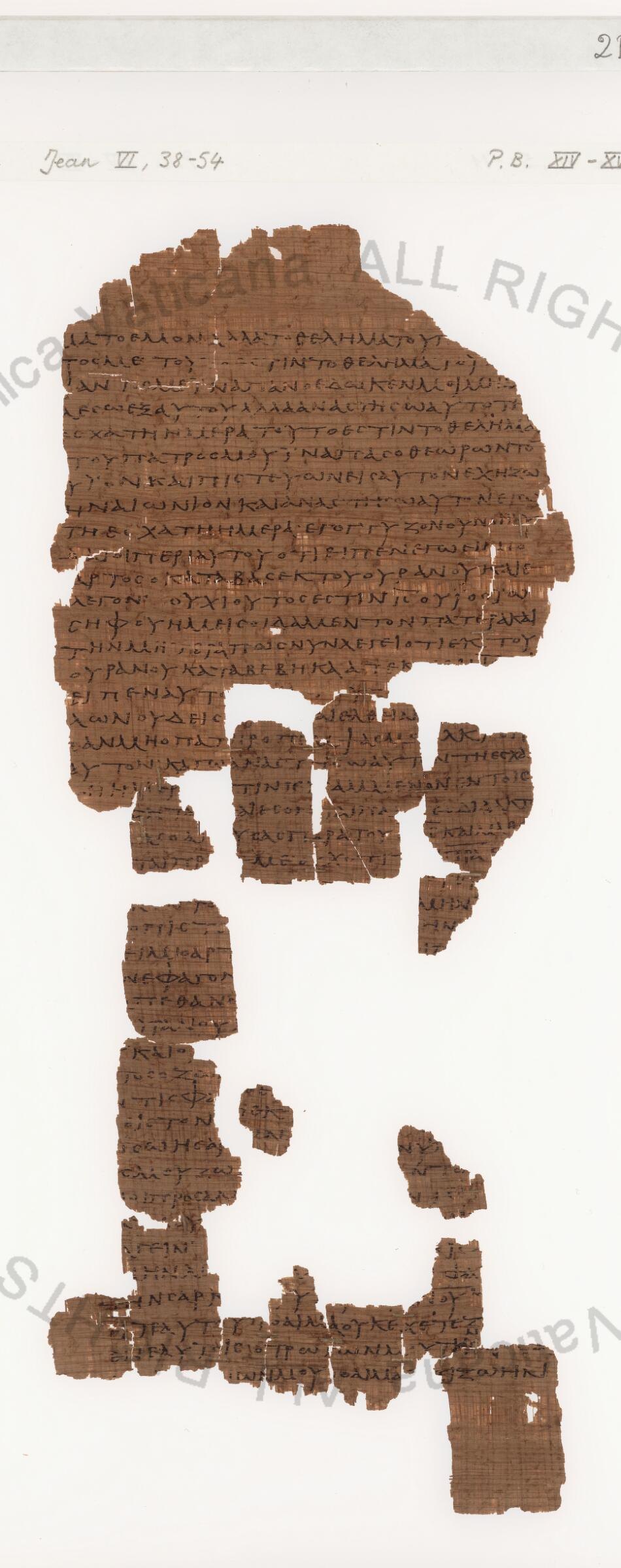
Vatican Library, Pap. Hanna 1 (Mater Verbi), DigiVatLib image 79, frame 2B.4r (https://digi.vatlib.it/view/MSS_Pap.Hanna.1(Mater.Verbi)/0079), cropped to the frame. NTVMR page 790 (folio 52r). 6:38 begins on the previous page; 6:54 continues on the next page. Checked on the image: near the top ζωην αιωνιον και αναστησω αυτον εγω τη εσχατη ημερα (6:40), near the foot ο τρωγων μου την σαρκα και πινων μου το αιμα εχει ζωην (6:54), matching the transcription of this page.
6:38 μ̣α το εμον αλλα το θελημα του π̣[εμψαν]
τος με· 39 τουτ̣ο ε̣στιν το θελημα του [πεμ]
ψ̣αντο̣ς με ινα παν ο εδωκεν μοι μη α[πο]
λεσω εξ αυτου αλλα αναστησω αυτο τη̣
εσχατη ημερα 40 τουτο εστιν το θελημα
του πατρος μου ινα πας ο θεωρων τον
υιον και πιστευων εις αυτον εχη ζω
ην αιωνιον και αναστησω αυτο̣ν εγω
τη εσχατη ημερα· 41 εγογγυζον ουν οι ιου
δαιοι περι αυτου οτι ειπεν εγω ειμι ο
αρτος ο καταβας εκ του ουρανου 42 και ε
λεγον· ουχι ουτος εστιν ι̅ς̅ ο υιος ιω
σηφ ου ημεις οιδαμεν τον πατερα και
την μητερα πως νυν λεγει οτι εκ του
ουρανου καταβεβηκα· 43 απεκ[ρ]ι̣θ̣η̣ ι̣̣̅ς̣̣̅ [κα]ι̣
ειπεν αυτο̣[ις μη γο]γ̣γυζ̣[ετε μετ αλλη]
λων 44 ουδεις [δυνατ]αι ελθειν [προς με]
εαν μη ο πατηρ ο πεμψας με̣ [ε]λκυ̣σ̣η̣
αυτον· καγω αναστησω αυτο̣ν τη εσχα
τ̣η ημερ[α] 45 [εσ]τιν γ̣εγ̣[ρ]αμμενον εν τοις
[προ]φ̣ητα̣[ις] κ̣αι εσονται πα[ντ]ες̣ διδακτο̣[ι]
[θ̅υ̅ π]ας ο ακ̣[ο]υσας παρα του [π̅ρ̅]ς̅ και μαθω̣[ν]
[ερχε]ται πρ[ος] ε̣με· 46 ου̣χ οτι τ̣[ον] π̅ρ̅α̅ ε̣[ωρα]
[κεν τις ει μη ο ων παρα τ]ο̣υ̣ θ̣̣̅υ̣̣̅ [ουτος]
[εωρα]κ̣ε̣ν̣ το[ν πατερα] 47 [αμην α]μην λ̣[εγω]
[υμιν] ο πιστε̣[υων εχει ζω]ην [αιωνιον]
48 [εγω] ειμι ο αρτ̣[ος της ζωης] 49 [ο]ι̣ π̣[ατερες]
[υμω]ν εφαγον̣ [εν τη ερημω το μαννα]
[και] α̣πεθανο[ν] 50 [ουτος εστιν ο αρτος ο εκ]
[του ο]υρανου κ̣[αταβαινων ινα τις φαγη εξ αυ]
[το]υ̣· και ου̣ [μη αποθανη] 51 [εγω ειμι ο]
[αρ]τος ο ζων̣ ο ε[κ του ουρανου καταβας]
[εα]ν̣ τις φα[γ]η̣ εκ τ̣[ουτου του αρτου ζη]
[σει] εις τον [αι]ω̣να̣ [και ο αρτος δε ον εγω]
[δ]ω̣σω η σαρ̣[ξ μου εστι]ν υπ̣[ερ της του]
[κο]σμου ζω[ης] 52 [εμαχο]ντο̣ [ουν οι ιου]
[δα]ι̣οι προς αλλ̣[ηλους λεγο]ν̣τ̣ε̣ς̣ π̣[ως δυ]
[ν]α̣τ̣[α]ι̣ ου[τος ημιν δουναι τη]ν̣ [σαρκα]
[φ]α̣γειν· 53 [ειπεν ουν αυτοις] ο̣ ι̅ς̣̣̅ α̣[μην]
[α]μ̣ην λε̣[γω υ]μ̣[ιν εαν μη] φα[γητε]
την σαρκ̣[α το]υ̣ υι̣[ο]υ̣ [το]υ̣ [α̅]ν̅ο̅υ̅ κ̣[αι πι]
ητε αυτου τ̣ο αιμα ουκ εχετε ζ[ωην]
εν εαυτοις· 54 ο τρωγ̣ων μο̣υ το σα̣ρ̣κ̣α̣
[και πει]ν̣ων μου τ̣ο αιμα ε̣[χ]ει ζωην
6:38For I came down from heaven, not to do mine own will, but the will of him that sent me. 39And this is the Father’s will which hath sent me, that of all which he hath given me I should lose nothing, but should raise it up again at the last day. 40And this is the will of him that sent me, that every one which seeth the Son, and believeth on him, may have everlasting life: and I will raise him up at the last day. 41The Jews then murmured at him, because he said, I am the bread which came down from heaven. 42And they said, Is not this Jesus, the son of Joseph, whose father and mother we know? how is it then that he saith, I came down from heaven? 43Jesus therefore answered and said unto them, Murmur not among yourselves. 44No man can come to me, except the Father which hath sent me draw him: and I will raise him up at the last day. 45It is written in the prophets, And they shall be all taught of God. Every man therefore that hath heard, and hath learned of the Father, cometh unto me. 46Not that any man hath seen the Father, save he which is of God, he hath seen the Father. 47Verily, verily, I say unto you, He that believeth on me hath everlasting life. 48I am that bread of life. 49Your fathers did eat manna in the wilderness, and are dead. 50This is the bread which cometh down from heaven, that a man may eat thereof, and not die. 51I am the living bread which came down from heaven: if any man eat of this bread, he shall live for ever: and the bread that I will give is my flesh, which I will give for the life of the world. 52The Jews therefore strove among themselves, saying, How can this man give us his flesh to eat? 53Then Jesus said unto them, Verily, verily, I say unto you, Except ye eat the flesh of the Son of man, and drink his blood, ye have no life in you. 54Whoso eateth my flesh, and drinketh my blood, hath eternal life; and I will raise him up at the last day.
Where on the image
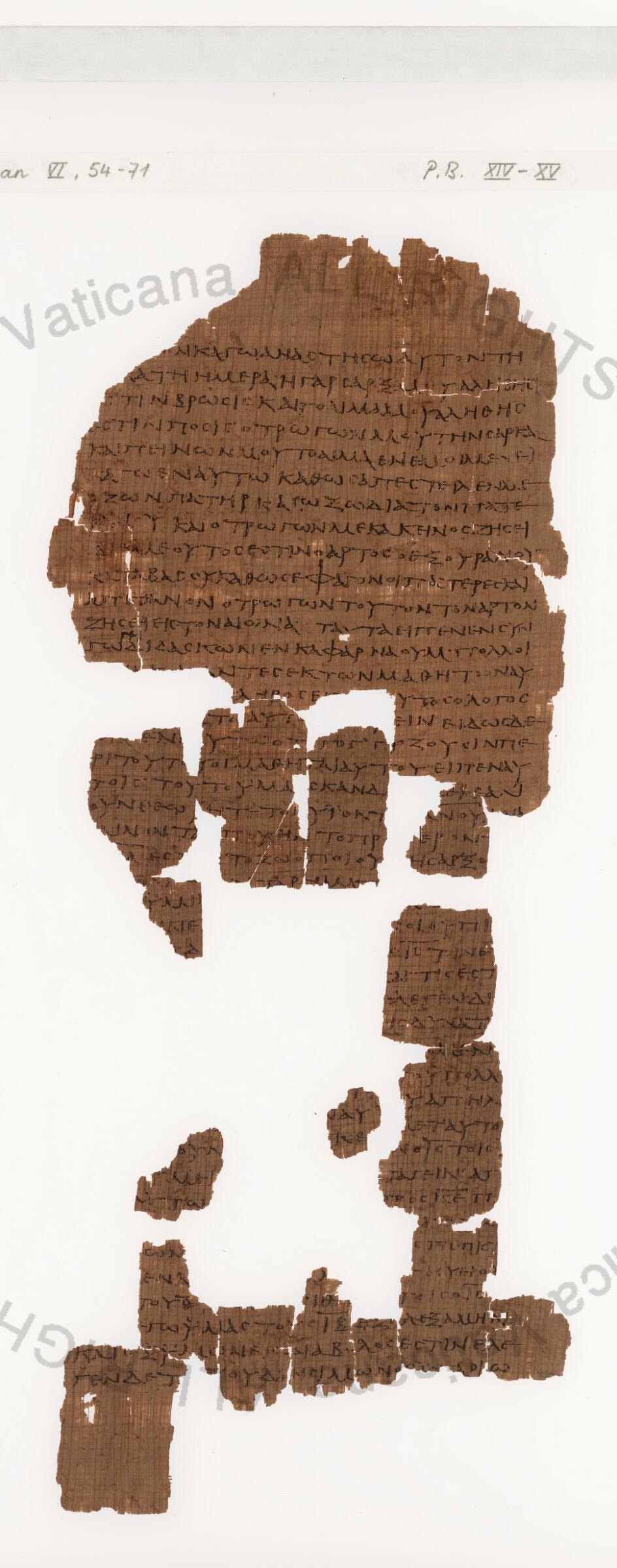
Vatican Library, Pap. Hanna 1 (Mater Verbi), DigiVatLib image 80, frame 2B.4v (https://digi.vatlib.it/view/MSS_Pap.Hanna.1(Mater.Verbi)/0080), cropped to the frame. NTVMR page 800 (folio 52v). 6:54 begins on the previous page; 6:71 continues on the next page. Checked on the image: near the top καθως εφαγον οι πατερες και απεθανον (6:58), near the foot εξ υμων εις διαβολος εστιν (6:70), matching the transcription of this page.
6:54 [αιωνι]ον καγω αναστησω αυτον τη
[εσ]χ̣ατη ημερα· 55 η γαρ σαρξ μου αληθης
[ε]στιν βρωσις και το αιμα μου αληθης
ε̣στιν ποσις· 56 ο τρωγων μου την σαρκα
και πεινων μου το αιμα εν εμοι μεν̣ει
καγω εν αυτω 57 καθως απεστειλεν με
ο ζων πατηρ καγω ζω δια τον πατε
ρα μου και ο τρωγων με κακεινος ζησει
δι εμε 58 ουτος εστιν ο αρτος ο εξ ουρανου
καταβας ου καθως εφαγον οι πατερες και
απεθανον ο τρωγων τουτον τον αρτον
ζησει εις τον αιωνα· 59 ταυτα ειπεν εν συν
α̣γω διδασκων εν καφαρναουμ· 60 πολλοι
[ουν] α̣κ̣[ο]υ̣[σ]α̣ντες εκ των μαθητων αυ
[του ειπαν σ]κ̣ληρος εσ̣τ̣[ιν ο]υτος ο λογος
[τις δυν]α̣τα̣[ι] αυτο̣[υ ακο]υ̣ειν 61 ειδως δε
ο̣ ι̣̣̅ς̣̣̅ εν ε̣[α]υτω οτ[ι] γογγυζουσιν πε
ρι τουτο̣υ οι μαθηται αυτου ειπεν αυ
τοις· τουτο υμα[ς] σκανδα̣[λιζ]ει 62 εαν
ουν θεωρ̣ητε τον υιον τ[ου] α̣̣̅ν̅ο̅υ̅ α̣ν̣α̣
[β]α̣ινοντα̣ [ο]που ην̣ το πρ[οτ]ερον 63 τ̣[ο]
[π̅ν̅]α̅ εστ̣[ιν] το ζωοποιου[ν] η σαρξ ο[υκ ω]
[φελει] ο̣υ̣δ̣[ε]ν̣ τα̣ ρη̣ματ̣[α α εγω λελα]
[ληκα] υμιν̣ [π̅ν̅α̅ εστιν κ]α̣ι̣ ζ̣[ωη εστιν]
64 [αλλ εισ]ι̣ν ε[ξ υμων τινε]ς̣ οι ου πι[στευ]
[ουσιν] η̣δ[ει γαρ εξ αρχης] ο ι̅ς̅ τινε[ς ει]
[σιν οι μη πιστευοντες] κ̣αι τις εστ[ιν]
[ο παραδωσων αυτον] 65 [και] ε̣λεγεν· δι[α του]
[το ειρηκα υμιν οτι ουδ]ε̣ις δυνατα̣[ι ελ]
[θειν προς με εαν μη η δεδ]ομεν[ον]
[αυτω εκ του πατρος] 66 [εκ] τ̣ο̣[υ]τ̣ου πολλ[οι]
[εκ των μαθητω]ν̣ αυτ̣[ο]υ απηλ[θον]
[εις τα οπισω και ου]κε[τι] μ̣ετ αυτο[υ]
[περιεπατ]ουν 67 [ειπεν ου]ν ο ι̅ς̅ τοις ι̣̣̅[β̅]
[μη και] υ̣μει[ς θελετε υ]π̣αγειν· 68 απ̣[ε]
[κριθη] α̣υτω [σιμων πε]τ̣ρος κ̅ε̅ π[ρος]
[τινα απελευσομεθα ρημ]ατ̣α̣ ζ̣ω̣[ης]
[αι]ων[ιου εχεις] 69 [και ημει]ς πεπιστ̣[ευ]
[καμ]εν κ̣[αι εγνωκα]μ̣[εν ο]τ̣ι συ ει ο α̣
[γιος] του θ̅υ̣̣̅ 70 [απεκ]ρ̣ιθη̣ [αυ]τοις ο ι̅ς̅
[ουκ] ε̣γω υμας του̣ς ι̅β̅ εξ̣ε̣λεξαμην
και ε̣ξ υμων εις δ̣ιαβο̣λος εστιν 71 ελε
γεν δε τ[ον] ι̣ουδαν σιμωνος̣ ι̣σ̣κ̣α̣ριω
6:54Whoso eateth my flesh, and drinketh my blood, hath eternal life; and I will raise him up at the last day. 55For my flesh is meat indeed, and my blood is drink indeed. 56He that eateth my flesh, and drinketh my blood, dwelleth in me, and I in him. 57As the living Father hath sent me, and I live by the Father: so he that eateth me, even he shall live by me. 58This is that bread which came down from heaven: not as your fathers did eat manna, and are dead: he that eateth of this bread shall live for ever. 59These things said he in the synagogue, as he taught in Capernaum. 60Many therefore of his disciples, when they had heard this, said, This is an hard saying; who can hear it? 61When Jesus knew in himself that his disciples murmured at it, he said unto them, Doth this offend you? 62What and if ye shall see the Son of man ascend up where he was before? 63It is the spirit that quickeneth; the flesh profiteth nothing: the words that I speak unto you, they are spirit, and they are life. 64But there are some of you that believe not. For Jesus knew from the beginning who they were that believed not, and who should betray him. 65And he said, Therefore said I unto you, that no man can come unto me, except it were given unto him of my Father. 66¶ From that time many of his disciples went back, and walked no more with him. 67Then said Jesus unto the twelve, Will ye also go away? 68Then Simon Peter answered him, Lord, to whom shall we go? thou hast the words of eternal life. 69And we believe and are sure that thou art that Christ, the Son of the living God. 70Jesus answered them, Have not I chosen you twelve, and one of you is a devil? 71He spake of Judas Iscariot the son of Simon: for he it was that should betray him, being one of the twelve.
Where on the image
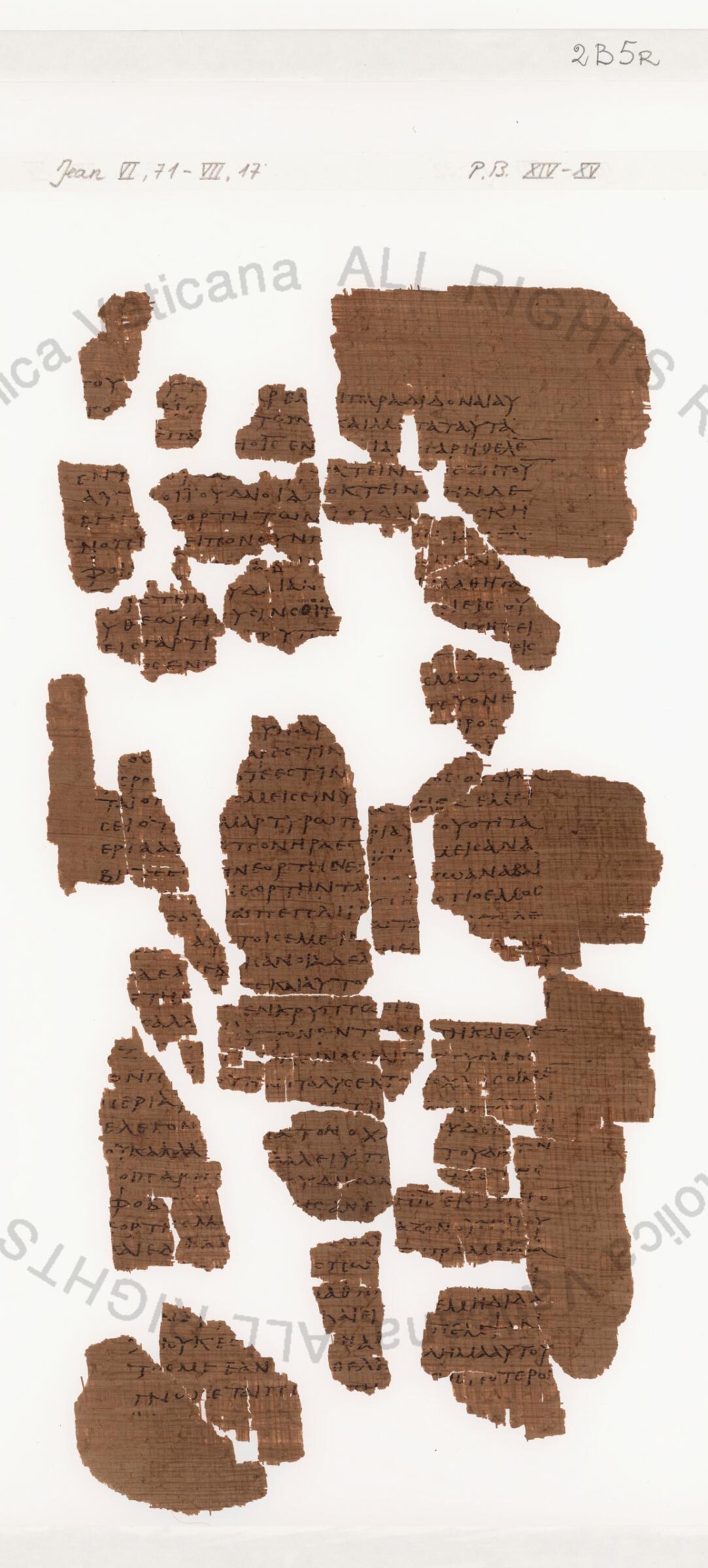
Vatican Library, Pap. Hanna 1 (Mater Verbi), DigiVatLib image 81, frame 2B.5r (https://digi.vatlib.it/view/MSS_Pap.Hanna.1(Mater.Verbi)/0081), cropped to the frame. NTVMR page 810 (folio 53r). 6:71 begins on the previous page; 7:17 continues on the next page. Checked on the image: near the top ειπον ουν (7:3), matching the transcription of this page.
6:71 τ̣ου [ο]υτο̣[ς γ]α̣ρ εμ̣[ελλε]ν̣ παραδιδοναι αυ
το[ν] εις [εκ] των [ι̅β̅] 7:1 κ̣αι με̣τα ταυτα
[περι]επα[τ]ε̣ι ο ι̅ς̅ εν [γαλιλα]ια ο̣υ̣ γαρ ηθελεν
εν τ[η ι]ο̣υ̣δ̣α̣ι̣[α πε]ρ̣ι̣π̣ατειν [ο]τ̣ι̣ εζητουν
αυτ̣[ον] οι ιουδαιοι αποκτεινα̣[ι] 2 ην δε
εγγυ̣[ς η] εορτη των ιουδαιω̣ν̣ [η] σκη
νοπη̣[γι]α̣ 3 ειπον ουν π̣[ρος α]υ̣[τ]ον οι αδ̣ελ
φοι α̣υ̣[τ]ο[υ] μ̣ε̣τ̣αβ̣η̣θ̣[ι εντευ]θ̣ε̣ν και υ̣[π]α̣
γ̣ε̣ ε̣ις την [ιο]υδα̣ιαν [ινα και ο]ι̣ μαθηται̣
[σο]υ θεωρησ̣ο̣υσιν σ[...] τ[α εργα α] π̣οιεις· 4 ου
[δ]εις γαρ τι [εν κ]ρυπτ̣[ω ποιει κα]ι̣ ζητει
[αυτ]ος εν π̣[αρρησια ειναι ει τα]υ̣τ̣α̣ π̣[ο]ι̣εις
[φανερωσον σεαυτον τω κο]σμω· 5 ου̣[δ]ε̣
[γαρ οι αδελφοι αυτου επισ]τευον ε[ις]
[αυτον] 6 [λεγει ο]υν̣ αυ[τοις ο ι̅ς̅ ο κ]α̣ιρος [ο ε]
μ̣ος [ουπω π]αρεστιν [ο δε καιρο]ς ο υ[με]
τ̣ερο[ς παντ]οτε εστιν [ετοι]μ̣ος· 7 ου δυνα
ται ο κ̣[οσμο]ς μεισειν υμ̣α̣ς̣ [ε]με δ̣ε μει
σει οτι̣ [εγω] μαρτυρω π[ε]ρι αυτ̣ου οτι τα
εργα αυ[το]υ̣ πονηρα εστ̣ιν· 8 υ̣μ̣εις ανα
βη̣τε ει[ς τ]η̣ν εορτην εγω ουπ̣ω αναβαι
[νω ε]ι̣ς τ̣[η]ν̣ εορτην ταυτ̣η[ν] οτι ο εμος
[καιρο]ς ουπ̣ω πεπληρ̣ωτα[ι] 9 [τα]υτα δ̣ε
[ει]π̣ω̣[ν] αυτοις εμειν̣ε̣ν̣ εν̣ [τη γα]λιλαια
10 [ως] δε αν̣εβη̣σαν οι αδελ[φοι αυτου εις] τ̣ην
[εο]ρ̣την̣ τ̣[ο]τ̣ε και αυτο[ς ανεβη ου φαν]ε̣
[ρω]ς αλλ[α] ω̣[ς] εν κρυπτω 11 οι ο[υν ιουδαιο]ι
[ε]ζ[η]τ̣ο̣υ̣ν̣ α̣υτον εν τη̣ ε̣ορτη και ελε
[γ]ον π[ο]υ [εσ]τιν̣ ε̣κεινος· 12 κ̣αι γογγυσ̣μος
π̣ερι αυ̣[τ]ο̣υ ην πολυς εν το̣[ι]ς̣ οχλο̣ις οι μεν
ελεγον [οτι αγαθος] ε̣σ̣τιν̣ [αλ]λ̣ο̣ι̣ δ̣ε̣ ε̣λε̣γ[ο]ν
ουκ απ̣ο̣π̣[λα]ν̣α τον οχλ̣[ον] 13 ο̣υδεις μ̣ε̣ν
[τ]οι παρησ[ια ε]λαλει υπ[... αυ]του δια το̣ν
φοβο̣ν̣ τ̣[ων ι]ουδαιων̣ 14 [ηδ]η δε τ̣ης
εορτης με̣[σουσ]η̣ς ανε[β]η ι̅ς̅ εις το ι̣ε̣ρον
κ̣αι εδιδα̣[σκεν] 15 ε̣θ̣αυ[μ]αζον ουν ο̣ι ιου
[δ]α̣ιοι λ̣ε̣γ̣[οντε]ς πως̣ [ου]τ̣ο̣ς γραμματ̣α
[οι]δ̣εν [μη με]μ̣αθη̣κ̣[ως] 16 [απεκ]ρ̣[ιθ]η̣
[ου]ν αυ̣τ̣[οις ι̅ς̅] και ει[πεν η] εμη διδα
χ̣η̣ ουκ εστ̣[ιν εμ]η αλ̣[λα του] πεμψαν
το̣ς με 17 εαν [τις] θελη̣ [το θε]λημα αυτου
γνωσεται πε̣[ρι] τ̣η̣[ς διδα]χ̣η̣ς π̣οτερον̣
6:71He spake of Judas Iscariot the son of Simon: for he it was that should betray him, being one of the twelve. 7:1After these things Jesus walked in Galilee: for he would not walk in Jewry, because the Jews sought to kill him. 2Now the Jews’ feast of tabernacles was at hand. 3His brethren therefore said unto him, Depart hence, and go into Judæa, that thy disciples also may see the works that thou doest. 4For there is no man that doeth any thing in secret, and he himself seeketh to be known openly. If thou do these things, shew thyself to the world. 5For neither did his brethren believe in him. 6Then Jesus said unto them, My time is not yet come: but your time is alway ready. 7The world cannot hate you; but me it hateth, because I testify of it, that the works thereof are evil. 8Go ye up unto this feast: I go not up yet unto this feast; for my time is not yet full come. 9When he had said these words unto them, he abode still in Galilee. 10¶ But when his brethren were gone up, then went he also up unto the feast, not openly, but as it were in secret. 11Then the Jews sought him at the feast, and said, Where is he? 12And there was much murmuring among the people concerning him: for some said, He is a good man: others said, Nay; but he deceiveth the people. 13Howbeit no man spake openly of him for fear of the Jews. 14¶ Now about the midst of the feast Jesus went up into the temple, and taught. 15And the Jews marvelled, saying, How knoweth this man letters, having never learned? 16Jesus answered them, and said, My doctrine is not mine, but his that sent me. 17If any man will do his will, he shall know of the doctrine, whether it be of God, or whether I speak of myself.
Notes
- Greek: the NTVMR diplomatic transcription, line by line as on the papyrus. Square brackets enclose letters that are lost or illegible and were supplied by the transcribers; a dot under a letter marks it as uncertain; [...] marks a gap. Nomina sacra and numerals keep the scribe's overline. Spelling is the scribe's (no accents or breathings). Words broken at a line end stay broken as on the papyrus. Corrections are not shown: the text is the first hand.
- English: the King James Version (1611), whole verses, for every verse that has text on the page. A verse that begins on one page and ends on the next is given in full on both. The KJV translates a later form of the Greek text, so its wording does not always match the papyrus; material differences (such as verses the papyrus does not have) are noted in the section.
Cite
Sources
- Source: Papyrus Hanna 1 (Mater Verbi), Vatican Library: photographs from DigiVatLib; Greek from the INTF NTVMR transcription of P75; English from the King James Version (holding institution)
- Critical edition: INTF NTVMR diplomatic transcription (CC BY 4.0)
← previous · → next · v cycle view · l back to library