P75 (Papyrus Hanna 1): John 7:17-8:22 (fols. 53v-54v)
Introduction
P75 is a papyrus codex of Luke and John copied in Egypt around 175-225, the oldest known copy of Luke and one of the oldest of John. It was bought by Martin Bodmer in the 1950s and published as Papyrus Bodmer XIV-XV; in 2006 it was given to the Vatican Library, where it is kept as Papyrus Hanna 1 (Mater Verbi). Its text is very close to that of Codex Vaticanus, written some 150 years later. Where Luke ends and John begins (folio 44r) both titles stand on the same page.
About 51 leaves survive, many damaged at the top and edges, especially in Luke 3-7. Lost: Luke 1:1-3:17, most of 3:23-4:33, 5:11-36, 6:5-10, 7:33-34 and 7:44-45 (and parts of 7:36-49), 17:16-19, 18:19-22:3; John 11:46-47, 12:1-2, 13:11-14:7 and everything after 15:10 except small fragments. Each section below is one page: the photograph, the NTVMR diplomatic transcription line by line, and the King James Version of every verse on the page. Where P75 lacks a verse or words that the KJV has (for example John 5:4 or the account of the adulteress, John 7:53-8:11), the section says so. Six damaged pages (folios 7v, 11r, 39v, 58r, 58v and 64v) are left out because their text could not be matched to the photographs with certainty.
This entry covers fols. 53v-54v (John 7:17-8:22), shown on the Vatican Library's photographs (frames 2B.5v to 2B.6v).
How was this verified? (Provenance)
Where on the image
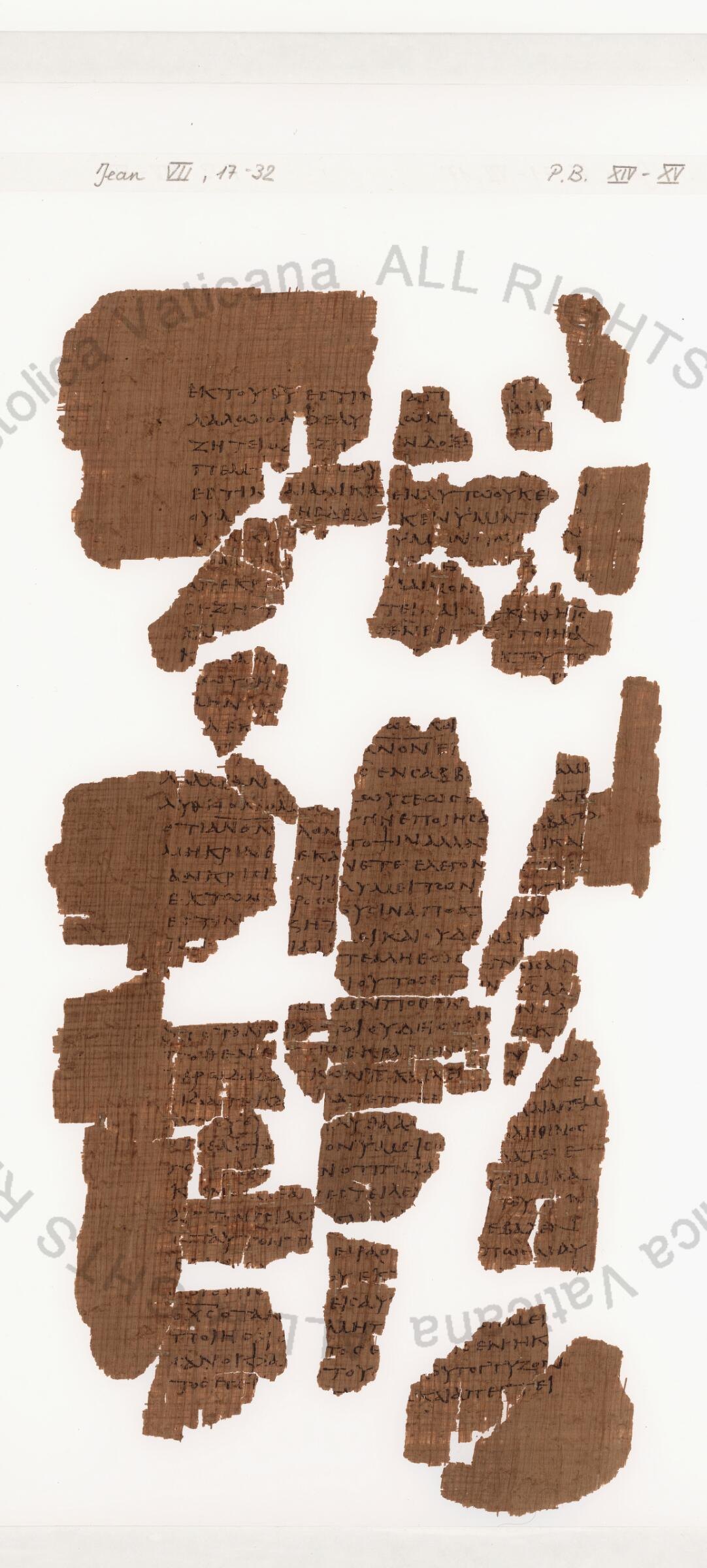
Vatican Library, Pap. Hanna 1 (Mater Verbi), DigiVatLib image 82, frame 2B.5v (https://digi.vatlib.it/view/MSS_Pap.Hanna.1(Mater.Verbi)/0082), cropped to the frame. NTVMR page 820 (folio 53v). 7:17 begins on the previous page; 7:32 continues on the next page. Checked on the image: near the foot ο χ̅ς̅ οταν ελθη (7:31), matching the transcription of this page.
7:17 εκ του θ̅υ̅ εστιν̣ [η εγω] απ [εμ]α̣υτο̣υ
λαλω· 18 ο αφ εαυ[του λα]λ̣ων τ̣[ην] ι̣διαν̣
ζητει ο δ̣ε̣ ζητ̣[ων τ]η̣ν δοξα̣[ν] του
πεμψ̣α̣[ν]τος αυτ[ον ουτος αληθης]
εστιν̣ [κ]αι αδικια εν αυτω ουκ εσ[τι]ν̣·
19 ου μ̣ω̣υ̣σ̣ης δεδω̣κεν υμιν τ[ον] ν̣ο
μον και ου̣[δ]ε̣[ις εξ] υμω̣ν π̣οιε[ι το]ν
[ν]ομο̣ν τ̣[ι με ζη]τειτ̣ε α̣π̣[ο]κ̣τ̣[ειν]α̣ι
20 απεκριθ̣[η ο οχλος] δαιμονι[ον] εχ̣ε̣ι[ς] τ̣ις
σε̣ ζητ[ει αποκ]τειναι· 21 απ̣ε̣κρ̣ιθη ι̅ς̅
και ε̣ι̣[πεν αυτοι]ς εν εργο̣ν̣ εποιησα
κ[αι] π̣αντ̣[ες θαυμαζετε] 22 [δ]ια τουτο
μ̣ωυσης [δεδωκεν υμιν την π]ε̣ρι̣[το]
μ̣ην ουχ̣ [οτι εκ του μωυσεως εστιν]
[αλ]λ εκ [των πατερ]ων̣ και [εν σαββατω]
[πε]ρ̣ι̣τ̣ε̣[μνετε] α̣̣̅ν̅ο̅ν̅ 23 ει [περιτομην]
λαμβανε̣[ι α̅ν̅ο̅]ς̅ εν σαββ[ατω ιν]α μη̣
λυθη ο νομο̣ς̣ μ̣ωυσεως ε̣[μοι χο]λ̣ατε
οτι α̅ν̅ο̅ν̅ [ο]λον υ̣γιη εποιησα [εν σα]β̣βατω
24 μη κρινε[τ]ε κατ οψιν αλλα τ̣[ην] δ̣ικαι
αν κρισιν̣ κρινετε· 25 ελεγον [ου]ν̣ τινες̣
εκ των ι̣[ε]ροσολυμειτων [ου]χ̣ ουτο̣[ς]
εστιν [ον] ζητουσιν αποκτ̣ε̣ινα[ι] 26 [και]
ιδε̣ [παρρησ]ια λα̣λ̣ει και ουδεν αυτ̣[ω λε]
γ̣[ουσιν μηπο]τε αληθως ε̣γνω̣σαν
[οι αρχοντες ο]τ̣ι ουτος εστ̣ι̣ν [ο] χ̣̣̅ς̅ 27 αλ[λα]
[τουτον ο]ι̣δα̣μ̣εν ποθεν [εστι]ν ο δ[ε]
χ̣̣̅ς̣̣̅ ο̣τα̣ν ε̣ρχη̣ται ουδεις γ̣ε̣ιν̣ω̣σκε̣[ι]
ποθεν εσ̣τιν· 28 εκραξ̣εν ουν̣ [ε]ν τ̣ω
ιερω διδα̣σκων ι̅ς̅ και λεγω[ν] κα̣με
οιδατε κα[ι] ο̣ιδατε ποθεν̣ ε̣ι̣[μι] κ̣αι απ εμ
α̣υ̣τ̣ου ου̣[κ ελ]η̣λυθα αλ̣[λ εστιν] α̣ληθινος
ο πεμψα̣[ς με] ον υμεις ο[υκ οι]δατε· 29 ε
γω̣ ο̣ιδα α̣[υτο]ν οτι παρ α[υτο]υ ειμι κα
κ[ε]ι̣ν̣ο̣ς̣ με απ̣εστειλεν̣ 30 [εζ]η̣τουν̣ ουν
αυ̣τον πιασα̣[ι] κα̣ι̣ ο̣υδ̣[εις επ]εβαλεν
επ αυτον τη̣[ν χ]ειρα ο[τι ου]πω εληλυ
θ̣ε̣ι̣ η̣ ω̣[ρα αυτ]ου 31 εκ τ̣[ου οχλου] δε π[ο]λ̣
λ̣οι̣ ε̣π̣ι̣σ̣[τευσαν] εις αυ[τον και ελ]ε̣γον̣
ο χ̅ς̅ οταν [ελθη] μη π̣[λειονα] σ̣η̣μει[α]
ποιησε̣ι ω̣[ν ου]τος ε[ποι]η̣σεν· 32 ηκ[ου]
σαν οι φα[ρισαιο]ι̣ του ο̣[χ]λ̣ου γογγυζον
τος περ̣ι̣ [αυτου] τ̣α̣[υτ]α̣· και απεστει
7:17If any man will do his will, he shall know of the doctrine, whether it be of God, or whether I speak of myself. 18He that speaketh of himself seeketh his own glory: but he that seeketh his glory that sent him, the same is true, and no unrighteousness is in him. 19Did not Moses give you the law, and yet none of you keepeth the law? Why go ye about to kill me? 20The people answered and said, Thou hast a devil: who goeth about to kill thee? 21Jesus answered and said unto them, I have done one work, and ye all marvel. 22Moses therefore gave unto you circumcision; (not because it is of Moses, but of the fathers;) and ye on the sabbath day circumcise a man. 23If a man on the sabbath day receive circumcision, that the law of Moses should not be broken; are ye angry at me, because I have made a man every whit whole on the sabbath day? 24Judge not according to the appearance, but judge righteous judgment. 25Then said some of them of Jerusalem, Is not this he, whom they seek to kill? 26But, lo, he speaketh boldly, and they say nothing unto him. Do the rulers know indeed that this is the very Christ? 27Howbeit we know this man whence he is: but when Christ cometh, no man knoweth whence he is. 28Then cried Jesus in the temple as he taught, saying, Ye both know me, and ye know whence I am: and I am not come of myself, but he that sent me is true, whom ye know not. 29But I know him: for I am from him, and he hath sent me. 30Then they sought to take him: but no man laid hands on him, because his hour was not yet come. 31And many of the people believed on him, and said, When Christ cometh, will he do more miracles than these which this man hath done? 32¶ The Pharisees heard that the people murmured such things concerning him; and the Pharisees and the chief priests sent officers to take him.
Where on the image
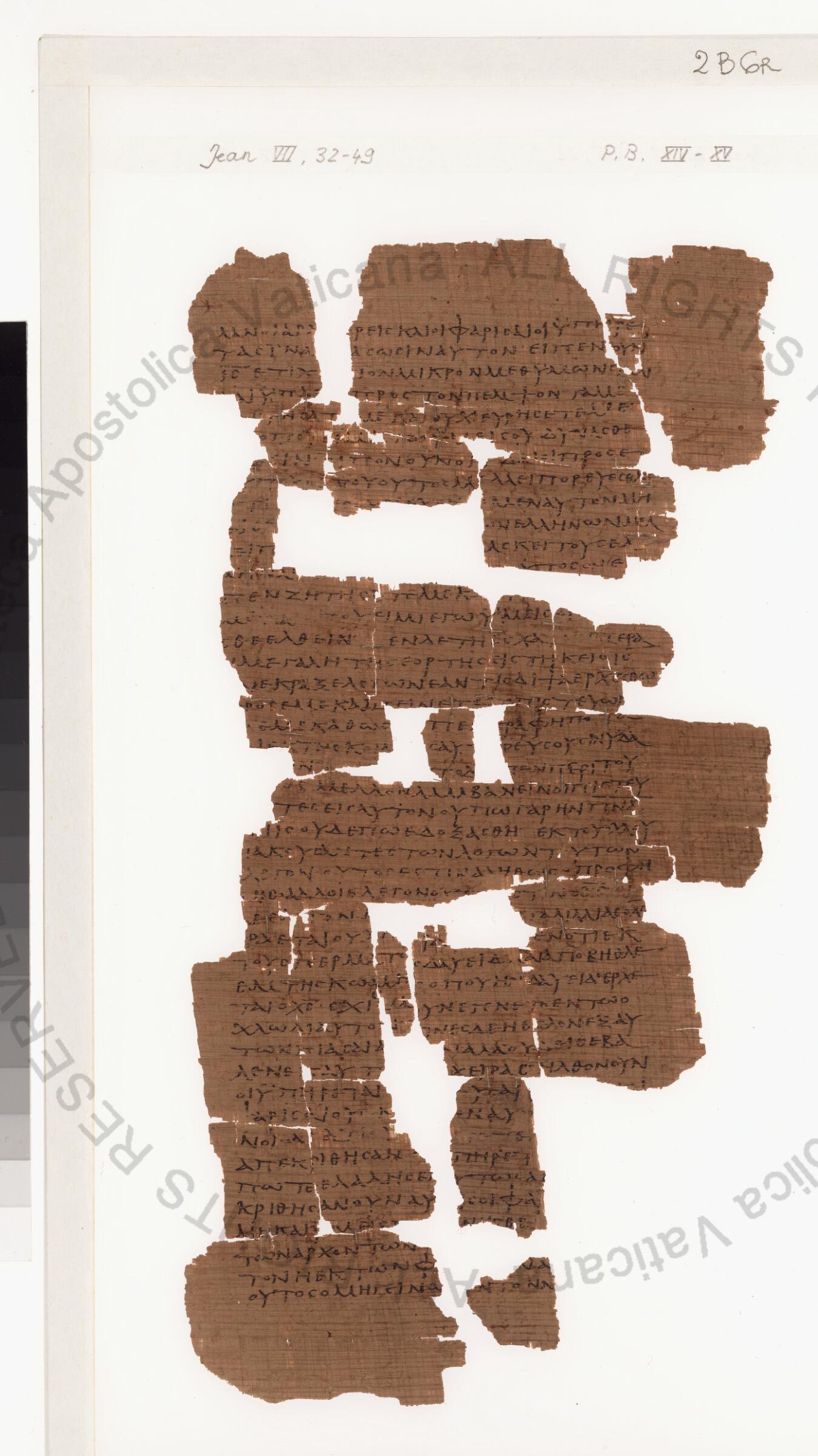
Vatican Library, Pap. Hanna 1 (Mater Verbi), DigiVatLib image 83, frame 2B.6r (https://digi.vatlib.it/view/MSS_Pap.Hanna.1(Mater.Verbi)/0083), cropped to the frame. NTVMR page 830 (folio 54r). 7:32 begins on the previous page; 7:49 continues on the next page. Checked on the image: in the upper part τουτο δε ειπεν περι του π̅ν̅ς̅ ου εμελλον λαμβανειν οι πιστευσαντες (7:39), in the lower part ο οχλος ουτος ο μη γεινωσκων (7:49), matching the transcription of this page.
7:32 λαν οι αρχ̣[ιε]ρεις και οι φαρισαιοι υπηρε
τας ινα [πι]ασωσιν αυτον· 33 ειπεν ουν
ι̅ς̅ ετι χ[ρο]ν̣ον μικρον μεθ υμων ε̣ι̣μ̣ι
κ̣αι υπαγ̣[ω] προς τον πεμψοντα με·
34 [ζ]η̣τησατ[ε] με και ουχ ευρησετε με·
[και] οπου ειμι̣ ε̣γω υμε̣ις ου δυνασθε
[ε]λ̣θ̣ειν· 35 ε̣ιπον ουν οι ι̣δαιοι προς ε
[α]υ̣το̣υς που ουτος μελλει πορευεσθαι·
ο̣τι [ημε]ις ου̣χ̣ ε̣υ̣ρ̣η̣[σ]ομεν αυτον μη
ε̣ις τ̣[ην διασποραν τ]ω̣ν ελληνων μελ
λ̣ει π[ορευεσθαι και διδ]ασκει τους ελ
λ̣ηνας̣ 36 [τις εστιν ο λογος ο]υ̣τος ον ε[ι]
πεν ζητησε̣τε με κα̣[ι ο]υ̣[χ ευρησετε]
με κ̣αι̣ ο̣π̣ου ε̣ιμι εγω υμεις ου̣ [δυνα]
σθε ελθειν· 37 εν δε τη εσχατ̣η ημερα
[τ]η̣ μεγαλη της εορτης ειστηκει ο ι̅ς̅
[κ]α̣ι εκραξε λεγων εαν τις διψα ερχεσθω
π̣ρος εμε και πεινετω· 38 ο̣ πιστευων̣
[ει]ς̣ εμε καθως [ει]πεν̣ [η] γ̣ραφη ποτα
[μο]ι ε̣κ της κοιλ̣[ια]ς αυτ̣[ου] ρευσουσιν υδα
[τος ζ]ω̣ντ̣ο̣[ς] 39 [το]υ̣το δ[ε ει]π̣εν περι του
[π̅ν̅ο̅ς̅] ο ε̣μελλον λαμβανειν οι πισ̣τευ
[σαν]τες εις αυτον ουπω γαρ ην π̅ν̅α̅
[ο]τ̣ι ι̅ς̅ ουδεπω εδοξασθη· 40 εκ του οχλου
[ου]ν̣ ακουσαντες των λογων τ[ο]υτων
[ε]λεγον· ουτος εστιν αλ̣ηθως ο̣ προφη
τ̣ης· 41 αλλοι ελεγον ουτ̣[ος ε]στιν ο χ̅ς̅· οι
δ̣ε ελ̣ε̣γον. μ̣[η γα]ρ̣ [εκ τη]ς̣ γαλιλαιας ο χ̅ς̣̣̅
ε̣ρχεται· 42 ουχ̣ η̣ [γ]ραφ̣[η ειπ]εν οτι εκ
του σπερματος δαυειδ και απο βηθλε
εμ της κωμης οπου ην δαυειδ ερχε
ται ο χ̅ς̅· 43 σχιμα ο̣υν εγενετο εν τω ο
χλω δι αυτον· 44 τ̣ινες δε ηθελον εξ αυ
των πιασαι α[υτο]ν· αλλ ουδεις εβα
λεν επ αυτο̣[ν τας] χειρας· 45 ηλθον ουν
οι υπηρεται [προς] τ̣[ο]υς αρ̣[χιερεις] κ̣[α]ι
φ̣αρισαιους̣. κ[αι ειπ]ον αυτ̣[οις εκει]
νοι· δι̣α τι ου̣[κ ηγ]αγε̣τε α̣[υτον]
46 απεκριθησαν ο̣[ι υ]πηρετ[αι ουδε]
πωτε ελαλησεν̣ [ο]υτως α̅ν̣̣̅[ο̅ς̅] 47 [απε]
κριθησαν ουν αυ[το]ι̣ς οι φαρ̣[ισαιοι]
μη και υμεις π̣[επλα]νη̣σθε. 48 μ̣[η τις εκ]
των αρχοντων [επιστευσεν εις αυ]
τον η εκ των φ[αρισαιω]ν. 49 α[λλα ο οχλος]
ουτος ο μη γεινω[σκω]ν τον ν̣[ομον]
7:32¶ The Pharisees heard that the people murmured such things concerning him; and the Pharisees and the chief priests sent officers to take him. 33Then said Jesus unto them, Yet a little while am I with you, and then I go unto him that sent me. 34Ye shall seek me, and shall not find me: and where I am, thither ye cannot come. 35Then said the Jews among themselves, Whither will he go, that we shall not find him? will he go unto the dispersed among the Gentiles, and teach the Gentiles? 36What manner of saying is this that he said, Ye shall seek me, and shall not find me: and where I am, thither ye cannot come? 37In the last day, that great day of the feast, Jesus stood and cried, saying, If any man thirst, let him come unto me, and drink. 38He that believeth on me, as the scripture hath said, out of his belly shall flow rivers of living water. 39(But this spake he of the Spirit, which they that believe on him should receive: for the Holy Ghost was not yet given; because that Jesus was not yet glorified.) 40¶ Many of the people therefore, when they heard this saying, said, Of a truth this is the Prophet. 41Others said, This is the Christ. But some said, Shall Christ come out of Galilee? 42Hath not the scripture said, That Christ cometh of the seed of David, and out of the town of Bethlehem, where David was? 43So there was a division among the people because of him. 44And some of them would have taken him; but no man laid hands on him. 45¶ Then came the officers to the chief priests and Pharisees; and they said unto them, Why have ye not brought him? 46The officers answered, Never man spake like this man. 47Then answered them the Pharisees, Are ye also deceived? 48Have any of the rulers or of the Pharisees believed on him? 49But this people who knoweth not the law are cursed.
Where on the image
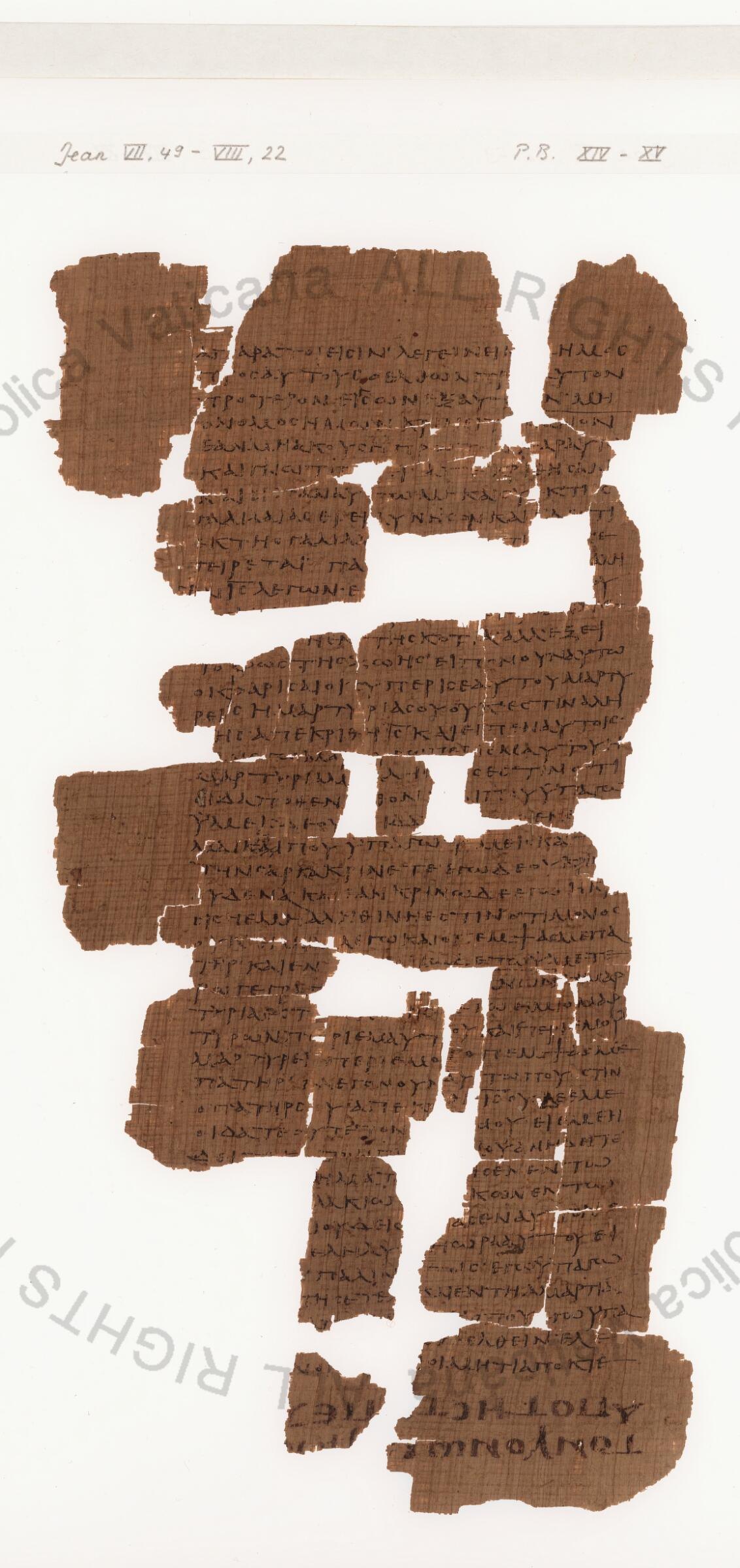
Vatican Library, Pap. Hanna 1 (Mater Verbi), DigiVatLib image 84, frame 2B.6v (https://digi.vatlib.it/view/MSS_Pap.Hanna.1(Mater.Verbi)/0084), cropped to the frame. NTVMR page 840 (folio 54v). 7:49 begins on the previous page; 8:22 continues on the next page. Not written in this papyrus: John 7:53-8:11. The NTVMR transcription marks these verses as empty at this point of the text, so the English leaves them out. Checked on the image: near the top ειπον ουν αυτω οι φαρισαιοι συ περι σεαυτου μαρτυρεις η μαρτυρια σου ουκ εστιν αληθης (8:13); the page passes from 7:52 to 8:12 with no break in the writing, matching the transcription of this page.
7:49 απ̣αρατοι εισιν· 50 λεγει νεικ̣[ο]δ̣ημος
προς αυτους ο ελθων πρ[ος] α̣υτον
προτερον εις ων εξ αυτ̣[ω]ν· 51 μη
ο νομος ημων κρινει τ̣[ο]ν̣ α̣̣̅ν̅ο̅ν̅
εαν μη ακουση πρωτο̣ν̣ π̣αρ αυτο̣υ̣
και γνω τι π̣[οι]ε̣ι· 52 απ̣εκριθησαν
και ειπαν αυτω· μη και συ ε̣κ τη̣ς
γαλιλαιας ει. ερ̣α̣υνησον και ι̣δ̣ε̣ ο̣τι
εκ της γαλιλα[ιας προ]φ̣[η]τη̣[ς ου]κ̣ ε
γειρεται· 8:12 πα[λιν ουν αυτοις ελ]αλη
σεν ι̅ς̅ λεγων· ε[γω ειμι το φως τ]ου
[κο]σ̣μ̣[ο]υ̣ [ο ακολο]υ̣[θων μ]ο̣ι̣ ο̣υ̣ μ̣η̣ π̣ε
[ριπατησ]η εν̣ τη σκοτι̣α· αλλ εξει
τ̣ο φ̣ως της ζ̣ωης· 13 ειπον ουν αυτω
οι φαρισαιοι· συ περι σεαυτου μαρτυ
ρεις η μαρτυρια σου ουκ εστιν αλη
[θ]ης· 14 απεκριθη ι̅ς̅ και ειπεν αυτοις·
[κ]α̣ν ε̣γω μαρ̣[τ]υ̣ρ̣ω πε̣ρ̣ι εμαυτου η
μαρτυρια μ[ου] α̣λη̣θ̣[η]ς εστιν οτι
ο̣ιδα ποθεν [ηλ]θον [κ]α̣ι που υπαγω
υμεις δε ου̣[κ ο]ιδα[τε] π̣[ο]θ̣εν ε[ρχο]
μαι και που υπαγω 15 υ̣μεις κατ̣[α]
την σαρκα κρινετε· εγω δε ου κριν̣[ω]
ο̣υδενα· 16 και εαν κρινω δε εγω η κρ̣ι̣
σις η εμη αληθινη εστιν· οτι μονος
ουκ ειμι αλ̣λ εγω και ο πεμψας με πα
τηρ· 17 και εν τ̣[ω νο]μ̣ω̣ δε τω υμετε
ρω γεγραπ̣[ται ο]τ̣ι̣ [δυο] α̣̣̅ν̅ω̅ν̅ η̣ μαρ
τυρια εστ[ιν α]λ̣[ηθ]ης· 18 ε̣γ̣ω ειμι ο μαρ
τυρων πε̣ρι εμαυτου και περι εμου
μαρτυρει περι εμου ο πεμψας με
πατηρ· 19 ε̣λεγον ουν̣ αυτω που ε̣στιν
ο πατηρ σο̣υ· απεκρ̣[ι]θη̣ ι̅ς̅ ουτ̣ε εμε
οιδατε ουτε τον [π̅ρ̅α̅] μ̣ου· ει εμε η
δειτ̣ε̣ κ̣[αι] τ̣ον π̣α̣[τερα] μ̣ου αν ηδειτε·
20 [ταυτα τα ρ]ηματ[α ελαλ]η̣σεν εν τω
[γαζοφυ]λακιω [διδα]σ̣κων εν τω
[ιερω κ]α̣ι ουδεις [επι]ασεν αυτον ο
[τι ουπω] εληλυ[θει] η ωρα αυτου 21 ει
[πεν ου]ν̣ παλιν [αυ]τ̣οις· εγω υπαγω
[και ζη]τησετε μ̣[ε] κ̣αι εν τη αμαρτιαν
[υμων] α̣π̣[οθανεισθ]ε̣· οπου ε̣γω υπα
[γω υμεις ου δυνα]σ̣θ̣ε̣ ελθειν· 22 ελε
[γον ου]ν οι [ιουδα]ιοι μητι αποκτε
7:49But this people who knoweth not the law are cursed. 50Nicodemus saith unto them, (he that came to Jesus by night, being one of them,) 51Doth our law judge any man, before it hear him, and know what he doeth? 52They answered and said unto him, Art thou also of Galilee? Search, and look: for out of Galilee ariseth no prophet. 8:12¶ Then spake Jesus again unto them, saying, I am the light of the world: he that followeth me shall not walk in darkness, but shall have the light of life. 13The Pharisees therefore said unto him, Thou bearest record of thyself; thy record is not true. 14Jesus answered and said unto them, Though I bear record of myself, yet my record is true: for I know whence I came, and whither I go; but ye cannot tell whence I come, and whither I go. 15Ye judge after the flesh; I judge no man. 16And yet if I judge, my judgment is true: for I am not alone, but I and the Father that sent me. 17It is also written in your law, that the testimony of two men is true. 18I am one that bear witness of myself, and the Father that sent me beareth witness of me. 19Then said they unto him, Where is thy Father? Jesus answered, Ye neither know me, nor my Father: if ye had known me, ye should have known my Father also. 20These words spake Jesus in the treasury, as he taught in the temple: and no man laid hands on him; for his hour was not yet come. 21Then said Jesus again unto them, I go my way, and ye shall seek me, and shall die in your sins: whither I go, ye cannot come. 22Then said the Jews, Will he kill himself? because he saith, Whither I go, ye cannot come.
Notes
- Greek: the NTVMR diplomatic transcription, line by line as on the papyrus. Square brackets enclose letters that are lost or illegible and were supplied by the transcribers; a dot under a letter marks it as uncertain; [...] marks a gap. Nomina sacra and numerals keep the scribe's overline. Spelling is the scribe's (no accents or breathings). Words broken at a line end stay broken as on the papyrus. Corrections are not shown: the text is the first hand.
- English: the King James Version (1611), whole verses, for every verse that has text on the page. A verse that begins on one page and ends on the next is given in full on both. The KJV translates a later form of the Greek text, so its wording does not always match the papyrus; material differences (such as verses the papyrus does not have) are noted in the section.
Cite
Sources
- Source: Papyrus Hanna 1 (Mater Verbi), Vatican Library: photographs from DigiVatLib; Greek from the INTF NTVMR transcription of P75; English from the King James Version (holding institution)
- Critical edition: INTF NTVMR diplomatic transcription (CC BY 4.0)
← previous · → next · v cycle view · l back to library